Singdu: An Innovative App for Learning Languages Through Music
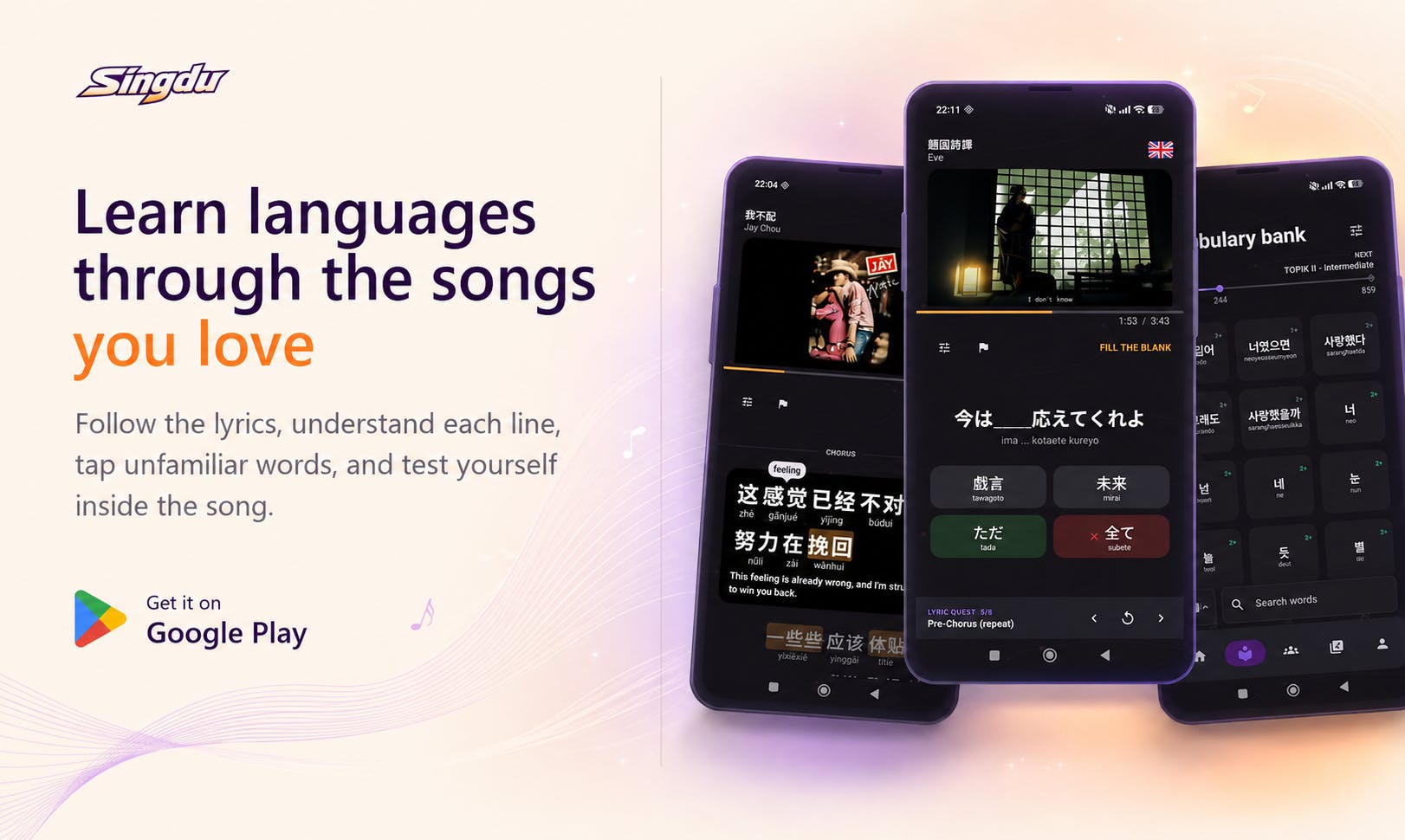
Learn languages through music with synchronized lyrics, gamification, and KTV karaoke experience
Singdu reimagines language learning by leveraging music as the core learning vehicle. The app provides synchronized lyrics with translations, tap-to-lookup functionality, gamified challenges, and a unique KTV big screen mode. Supporting seven languages, it transforms language acquisition from tedious memorization into engaging entertainment.
When Language Learning Meets Music
Traditional language learning apps mostly rely on fixed curricula, isolated vocabulary lists, and repetitive practice patterns. While systematic, this approach is often tedious and boring, leading many learners to give up halfway. Singdu, recently featured on Product Hunt, offers a fresh perspective: starting with songs people already want to listen to, it turns language learning into something genuinely enjoyable.
About Product Hunt: Product Hunt is one of the world's most influential product discovery platforms, founded in 2013. It provides a stage for entrepreneurs and developers to showcase new products, with hundreds launching daily. The platform uses a community voting mechanism where users can upvote products they like, and top-ranked products each day gain massive exposure. Many successful SaaS products, mobile apps, and Chrome extensions acquired their first cohort of seed users through Product Hunt. For indie developers, gaining attention on Product Hunt often marks an important milestone in product validation.
Singdu's core philosophy is simple—interest-driven learning. Rather than forcing users to memorize sentences unrelated to their lives, it lets them naturally encounter vocabulary and expressions in authentic contexts through music they love. This 'content-anchored' learning model is becoming an important trend in language education.
The Science Behind Contextual Learning: Contextual learning emphasizes acquiring knowledge in authentic, meaningful situations rather than through isolated memorization. Neuroscience research shows the brain more easily remembers information linked to emotions and sensory experiences. Music, as a multisensory stimulus, simultaneously activates the auditory cortex, language areas, and emotional centers, forming powerful memory networks. This phenomenon is called the 'Music Memory Effect'—many people can fully recall lyrics from songs heard decades ago but can't remember words they studied yesterday. Learning language through music leverages this mechanism: melodies become memory 'anchors,' vocabulary embeds within musical contexts, and when recalling, the melody automatically triggers associated words. This is far more efficient than rote memorization.
Turning Every Song Into an Interactive Lesson
In Singdu, every song is deconstructed into an interactive lesson. The app provides several key features:
Synchronized Lyrics with Line-by-Line Translation
Lyrics scroll in real-time with the music, accompanied by line-by-line translations. Learners can listen and read simultaneously, directly connecting melodies with meanings. This audiovisual approach helps deepen memory—familiar melodies become natural 'memory hooks' for words and sentences.
Tappable Words and Lyric Challenges
The app supports a 'tap-to-look-up' feature where users can simply tap unfamiliar words to see definitions without leaving the app to consult a dictionary. Additionally, Singdu has designed 'lyric challenges' that gamify the learning process, allowing users to reinforce what they've learned while completing tasks.
Song Selection by Difficulty
Considering learners at different levels, Singdu allows users to choose songs based on difficulty. Beginners can start with simple, repetitive songs, while advanced learners can tackle faster-paced works with richer vocabulary. This tiered mechanism makes the learning curve smoother.
Gamification and Social Motivation Systems
Singdu draws from the proven experience of popular language learning apps, introducing a complete gamification incentive system:
- Experience Point System: Completing learning tasks accumulates experience points, quantifying learning outcomes
- Streak Tracking: Through consecutive learning day mechanisms, cultivates user learning habits
- Friend Interactions: Supports learning with friends, where social interaction enhances engagement and enjoyment
Theory and Practice of Gamified Learning: Gamification is the strategy of applying game design elements to non-game scenarios, with theoretical foundations in behavioral psychology and motivation theory. Core mechanisms include instant feedback, progress visualization, and achievement unlocking. Research shows gamification can activate the brain's reward system, releasing dopamine and thereby enhancing learning motivation. Duolingo is a典型 representative in this field, using streak days, experience points, and leaderboards to boost daily active user time to over 3 times the industry average. However, gamification also has controversies: over-reliance on external incentives may weaken intrinsic learning motivation. Balancing 'fun' with 'effective' is an eternal challenge in educational product design.
The core purpose of these mechanisms is solving the biggest pain point in language learning—consistency. When learning itself becomes as addictive as playing a game, user retention and long-term effectiveness naturally improve significantly.
KTV Big Screen Experience: The Most Eye-Catching Differentiator
Singdu's most distinctive feature is perhaps its KTV big screen experience. Users can use their phone as a remote control to operate a karaoke interface on a large screen. This means Singdu isn't just a tool for solitary study—it can also become an entertainment option at gatherings and family activities.
Technical Implementation: Using a phone as a remote to control a large screen device involves multiple technical approaches. Common ones include: WebSocket communication over local networks, casting via third-party protocols like AirPlay/Chromecast, or establishing device connections through QR code pairing. This 'second screen' interaction pattern is already mature in smart TV applications. Technical challenges include ensuring audio-video synchronization (audio-visual delay must be kept within 50ms for karaoke experience), stability of multi-device concurrent control, and cross-platform compatibility. Singdu's KTV function needs to handle precise synchronization between lyric timelines and audio playback, requiring a robust timestamp annotation system and low-latency data transmission architecture in the backend.
This design cleverly merges two scenarios: 'learning a foreign language' and 'singing.' Imagine at a friend's gathering, everyone singing foreign language songs together while unconsciously memorizing new words and expressions—learning becomes a form of social entertainment rather than a burden. This contextual innovation is what sets Singdu apart from other language apps.
Current Status and Future Development
Currently, Singdu supports seven languages and plans to continuously add more. As a product on the Android platform spanning music, education, and language categories, it was created by indie developer Edward Salim. On Product Hunt, it received initial attention, ranking 18th.
From a product positioning perspective, Singdu has captured two key insights: first, music is a universal language transcending cultures—nearly everyone has foreign language songs they enjoy; second, interest is the best teacher—starting from users' existing passions is more effective than forced indoctrination.
Competitive Landscape: The global language learning app market has exceeded $12 billion and is projected to reach $25 billion by 2025. Duolingo (valued at $6.6 billion), Babbel, and Rosetta Stone are major players. The market shows two major trends: first, content verticalization—apps targeting specific scenarios (business English, travel conversation, dialect learning) are constantly emerging; second, learning method diversification—shifting from pure course-based learning to content consumption-based learning through reading news, watching videos, and listening to podcasts. Singdu's music entry point belongs to the latter. However, competition in this space is fierce, with generally low user retention rates (30-day retention averages only 15%). Products need to find the optimal balance between content quality, learning effectiveness, and user experience.
Of course, as a new product, Singdu also faces challenges. The licensing and richness of its music library, translation accuracy, and how to balance entertainment with systematic learning are all areas requiring continuous refinement.
Complexity of Copyright Issues: Music copyright is the core risk for Singdu-type products. Music copyright includes composition copyright (managed by publishers) and recording copyright (held by record labels)—using complete songs requires both types of authorization. Solutions typically include three options: partnering with copyright aggregation platforms (like Spotify API, Apple Music API) to provide only preview clips; signing licensing agreements with collective management organizations (like ASCAP in the US, Music Copyright Society of China); or focusing on public domain and CC-licensed music. Karaoke apps also need synchronization rights, allowing lyrics to display synchronized with music. These licensing fees are expensive and rules vary by country, representing a major cost for startups. Many similar apps adopt a 'user-uploaded content' model to circumvent copyright, but this brings legal risks and content quality issues.
Additionally, while the KTV big screen feature is novel, whether it can truly become a high-frequency use scenario remains to be validated by the market.
Conclusion
Singdu represents an interesting direction for language learning products: entering through content interests, using gamification and socialization to lower learning barriers. For learners discouraged by traditional language apps, 'learning a foreign language through favorite songs' is undoubtedly a more attractive entry point. It may not replace systematic language courses, but as a supplementary tool for developing language sense, expanding vocabulary, and maintaining learning enthusiasm, Singdu's approach deserves attention. If you want to learn a foreign language and are also a music lover, why not let melodies guide your learning journey?
Related articles
Batch Generating Ad Creatives from a Single Product Image: Real Bottlenecks and Solutions for Scaled Workflows
From one product photo to multi-platform ad assets—brand consistency, text rendering, and cross-platform adaptation collapse first. Deep dive into AIGC marketing workflow bottlenecks with template-driven and layered composition solutions.

Scriptly: AI Voice-Following iOS Teleprompter That Eliminates Pace-Chasing
Scriptly is an iOS voice teleprompter using AI real-time voice-following technology to auto-match speaking pace. Supports local storage for privacy, integrates writing, script management & video recording workflow for content creators.
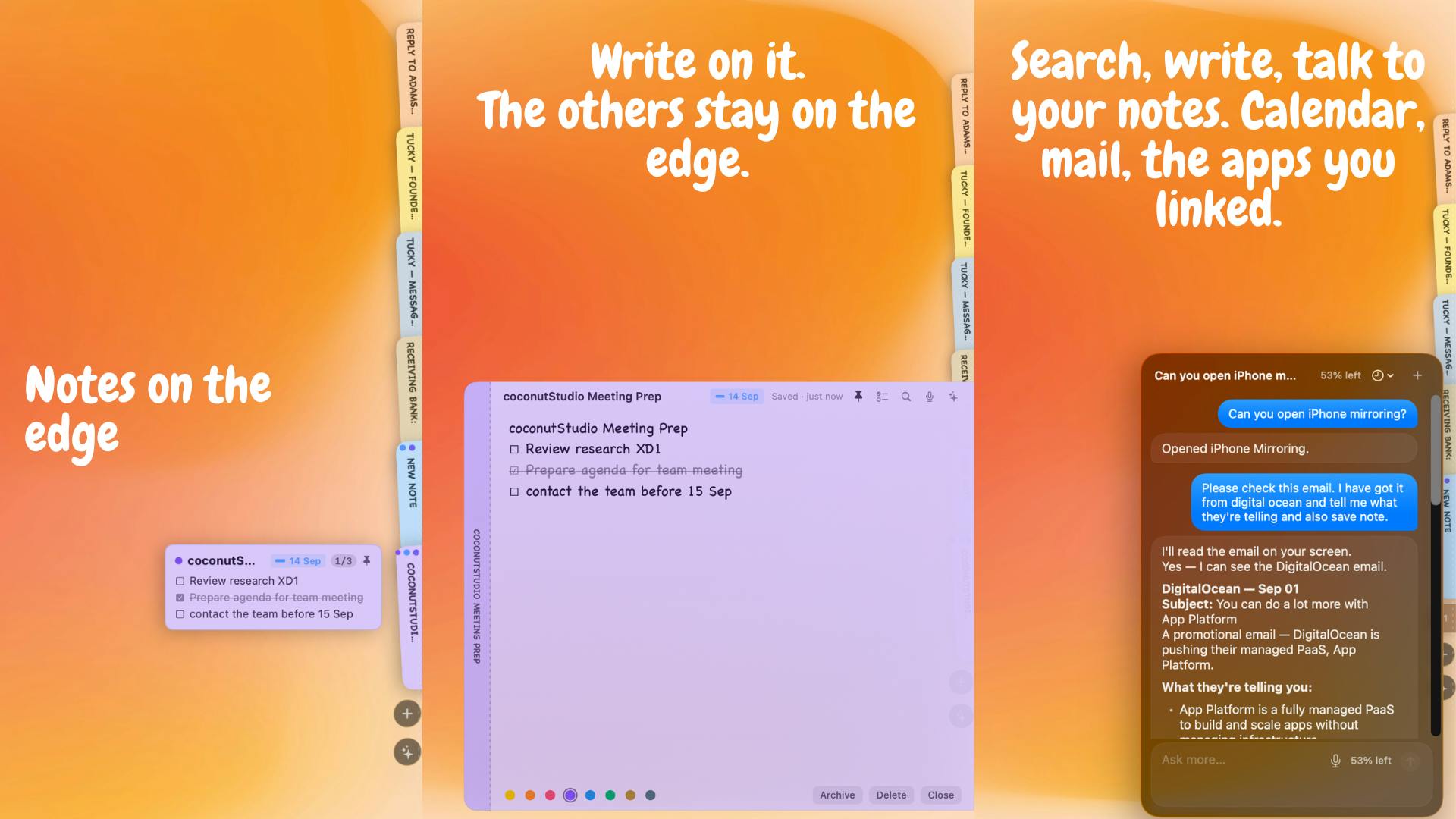
Tucky: An In-Depth Look at the macOS AI Note-Taking App Hidden at the Edge of Your Screen
Tucky is a native macOS AI note-taking app that hides at the screen edge for instant access, with a built-in AI Agent and local encrypted storage. A deep dive into its design, privacy, and pricing.