Singularity: Replace Chat with Tickets and Let AI Coding Agents Work in Parallel

Singularity replaces chat with atomic tickets and isolated Git worktrees to enable parallel AI coding agents.
Singularity is an AI coding tool launched on Product Hunt that ditches the chat paradigm in favor of atomic tickets driving AI agents. Each ticket maps to a single scope, an isolated Git worktree, and minimal context — tackling the context bloat and focus drift endemic to chat-based workflows. Task isolation lets multiple agents work across repos in parallel, with diff review before merging for a process closer to real code review. The tool is local-first, supports bring-your-own-key, and is currently free. It earned 68 upvotes on launch day and offers a differentiated approach, though it remains in early-stage validation.
The Hidden Cost of Chat-Based AI Coding
Talking to an AI coding assistant sounds efficient — until you've actually used one long enough to feel the pain. Every exchange consumes your context window, and the back-and-forth burns through precious tokens while eating into developer time. Worse, as conversations grow longer, models gradually lose focus on the original goal and output quality degrades.
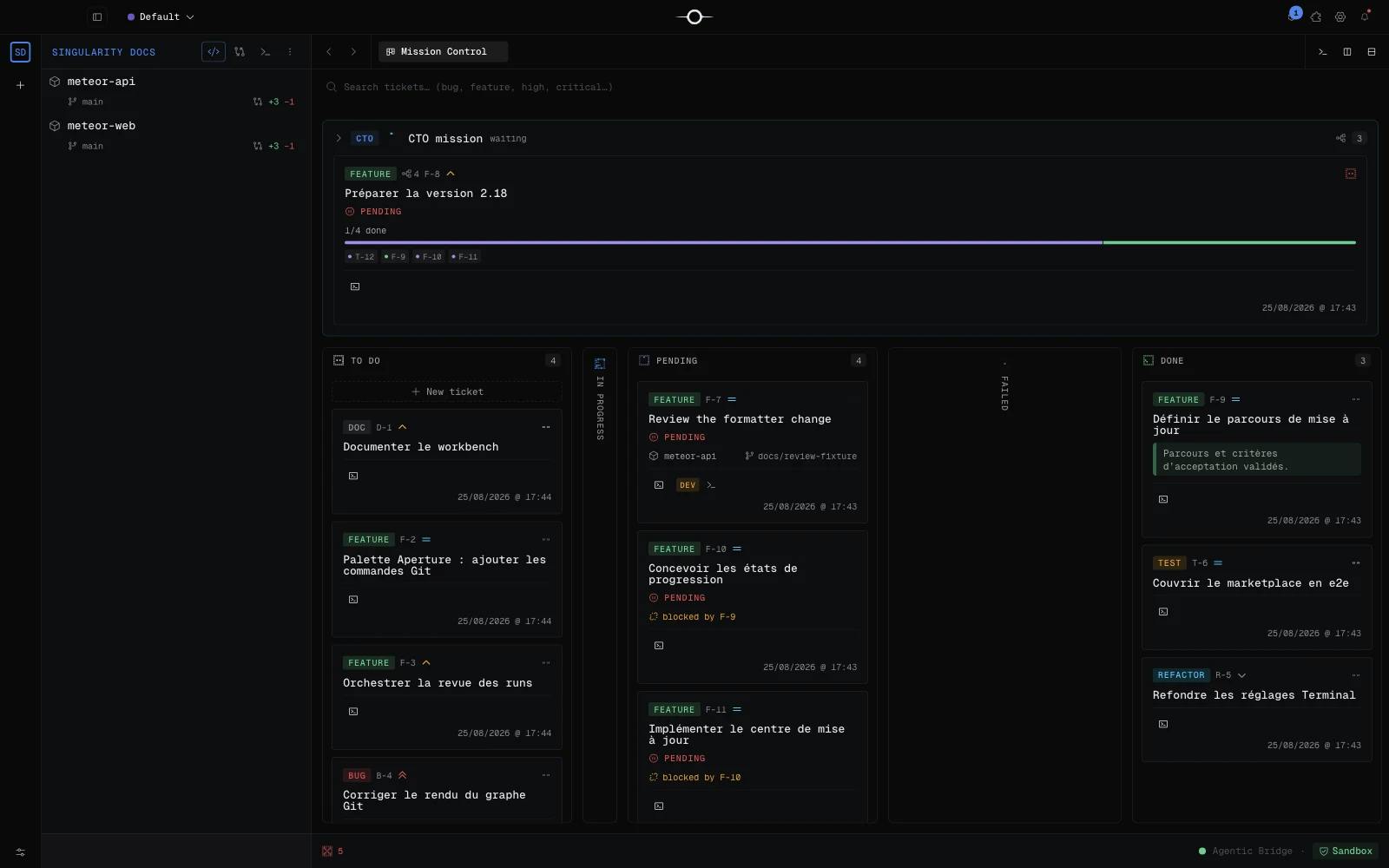
Singularity, a new launch on Product Hunt, takes direct aim at this problem. Its core proposition is straightforward: ditch the chat paradigm entirely and instead drive AI coding agents with atomic tickets. Each ticket maps to a single, well-scoped task, an isolated Git worktree, and the minimal context needed to get the job done.
What the Ticket-Based Approach Solves
The reason traditional chat mode is inefficient comes down to one thing: it stuffs every task into a single session that keeps ballooning. Context grows noisier, the model's attention gets diluted, and developers struggle to trace the history of any given change.
Singularity breaks work into discrete tickets. Per the official description, it follows the principle of one scope, one isolated Git worktree, minimal context:
- One scope: Each ticket focuses on a single task, keeping requirements from bleeding into each other.
- Isolated Git worktree: Each task runs in its own working tree, so changes are cleanly bounded and nothing bleeds across tasks.
- Minimal context: The agent only receives what it needs to complete the current ticket, cutting down on context overhead.
The immediate payoff is that changes become controllable and reviewable. Developers can inspect the diff after a task completes, confirm everything looks right, and then merge — a workflow far closer to the code review habits of mature engineering teams, rather than letting an AI roam free inside a black box.
Parallel Execution Is the Key Selling Point
Singularity's tagline emphasizes "run in parallel, one ticket at a time." Because each task is isolated in its own worktree, multiple AI agents can work simultaneously across different repos and different tasks without conflicting. For developers who need to advance multiple feature branches or maintain several codebases at once, that parallel capacity translates directly into higher throughput.
Git worktree is a native Git feature that lets a single repository maintain multiple independent working directories on the filesystem at the same time, each checked out to a different branch, with no interference between them. Unlike the traditional approach of cloning multiple copies, all worktrees share the same
.gitobject database, making the overhead of switching extremely low. Singularity uses this mechanism as the foundation for task isolation: each AI agent operates inside its own worktree, where file writes, test runs, and commits all happen on an isolated branch — no risk of polluting the main branch or causing file-level conflicts with other parallel tasks. This turns "multi-agent parallelism" from a concept into an engineering practice that actually holds up, sidestepping the race-condition writes that plague shared workspaces.
Local-First and Bring Your Own Key
At a time when data privacy and cost control are growing concerns, Singularity has opted for a local-first and bring your own key (BYOK) approach.
Local-first means the tool runs primarily in the developer's own environment — your code never has to leave for a third-party server, which makes it far more appealing to enterprises and privacy-conscious individual developers. BYOK lets users connect their own LLM API accounts directly, keeping costs transparent and under personal control rather than locking users into a subscription tier.
The product is currently free, which lowers the barrier to entry considerably. For developers already using API access to Claude, GPT, or similar models, the integration cost is relatively low.
The Bring Your Own Key (BYOK) model has grown increasingly popular in the AI tooling space, and the core logic is simple: the user holds API keys issued directly by the model provider (such as Anthropic or OpenAI), and the tool acts purely as a calling layer — it never touches billing or retains data. For developers, this means full cost transparency: you pay for actual token usage with no platform markup, and you're free to swap out the underlying model without being locked to a single vendor. The trade-off is that you're responsible for key security and budget management, which adds a bit of friction for newcomers. Combined with local-first architecture — where neither code nor keys ever pass through Singularity's servers — this carries real compliance significance for enterprise teams working with sensitive codebases.
Market Positioning and Observations
Categorically, Singularity spans Productivity, Developer Tools, and Artificial Intelligence. On its launch day it earned 68 upvotes and 12 comments, landing at #20 on the daily rankings — notable attention, but not yet a breakout hit.
The space it's entering is already crowded: from Cursor and Cline to various agent frameworks, products promising to "let AI write your code" keep multiplying. Singularity's differentiation lies in its refusal to compete on conversational experience. Instead, it bets on an engineering-oriented workflow — tickets, worktrees, and diff review — as a way to bring AI coding into a manageable, auditable process.
That instinct addresses a genuine pain point in real-world development. That said, the product is still early-stage. The stability of parallel agents, the intelligence of ticket decomposition, and how well it adapts to diverse codebases all need validation in real projects. Developers accustomed to chat-based interaction will also need some mental adjustment to embrace a ticket-driven workflow.
Summary
Singularity represents a new direction for AI coding tools: instead of chasing longer context windows, atomize tasks and engineer the process. Its combination of local-first architecture, BYOK, and free pricing makes it genuinely attractive on privacy and cost grounds. Whether it can actually deliver on the promise of parallel, auditable development in practice is worth watching closely.
Related articles

DeepCell: One-Click AI Generation of Documents, Spreadsheets, and Slides
DeepCell tops Product Hunt with one-click generation of documents, spreadsheets, and slides, using the .deepcell format for linked updates, designed for System 2 tasks like modeling and sales reviews.

Doneas: 15-Minute Daily Accountability Calls That Keep Indie Developers From Procrastinating
Doneas is a daily accountability tool for indie developers: plan tasks on Monday, join a 15-minute call with five builders each day, and log deliveries on a public progress page. This article analyzes its core mechanics, effectiveness, and potential issues around retention and matching.

Fastlane 2.0: Fully Automated AI Ad Campaigns, From Creative to Optimization
Fastlane 2.0 is an AI ad automation tool: enter your website and it learns your brand, generates video and image ads, and runs and optimizes them on Meta, TikTok, Instagram, and YouTube.