Siri AI Opens to Third-Party Apps, Voice Assistant Capabilities Upgraded

Apple opens three core Siri AI capabilities to third-party apps with iOS 27.3.
In the iOS 27.3 update, Apple announced that developers can integrate Siri AI's new capabilities into all apps, shifting the voice assistant from a built-in system tool to a cross-app task execution layer. The core capabilities opened up include leveraging personal context, processing natural language commands, and on-screen awareness, enabling Siri to understand the user's current situation and complete operations directly within apps. For developers, this means gaining a system-level voice entry point, so users can trigger app functions without clicking through layers of menus. At the same time, opening personal context and on-screen awareness raises privacy boundary issues, and specific permission control mechanisms have not yet been disclosed. The article argues that this move follows the trend of voice assistants evolving toward agents but also requires developers to rethink voice-first interaction design.
Apple Turns Siri from a Built-in System Tool into a Cross-App Intelligent Assistant
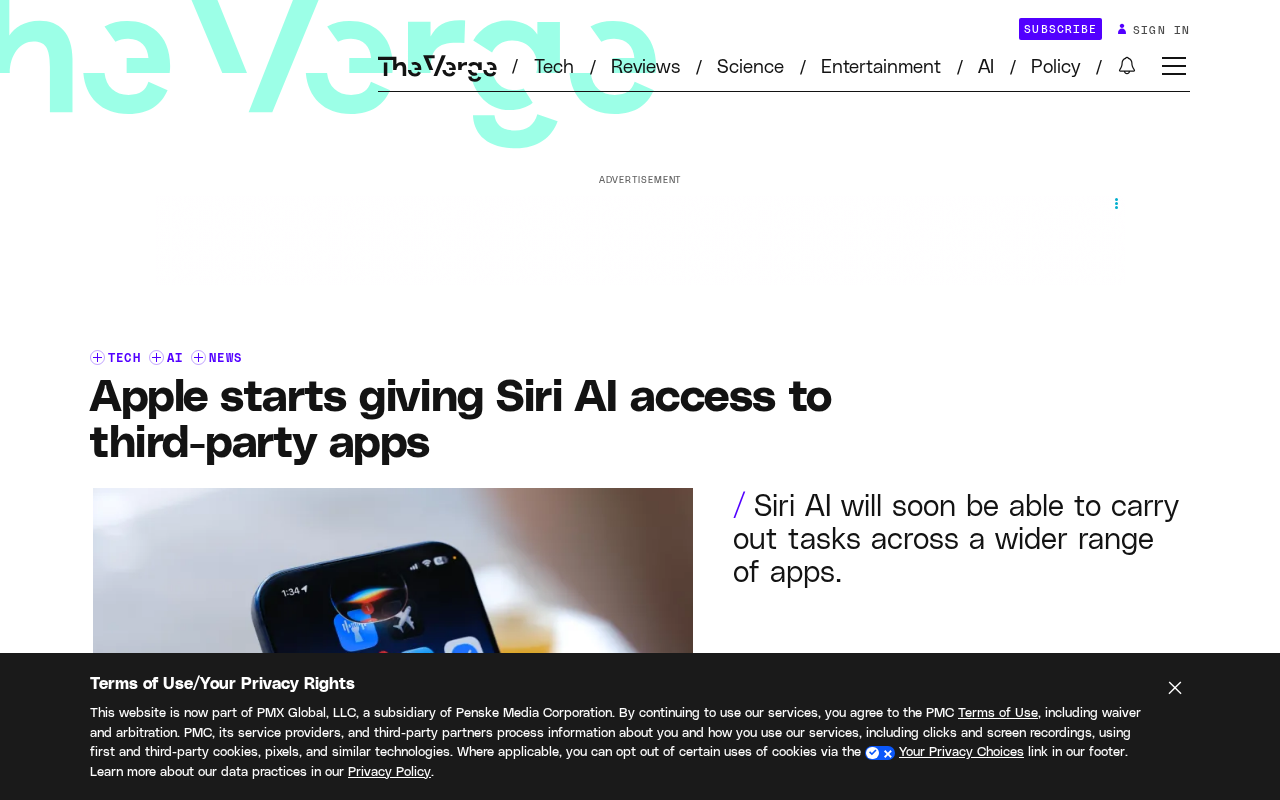
Apple is transforming Siri from a built-in system voice tool into an intelligent assistant capable of executing tasks across apps. According to the latest news, with the rollout of the iOS 27.3 update, Apple has announced that developers can now integrate Siri AI's new capabilities into "all apps," meaning the voice assistant is no longer limited to Apple's own services but can reach deep into the third-party app ecosystem.
From System Assistant to Cross-App Agent
According to the original report, the core capabilities Siri AI is opening up this time include three aspects: leveraging the user's personal context, processing natural language commands, and being aware of on-screen content. These features previously remained mostly at the system level; now, opened to third-party developers through APIs, Siri can understand what the user is currently doing and complete operations directly within apps.
The significance of this change is that the voice assistant is no longer just an entry point for "answering questions" but has the potential to become a cross-app task execution layer. Users can describe their needs in natural language, and Siri, combining information on the screen with personal data, can invoke the corresponding app's functions to complete the task. Apple's use of the phrase "all apps" in the update notes shows an open attitude toward the developer ecosystem.
Personal Context refers to the set of information strongly related to the user that accumulates on the device side, including calendar, location, contacts, usage habits, health data, and more. Apple has long restricted the flow of such data through technologies like on-device processing and differential privacy. Opening personal context to third-party apps means Siri can, with authorization, use this data as input for understanding user intent—for example, determining "where to go now" requires combining the calendar with real-time location. This is also the prerequisite for cross-app task orchestration to work, because compound requests often require user information across multiple dimensions to be correctly parsed.
On-screen Awareness means the assistant can read the content and structure of the current interface, understanding what the user is looking at and which step of an operation they are on. Unlike pure voice input, it provides the visual context in which an operation takes place, allowing commands to omit a great deal of background description—for example, on a product detail page, simply saying "help me compare prices" without having to state the product name. For third-party apps, on-screen awareness requires the system to parse app interface elements, which typically relies on accessibility interfaces or dedicated content-exposure mechanisms, and is directly related to permission boundaries and the principle of data minimization.
What Developers Can Gain
For developers, integrating with Siri AI means apps gain a system-level voice interaction entry point. Users don't need to manually open an app and click through menus level by level; instead, they can trigger specific in-app functions directly through voice commands. On-screen awareness allows Siri to understand the app's current interface state, enabling more accurate execution of operations.
The introduction of personal context is another key point. Siri can combine information such as the user's calendar, location, and usage habits to understand commands, making cross-app task orchestration possible. For example, when a user makes a compound request involving multiple apps, Siri can theoretically chain together the capabilities of different apps to complete it.
A Dual Test of Privacy and Ecosystem
Apple has always emphasized privacy protection, and opening personal context and on-screen awareness to third-party apps will inevitably raise privacy boundary issues. The original information did not disclose the specific permission control mechanisms, but it is foreseeable that Apple needs to find a balance between developer flexibility and user data security. Users need clear control options over which apps are authorized to access personal context and which data can be invoked by Siri.
From an ecosystem perspective, opening up Siri AI is also a reinforcement of Apple's intelligent assistant competitiveness. Against the backdrop of rapidly developing generative AI assistants, Siri needs to leverage a vast third-party app ecosystem to expand its capability boundaries rather than relying solely on built-in system features. Getting developers involved helps Siri cover more usage scenarios.
Impact on the Industry
Apple's move follows the trend of voice assistants evolving toward "agents." When a voice assistant can understand on-screen content, invoke third-party apps, and leverage personal context, the focus of human-computer interaction shifts from "opening apps" to "expressing intent." For app developers, this is both an opportunity and a challenge: apps need to rethink how to expose their capabilities in a voice-first interaction.
Currently, this capability is being rolled out with the iOS 27.3 update; the specific scope of support and developer integration details remain to be further observed. But what is certain is that Siri is moving from a closed system feature toward an open cross-app intelligent platform.
Agent in this context refers to an AI system capable of autonomously breaking down goals, invoking external tools, and executing multi-step operations in sequence, as distinct from a chatbot that only handles single-turn Q&A. Its key technical components include intent understanding, task planning, tool invocation, and result validation. The core change in the evolution of voice assistants toward agents is that the entry point shifts from "app icons" to "natural language intent," requiring the system to map user goals onto specific apps' capability interfaces. This also explains why open APIs and on-screen awareness are both indispensable: the former provides invocable actions, while the latter provides state feedback during execution.
Final Thoughts
Opening Siri AI to third-party apps is an important strategic adjustment by Apple in the intelligent assistant space. The opening of three capabilities—personal context, natural language processing, and on-screen awareness—gives the voice assistant the potential to become a cross-app task hub. Privacy control mechanisms and the actual results of developer integration will determine whether this openness can truly take hold. For practitioners focused on AI applications and voice interaction, this is a direction worth continuing to track.
One-line Summary
Apple opens three core Siri AI capabilities to third-party apps with iOS 27.3.
Paragraph Summary
In the iOS 27.3 update, Apple announced that developers can integrate Siri AI's new capabilities into all apps, transforming the voice assistant from a built-in system tool into a cross-app task execution layer. The core capabilities opened up include leveraging personal context, processing natural language commands, and on-screen awareness, enabling Siri to understand the user's current situation and complete operations directly within apps. For developers, this means gaining a system-level voice entry point, so users can trigger app functions without clicking through layers of menus. At the same time, opening personal context and on-screen awareness raises privacy boundary issues, and specific permission control mechanisms have not yet been disclosed. The article argues that this move follows the trend of voice assistants evolving toward agents but also requires developers to rethink voice-first interaction design.
Related articles

AI Coding Enters the Team Collaboration Era: Interpreting Three Major Moves from Meta, GitHub, and Mistral
Meta acquires Conductor, GitHub Copilot Fusion becomes available, Mistral opens Large 4 weights—three moves show AI coding shifting from code generation to organizing development workflows. This article explains task orchestration, model collaboration, and cost control for developers.

Building a RAG Assistant with Dify: A Practical Guide to Knowledge Bases, Workflows, and Agent Nodes
How should knowledge bases, workflows, and Agent nodes connect in a Dify RAG assistant? We break down the division of labor and wiring logic for a shippable app.
 Tech Frontiers
The AI Industry Doesn't Lack Marketing—It Lacks Good Products
AI faces market selloffs and public skepticism—is marketing really the problem? This analysis of market signals and product experience argues the core困境 is incomplete products and a gap between promises and experience; the only way to change perceptions is to ship better products.