SituRecBench: A Benchmark for Evaluating Contextualized Recommendation Assistants in 3D Environments
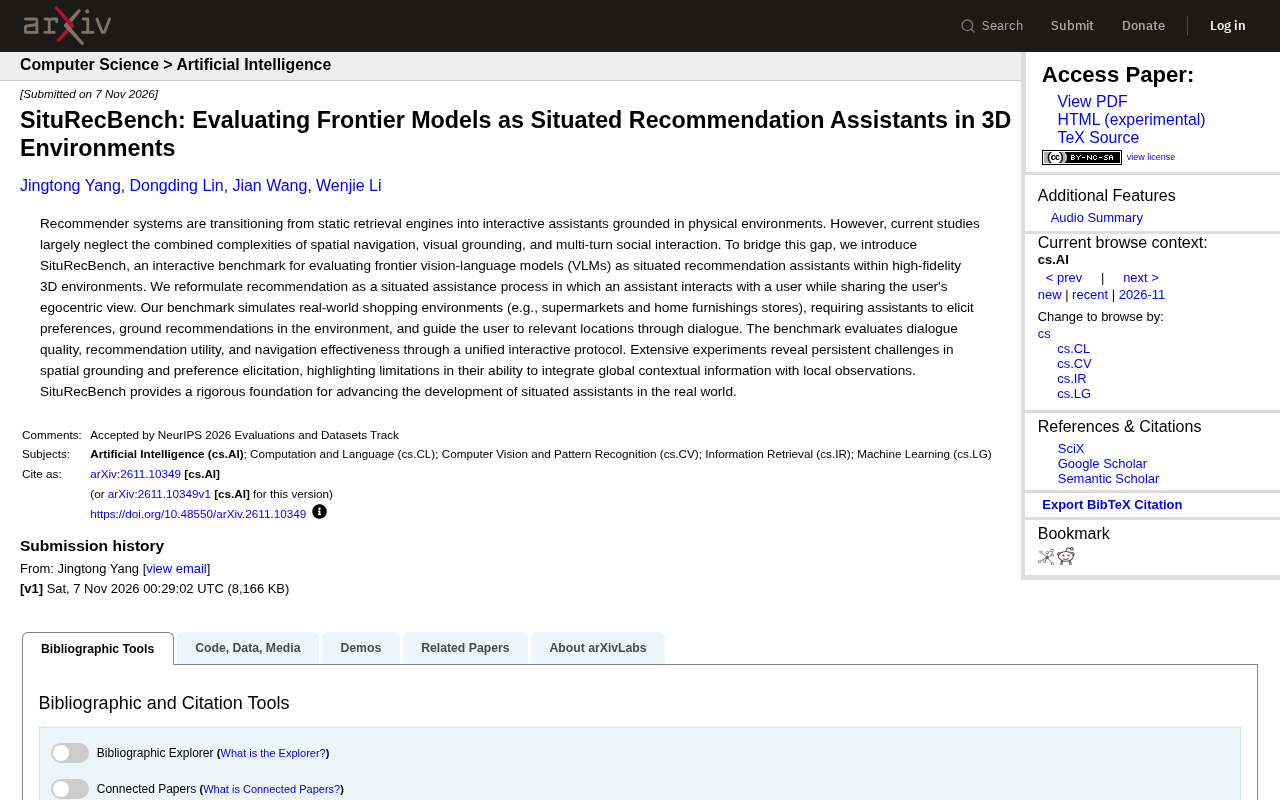
SituRecBench benchmarks VLM capability gaps as contextualized recommendation assistants in 3D environments.
SituRecBench is an interactive benchmark evaluating vision-language models as contextualized recommendation assistants in high-fidelity 3D shopping environments. It reframes recommendation as embodied assistance sharing the user's first-person view, requiring multi-turn preference elicitation, visual grounding, and navigation guidance. Experiments show frontier VLMs still struggle with spatial grounding and preference elicitation.
Recommendation systems are shifting from static retrieval tools to interactive assistants embedded in physical environments. Yet most existing research overlooks the complexity introduced by the combination of spatial navigation, visual grounding, and multi-turn social interaction. To address this, researchers propose SituRecBench, an interactive benchmark for evaluating frontier vision-language models (VLMs) as contextualized recommendation assistants in high-fidelity 3D environments.
From Static Retrieval to Contextualized Assistants
Traditional recommendation systems typically assume users operate in a "disembodied" interface: the system receives historical behavior or queries and returns a list of items. SituRecBench's core argument is that when recommendations occur in real spaces such as supermarkets and home goods stores, assistants require a fundamentally different set of capabilities.
The benchmark reframes recommendation as a contextualized assistance process: the assistant shares the user's egocentric view, proactively asks about preferences during dialogue, grounds recommendations to specific locations in the environment, and guides the user to relevant shelves or areas. This requires models to simultaneously handle spatial navigation, visual understanding, and multi-turn dialogue—all three are indispensable.
Vision-language models (VLMs) are a class of multimodal models that process both image and text inputs, typically using a vision encoder (such as ViT) to map images into feature sequences, which are then fed together with text tokens into a large language model for joint reasoning. Unlike pure-text LLMs, VLMs can answer questions about image content, describe scenes, or generate instructions based on visual cues. In the context of SituRecBench, VLMs must continuously receive rendered frames of the 3D environment from a first-person perspective and align language intent with the positions of shelves and products in the view across multi-turn dialogue—a direct test of their cross-modal spatial understanding.
Evaluation Environment and Task Design
SituRecBench constructs 3D environments simulating realistic shopping scenarios, covering two typical space types: supermarkets and home goods stores. In these environments, assistants must not only "say" recommendations but also "see" the environment and "walk" the right routes.
The task flow requires assistants to proactively elicit user preferences through dialogue (preference elicitation), map recommendations to visible products or areas in the environment (visual grounding), and provide actionable navigation guidance. Through a unified interaction protocol, the benchmark simultaneously measures three dimensions: dialogue quality, recommendation utility, and navigation effectiveness. This multi-dimensional evaluation approach is closer to how real assistants work than single success rates or ranking metrics.
Egocentric view refers to the frames an agent or assistant obtains by observing the environment from its own "eye" position, as opposed to a third-person global overhead view. In embodied interaction, the assistant can only see local information within its current orientation and field of view, and must progressively build spatial understanding through movement and turning. This setting significantly increases task difficulty: models cannot obtain the complete scene layout at once and must continuously integrate local observations during dialogue and navigation to form coherent knowledge of product locations and paths.
Experiments Reveal Capability Gaps
The paper's extensive experiments point to a consistent conclusion: current frontier VLMs still face persistent challenges in spatial grounding and preference elicitation. Models struggle to effectively integrate global context information with local observations—they may understand the user's general intent but cannot accurately map that intent to specific locations or products in the 3D environment before them.
This finding aligns with consensus across multi-source analyses: progress in vision-language models on static image question answering does not automatically translate into reliable performance in embodied or contextualized scenarios. Shortcomings in preference elicitation are equally evident—assistants often require multiple rounds of probing to approach users' true needs, exposing deficiencies in proactive dialogue strategies.
A notable point of divergence concerns the positioning of the evaluation ecosystem. Some argue that such high-fidelity 3D benchmarks are closer to real-world deployment and can drive models toward practical application; others note that gaps in perception and interaction remain between simulated environments and real stores, and benchmark scores should not be directly equated with real-world capability. SituRecBench's value lies in providing a reproducible, rigorous foundation rather than a final answer.
Preference elicitation originates from research on conversational recommendation and interactive information retrieval, referring to systems progressively approaching users' unexpressed preferences through proactive questioning, clarification, and probing. Unlike traditional recommendation that relies on historical behavior, contextualized assistants face immediate, ambiguous needs that may change during dialogue, requiring them to select high-information questions within limited turns. This process involves dialogue strategy planning and uncertainty management—an area where current VLMs are relatively weak, and the reason SituRecBench evaluates it alongside spatial grounding.
Implications for Recommendation Systems Research
SituRecBench redefines "recommendation" from a list-ranking problem into an embodied assistance problem. This presents researchers with a new capability checklist: spatial reasoning, visual grounding, multi-turn preference elicitation, and navigation guidance need to be jointly optimized rather than improved in isolation.
For the product side, the benchmark also highlights evaluation blind spots for interactive recommendation assistants—testing only dialogue fluency or recommendation accuracy would miss what users truly care about: "can you actually take me there?" Joint evaluation of three dimensions under a unified interaction protocol provides more complete feedback signals for subsequent model iteration.
The paper positions SituRecBench as foundational work advancing the development of real-world contextualized assistants. As VLM capabilities continue to evolve, whether such benchmarks can smoothly transfer from simulated environments to real spaces will be the next question worth tracking.
Embodied assistance emphasizes that agents possess a physical or virtual body capable of perceiving, moving, and executing user-oriented actions in an environment. Unlike chat assistants that only offer suggestions at the text level, embodied assistants must translate recommendations into actionable navigation instructions and take responsibility for obstacles, distances, and reachability in the environment. This concept extends recommendation system evaluation from "ranking quality" to "task completion," requiring models to establish a closed loop among perception, language, and action—and imposing new requirements for joint optimization in benchmark design.
One-line Summary
SituRecBench evaluates VLM capability gaps as contextualized recommendation assistants in 3D environments.
Paragraph Summary
SituRecBench is an interactive benchmark for evaluating vision-language models as contextualized recommendation assistants in high-fidelity 3D shopping environments. It reframes recommendation from static list ranking into an assistance process sharing the user's first-person view, requiring assistants to elicit preferences through multi-turn dialogue, ground recommendations to specific locations in the environment, and provide navigation guidance. The benchmark simulates supermarket and home goods store scenarios, jointly evaluating dialogue quality, recommendation utility, and navigation effectiveness under a unified interaction protocol. Experiments show that frontier VLMs still face persistent challenges in spatial grounding and preference elicitation, struggling to integrate global context with local observations. The work provides a reproducible evaluation foundation for embodied recommendation assistants, though the gap between simulation and real spaces remains to be validated.
Related articles

Anthropic Model Benchmarking: Fable 5 vs 5.1 vs 5.2 Comparison
Based on Reddit community comparison material, this analyzes benchmark differences among Anthropic models Fable 5, 5.1, and 5.2, and discusses the practical implications of version iterations for developers and model selection advice.

Jensen Huang Steps Down as Nvidia CEO, Asian Governments Scramble to Respond to Chip Supply Shifts
Jensen Huang's departure as Nvidia CEO triggers chain reactions across Asian governments: some confirm chip supply commitments, others monitor local AI project impacts and handle related investigations. This article analyzes supply chain stability, project risks, and compliance uncertainty.
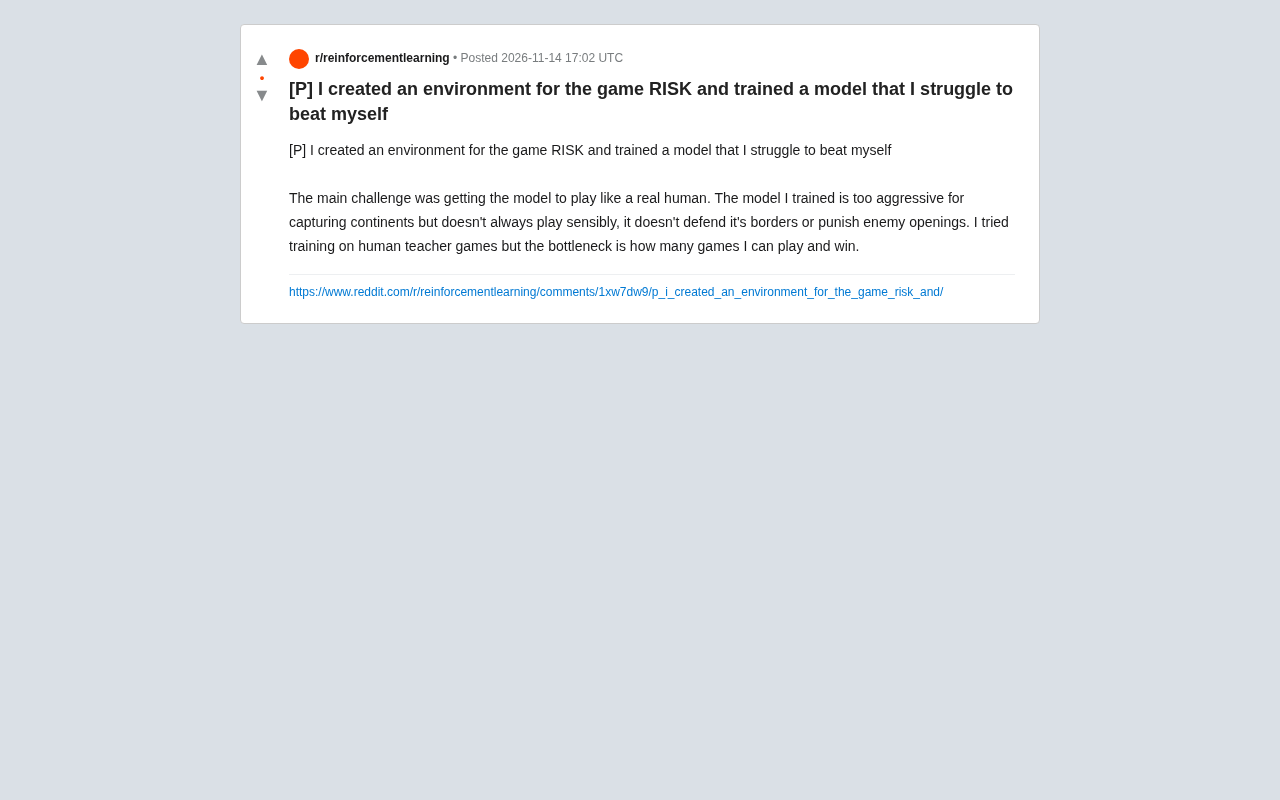
Reddit Player Builds RISK Game Environment and Trains an AI That's Nearly Impossible to Beat
Reddit player builds a RISK training environment and trains an aggressive AI model that's nearly unbeatable. Strong at expansion but weak at defense, the author hits a bottleneck trying human data training, revealing common game AI development challenges.