Six Major AI Agent Orchestration Frameworks Compared: A Selection Guide

A breakdown of use cases and selection logic for six mainstream Agent orchestration frameworks.
The article argues that AI models provide intelligence, but orchestration turns it into coordinated action, making "who manages these Agents" a core issue in 2026. It examines six mainstream Agent orchestration frameworks: LangGraph for stateful workflows with branching and checkpoints, CrewAI for role-based Agent teams, Microsoft Agent Framework for enterprise processes and human approval, OpenAI Agents SDK for specialist handoffs and delegation, Google ADK for multi-Agent parallelism and result merging, and Claude Agent SDK for tool-intensive iterative execution. The key to selection lies not in framework strength but in first clarifying your workflow shape and then matching framework capabilities.
Why Everyone Is Talking About Agent Orchestration in 2026
AI models provide intelligence, but orchestration is what turns intelligence into coordinated action. As more and more teams build AI Agents, a practical question surfaces: who manages these Agents? This is exactly the core problem that agentic AI orchestration frameworks are designed to solve.
Around this need, there are currently six mainstream frameworks, each targeting a different workflow shape. Based on the breakdown in the original video, this article examines their applicable scenarios one by one and offers selection advice.
Agent Orchestration refers to the mechanism for unified scheduling, coordination, and state management across multiple AI Agents or tool calls. A single large model can only complete one round of reasoning or generation, whereas real business often requires multi-step, multi-role, recoverable execution flows—the orchestration layer decides "who does what and when, how to roll back after a failure, and how to aggregate results." It typically includes task decomposition, routing and dispatch, context passing, error retry, and human intervention. Without orchestration, Agents are just isolated intelligence units; with orchestration, model capabilities can be organized into reliable, observable, auditable automated workflows—which is the fundamental reason this topic has surged in 2026.
LangGraph: The Go-To for Stateful Workflows
LangGraph is suited for stateful workflows with branching logic and checkpoints. The example given in the video is very concrete: an AI Agent processes a customer order, checks inventory, verifies payment, and decides what to do next; if a step fails, it can recover from an earlier step without losing important workflow state.
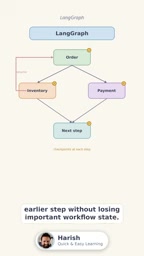
This "recoverability" is critical for stateful, multi-step business processes. When your Agent needs to preserve context across multiple steps and take different branches based on conditions, LangGraph's graph structure is a natural fit.
Stateful Workflow and Checkpoint: In the Agent context, "state" refers to the context that must be preserved across steps during workflow execution, such as collected order information, completed verification results, and the current branch. Traditional stateless calls start fresh every time and cannot resume from an interruption. The checkpoint mechanism persists the current state at key nodes, so once a step fails or human intervention is needed, the system can recover from the most recent checkpoint without rerunning from scratch. This is precisely the intent behind LangGraph's "graph" modeling: nodes represent processing steps, edges represent conditional branches, and state flows through the graph and is snapshotted, thereby supporting long-running, recoverable, and traceable business automation.
CrewAI: An Agent Team Like an Office
CrewAI is positioned around collaborative Agents. Think of it as an AI-driven office: one Agent handles research, another handles analysis, a third writes the final report, and a manager coordinates and reviews their work.
When tasks can be split into specialized roles and require collaboration among roles, CrewAI's design philosophy is closer to how human teams are organized.
Microsoft Agent Framework: Enterprise Processes and Human Approval
Microsoft's framework targets structured enterprise workflows, especially processes where humans and AI participate together. The refund case in the video is typical: verify the request, request human approval when necessary, process the payment and notify the customer if approved, otherwise escalate.
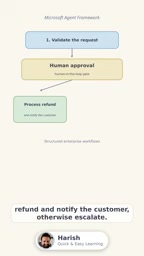
For enterprise scenarios involving approval nodes, permission control, and escalation paths, this framework is a better fit.
OpenAI Agents SDK: Handoffs and Delegation
The OpenAI Agents SDK excels at handoffs and delegation among specialist Agents. Take a customer service assistant as an example: a customer asks about a billing issue, and the service Agent transfers control to a billing specialist; or an orchestrator calls another Agent as a tool and retrieves its answer.
When your system needs to split specialists by domain and route control among them, this SDK's abstractions are more direct.
Handoff and Delegation are two different ways of transferring control in multi-Agent collaboration. A handoff means the current Agent transfers full control of the conversation or task to another specialist Agent, which then continues interacting with the user or downstream, while the original Agent steps out of the driver's seat; delegation means the orchestrator dispatches a subtask to a specialist Agent as a single call and, after retrieving the result, still holds the main thread. The former suits domain-based routing (such as a service agent transferring to a billing specialist), while the latter suits using specialists as composable tools. Understanding the difference helps assess a framework's design orientation regarding "ownership of control" and "context isolation."
Google ADK: Multi-Agent Parallelism and Result Merging
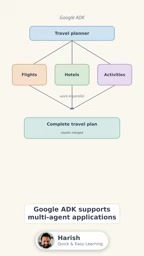
Google ADK supports multi-Agent applications and workflow coordination. The travel planning example in the video illustrates its strength: one Agent searches flights, another looks up hotels, a third recommends activities, and they can work in parallel, ultimately merging the results into a complete travel plan.
Scenarios that require parallel execution followed by result aggregation are this framework's primary use case.
Google ADK (Agent Development Kit) is an open-source Agent development framework launched by Google for building and orchestrating multi-Agent applications. It provides Agent definition, tool integration, workflow coordination, and other capabilities, supports orchestration patterns such as sequential and parallel, and can connect to models like Gemini as well as external tool ecosystems. Its design emphasizes organizing multiple specialized Agents into a collaborative system, with the framework responsible for task distribution and result aggregation, making it especially suitable for scenarios that require parallel information gathering followed by unified summarization, such as simultaneously querying flights, hotels, and activities in travel planning.
Claude Agent SDK: Tool-Driven Iterative Execution
The Claude Agent SDK is particularly well suited for tool-intensive Agent tasks. Take an AI coding assistant as an example: it reads code, makes changes, runs tests, checks for errors, fixes issues, and iterates continuously until the task is complete or further input is needed.
This "execute—verify—fix" loop is the typical shape of tool-driven tasks.
Quick Reference for Choosing Among the Six Frameworks
The selection logic given in the video maps directly to workflow shapes:
- LangGraph: stateful graphs, branching, and checkpoints
- CrewAI: Agent teams with role division
- Microsoft Agent Framework: enterprise workflows and human approval
- OpenAI Agents SDK: handoffs and delegation
- Google ADK: multi-Agent coordination with parallel merging
- Claude Agent SDK: tool-driven execution loops
The key to selection isn't which framework is "strongest," but what shape your workflow takes: a long-running process that needs state recovery, role collaboration, or parallel aggregation. Clarifying your process structure first and then matching framework capabilities is more effective than chasing framework hype.
Which framework are you using? Feel free to share in the comments.
Related articles

Gemini 4 Neon Leak: A Potential Strong Contender Against Opus 5.5
A Hacker News thread suggests Gemini 4 Neon looks like an Opus 5.5 competitor. This article unpacks the product positioning behind this community signal, shifts in the top-model competitive landscape, and what it means for developers' model selection strategy.

Claude Fable 5.2's Self-Authored Short Film 'Fable' Sparks Discussion
A short film 'Fable,' credited to Claude Fable 5.2 for script, visuals, and directing, appears on Hacker News. This article analyzes the significance of full-pipeline AI creation, community reactions, and what it means for content creators.

Anthropic IPO Pricing: A Signal of AI Giants Going Public
Anthropic's IPO pricing draws attention. This article analyzes its potential impact on AI industry valuation, commercialization paths, and the competitive landscape, and highlights public-market expectations and challenges for AI companies.