SKI: A Free Voice Coding Tool That Gives Claude Code a Voice

SKI adds free bidirectional voice interaction to Claude Code and Codex, enabling conversational programming.
SKI is a free, locally-run developer tool that brings bidirectional voice conversation to AI coding agents like Claude Code and Codex. Unlike simple dictation tools, SKI creates a voice dialogue loop where the AI agent speaks back to developers. It runs entirely on local machines for data privacy, supports Mac and Windows, and activates with a simple hotkey for minimal friction integration into development workflows.
A New Paradigm in Voice Programming
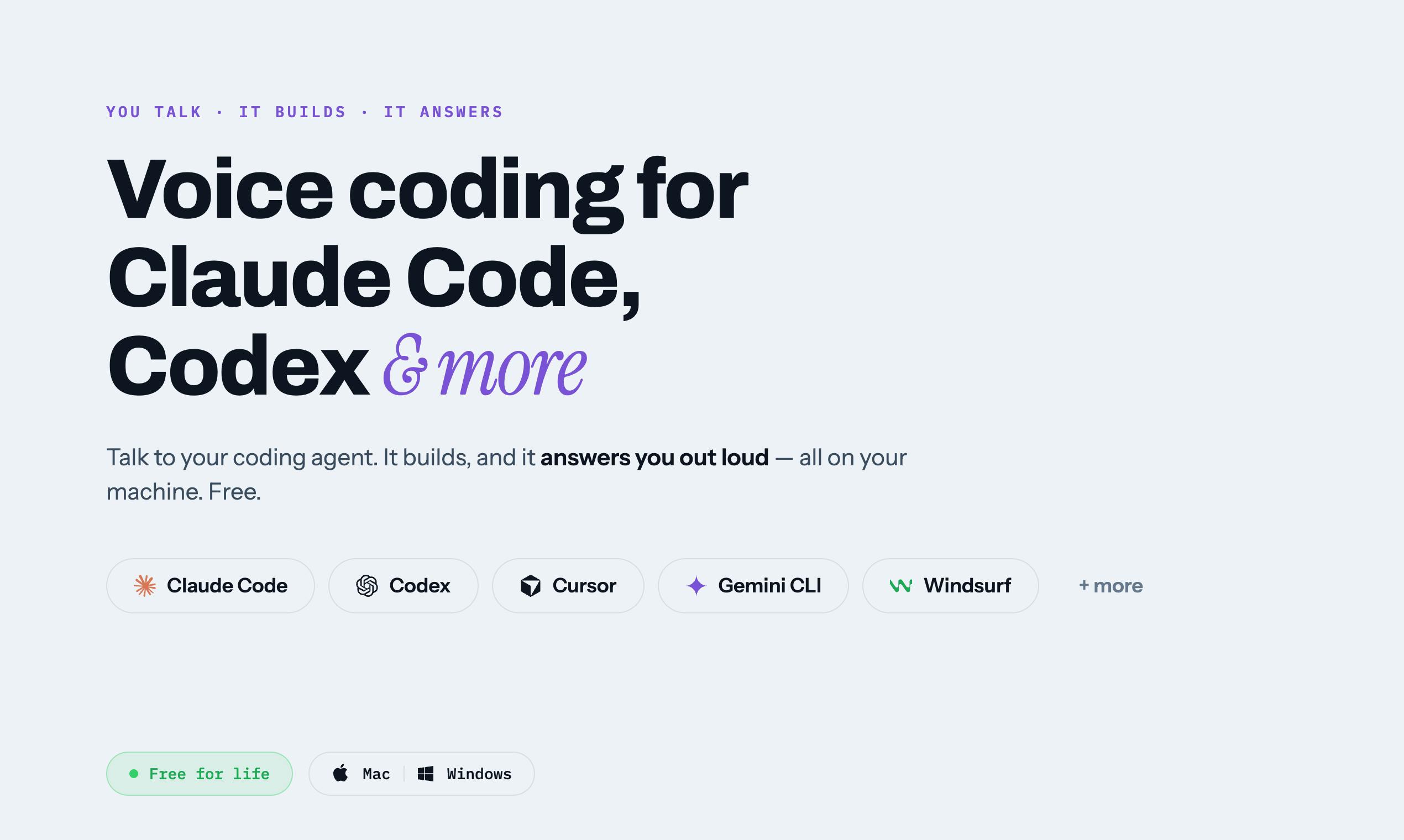
Recently, a developer tool called SKI launched on Product Hunt with an imaginative positioning: providing free voice interaction capabilities for AI coding agents like Claude Code and Codex. Its tagline is concise and powerful — "Free voice coding for Claude Code, Codex and more."
Claude Code is a command-line AI coding agent from Anthropic that can understand developers' natural language instructions directly in the terminal, autonomously read and write files, execute commands, search codebases, and complete full development tasks from code refactoring to feature implementation. Unlike traditional code completion tools, it has the ability to understand entire project contexts and execute multi-step operations autonomously. Codex is a similar product from OpenAI, also functioning as an autonomous coding agent. These "agent-type" programming tools represent a paradigm shift in AI-assisted programming from "suggestive" to "executive" — the developer's role transforms from writing code line by line to describing intent in natural language and reviewing AI output. SKI targets precisely the room for improving human-machine communication efficiency under this new paradigm.
Unlike the voice input (dictation) we're familiar with, SKI emphasizes a bidirectional, conversational programming experience. Your AI agent doesn't just passively convert your speech to text — it actively "speaks back," like a real team member. This interaction model breaks the traditional "type-wait-read" programming rhythm, enabling developers to build software at "the speed of thought."
More Than Dictation: Making AI Agents "Speak" for Team Collaboration
The most fundamental difference between SKI and common voice coding tools on the market lies in its interaction loop. According to the official description, SKI is not simply a dictation tool — it builds a voice conversation loop: you voice your requirements to the agent, and the agent not only executes but also provides audio feedback on progress and results.
From a technical perspective, building such a bidirectional voice dialogue system typically involves three core modules: ASR (Automatic Speech Recognition) converts user speech to text, NLU (Natural Language Understanding) parses intent and routes to corresponding agent operations, and TTS (Text-to-Speech) synthesizes the agent's text responses into voice output. In recent years, the maturation of ASR models like OpenAI's open-source Whisper has made localized high-precision speech recognition possible, while advances in real-time TTS technology have reduced synthetic speech latency to acceptable conversational levels. SKI's "conversation loop" design means it needs to achieve low-latency streaming processing across these three modules while communicating asynchronously with the underlying coding agent's API — a non-trivial engineering challenge.
This "voice response" design means developers can maintain a near-verbal collaborative state with AI without staring at the screen. The official team has provided two imaginative use cases:
- Live coding in meetings: Call up SKI directly in team meetings, driving the agent in real-time with voice to build features, making "discuss while implementing" possible.
- Speaking on your behalf: Let SKI "speak for you," taking on the role of expression and communication in certain scenarios.
While these scenarios sound somewhat idealistic, they reflect the SKI team's intent to redefine the boundaries of human-machine collaboration — AI agents are no longer tools hidden behind editors but are pushed to the forefront of collaboration.
Lightweight "Always-On Desktop" Interaction Design
In terms of usage, SKI adopts an "ambient" design philosophy. It quietly resides on the desktop without requiring complex interface switching: press a hotkey, start talking, and it starts working.
Ambient Computing is an interaction design concept rooted in the "ubiquitous computing" concept proposed by Mark Weiser at Xerox PARC. The core idea is to let technology blend into users' daily environment rather than requiring users to actively "enter" a specific application or interface. In the desktop software context, this means tools reside in the background with minimal visual and cognitive footprint, responding with the lowest friction only when needed. macOS's Spotlight and Alfred are typical embodiments of this philosophy — a single hotkey awakens full functionality.
This minimalist interaction path addresses a key pain point in voice tool adoption — friction cost. Any voice feature that requires developers to frequently switch windows or click multiple buttons to activate will struggle to integrate into actual workflows. The "hotkey activation" design transforms voice programming from a feature that requires deliberate use into an auxiliary capability available at a moment's notice. For voice programming tools, this design is especially critical because the advantage of voice interaction lies precisely in "freeing hands and eyes" — if the tool itself requires complex GUI operations to launch, it fundamentally contradicts the purpose of voice interaction.
Additionally, SKI currently supports both Mac and Windows, covering the vast majority of developers' work environments.
Local Execution and Free Pricing: Balancing Security and User Acquisition
Two additional technical and business positioning aspects are worth noting.
First is local execution (All on your machine). The team explicitly states that SKI runs on the developer's own machine, which is a compelling selling point in an era of increasing concern over data privacy and code security.
Local execution is an increasingly important technical direction in the AI tools space. Traditional cloud-based AI services require uploading user data to remote servers for processing, which faces severe compliance challenges in enterprise development scenarios — whether it's GDPR (General Data Protection Regulation), SOC 2 certification requirements, or internal corporate code security policies, all impose strict limitations on sensitive data transmission and storage. For voice programming tools, "local execution" needs to solve two technical challenges: running sufficiently accurate speech recognition models on consumer-grade hardware (OpenAI's open-source Whisper model makes this possible), and completing voice synthesis without relying on cloud inference. However, it's important to note that Claude Code and Codex, which SKI connects to as an adapter layer, still require cloud API calls. Therefore, "local execution" primarily means the voice processing component doesn't involve third-party data transmission — developers' voice data and local code aren't additionally uploaded to SKI's servers.
For enterprise developers, keeping code and voice data local means lower compliance risk.
Second is completely free. At a time when AI programming tools are generally moving toward subscription models and usage-based billing, SKI's choice to offer free access is undoubtedly a typical early-stage user acquisition and ecosystem positioning strategy.
Looking at the business model evolution in the AI programming tools space: GitHub Copilot pioneered this market with a $10-19/month subscription, followed by Cursor offering a more deeply integrated IDE experience at similar pricing, while agent-type tools like Claude Code and Codex typically adopt token-based pricing directly tied to underlying model API costs. Against this backdrop, SKI's free strategy has clear strategic logic: it doesn't carry core code generation capabilities but rather serves as an "interaction layer" built on top of existing paid agent products. This is similar to the browser extension ecosystem logic — first acquire user scale through free offerings, then monetize through value-added services, enterprise features, or data insights. As an "adapter layer" connecting mature agent products like Claude Code and Codex, its free positioning helps rapidly build a user base.
Opportunities and Challenges of Voice Programming
SKI's emergence represents an interesting direction in AI programming tool evolution: moving from text interaction to multimodal and even conversational interaction. As agent-type programming tools like Claude Code and Codex grow increasingly powerful, reducing the communication bandwidth bottleneck between humans and machines becomes the next key to improving development efficiency. Voice, as one of humanity's most natural forms of expression, carries high expectations.
From an information theory perspective, the average information transmission rate of human speech is approximately 150-160 English words per minute, while proficient typists typically achieve 60-80 words per minute. This means voice inherently has approximately a 2x bandwidth advantage in "expressing intent." However, programming isn't purely about intent expression — it also involves precise symbol manipulation, naming conventions, and structured syntax, which are actually less efficiently expressed through voice than keyboard input.
Nevertheless, voice programming faces practical challenges. Programming is inherently a highly precise, structured activity involving extensive symbols, naming, and contextual references, which are often less precisely expressed through voice than typing. SKI's emphasis on a "conversational" rather than "dictation" experience is perhaps intended to circumvent this difficulty — it lets AI handle the work of understanding intent rather than requiring users to dictate code word by word. This design philosophy forms a natural complement to the capability evolution of agent-type programming tools: when AI agents are smart enough to infer specific code implementations from high-level natural language descriptions, the precision disadvantage of voice as an input channel is no longer a fatal bottleneck.
From a product stage perspective, SKI has just launched on Product Hunt, and actual experience and stability remain to be validated by more users. However, its combined positioning of "free + local + bidirectional voice + cross-platform" does provide a differentiated entry point in the crowded AI programming tools landscape. For developers already comfortable with Claude Code or Codex, it's worth trying as an experimental tool to enhance workflow experience.
Key Takeaways
Related articles

WCF Modernization: CoreWCF or gRPC? A Decision Framework and Migration Guide
In-depth analysis of two WCF modernization paths: CoreWCF for smooth transition vs gRPC for full restructuring. Includes a decision framework based on contract compatibility, performance needs, and migration scope.

Practical Guide to Building a Multimodal RAG Application with Nemotron 3 Nano Omni
Learn how to build a multimodal RAG application with NVIDIA Nemotron 3 Nano Omni, covering Modal cloud deployment, Gradio frontend, and document retrieval Q&A workflows.

C64 Demoscene Technical Breakdown: Visual Black Magic on Extreme Hardware
A deep dive into Commodore 64 Demoscene techniques including sprite multiplexing, border opening, and raster interrupts—how 8-bit era coders achieved the impossible through cycle-exact programming.