Skill-Agent: A Production-Grade AI Agent Framework Built on FastAPI with 100+ LLM Support

Skill-Agent: A production-grade full-stack open-source AI Agent framework built on FastAPI
Skill-Agent is an open-source AI Agent framework built on FastAPI that integrates five core capabilities: unified access to 100+ LLM providers, MCP tool protocol integration, multi-agent collaboration, RAG knowledge base, and sandbox isolated execution. Positioned as production-grade, it aims to provide a one-stop solution for key AI Agent development challenges including model integration, tool invocation, collaboration, knowledge retrieval, and secure execution, suitable for enterprise intelligent assistants and automated workflows.
Project Overview
In today's flourishing landscape of AI Agent frameworks, an open-source project called Skill-Agent has caught the attention of the developer community. It's a production-grade AI Agent framework built on FastAPI, open-sourced by developer alleneee on GitHub and developed in Python. Although the project currently has only 20 stars, the breadth of its feature design and the maturity of its architectural philosophy give it the potential to become foundational infrastructure for enterprise-grade Agent development.
The framework's core positioning can be summarized in one sentence: A one-stop solution for the key challenges in AI Agent development, including model integration, tool invocation, multi-agent collaboration, knowledge retrieval, and secure execution.
The AI Agent framework space is currently undergoing rapid evolution—from early entrants like LangChain and AutoGPT to later arrivals such as CrewAI, AutoGen, and Dify. Each framework attempts to solve different pain points in Agent development. LangChain focuses on chain-of-call orchestration, AutoGen specializes in multi-agent conversations, and CrewAI emphasizes role-playing collaboration. However, most frameworks are either too academic and lack production-readiness, or are too narrowly focused, requiring substantial glue code to build complete applications. Skill-Agent aims to find its own place in this landscape—providing an out-of-the-box, full-stack solution.
Five Core Capabilities Explained
Unified Access to 100+ LLM Providers
One of Skill-Agent's most prominent features is its support for over 100 LLM providers. Developers don't need to write different adapter code for different models—the framework has already completed the unified abstraction at the framework level. Whether it's mainstream international models like OpenAI, Anthropic, and Google, or domestic Chinese models like Qwen and ERNIE Bot, all can be called through a unified interface.
This design dramatically reduces the cost of model switching—when a particular model experiences service instability or pricing changes, developers can switch to other providers at near-zero cost. In production environments, this flexibility translates to higher system availability and lower operational pressure.
The technical difficulty of unified access to 100+ LLM providers far exceeds what appears to be simple interface wrapping. Different model providers have significant differences in API formats, authentication methods, streaming response handling, token billing logic, rate limiting strategies, and error code systems. For example, OpenAI uses Bearer Token authentication while some domestic models use AK/SK signature mechanisms; Claude's message format has structural differences from the GPT series; and different models vary in their support level and format for Function Calling. Similar unified abstraction layers have precedents in the industry—the LiteLLM project, for instance, focuses specifically on solving this problem, and Skill-Agent likely draws from or integrates a similar adapter layer design.
MCP Tool Integration: Connecting AI to the Real World
MCP (Model Context Protocol) is a model context protocol proposed by Anthropic that is becoming the de facto standard for AI Agent tool invocation. Skill-Agent natively supports the MCP protocol and can seamlessly integrate with various tools and services that comply with the MCP standard.
Through MCP integration, Agents can call external APIs, operate databases, access file systems, and more—combining the reasoning capabilities of large language models with the ability to operate in the real world. This is the critical step in evolving from a "chatbot" to an "intelligent assistant."
MCP was officially released by Anthropic in late 2024, with its design inspired by the success of LSP (Language Server Protocol) in the IDE ecosystem. MCP defines a standardized JSON-RPC 2.0 communication protocol with three core primitives: Resources (resource exposure), Tools (tool invocation), and Prompts (prompt templates). MCP adopts a client-server architecture where AI applications serve as MCP Clients and external tools and services serve as MCP Servers, communicating via stdio or HTTP+SSE. The significance of this protocol lies in breaking the M×N problem of tool integration—previously, every AI application needed to individually interface with each tool, but now interoperability is achieved simply by following the MCP standard. Hundreds of MCP Servers have already been developed by the community, covering common scenarios like GitHub, Slack, databases, and file systems.
Multi-Agent Collaboration Mechanism
A single Agent's capabilities are ultimately limited; complex tasks often require multiple specialized Agents working together. Skill-Agent has a built-in multi-agent collaboration mechanism that supports task distribution, information passing, and result aggregation between different Agents.
Here's a practical example: an Agent responsible for information retrieval passes results to an Agent responsible for data analysis, which then hands off to an Agent responsible for report generation to produce the final output. This pipeline-style collaboration pattern can effectively decompose complex enterprise business scenarios.
Multi-agent collaboration has formed several mainstream architectural patterns in both academia and industry. The first is Hierarchical, where an Orchestrator Agent handles task decomposition and distribution while subordinate Agents execute specific subtasks. The second is Peer-to-Peer, where multiple Agents autonomously negotiate through message passing. The third is Pipeline, where Agents process in a predefined sequence. Each pattern has its applicable scenarios: hierarchical suits scenarios with clear task boundaries, peer-to-peer suits complex decisions requiring dynamic negotiation, and pipeline suits business processes with fixed steps. Implementing multi-agent collaboration also requires solving engineering challenges such as shared memory management, conflict resolution, deadlock prevention, and communication overhead optimization.
RAG Knowledge Base: Solving Hallucination and Timeliness Issues
RAG (Retrieval-Augmented Generation) is the mainstream approach for addressing large model "hallucination" problems and knowledge timeliness issues. Skill-Agent integrates complete RAG knowledge base functionality, allowing developers to connect private documents, enterprise knowledge bases, and other data to the Agent system.
When answering questions, the Agent first retrieves relevant information from the knowledge base, then generates responses based on the retrieval results, significantly improving answer accuracy and reliability. For enterprise applications that need to handle domain-specific expertise, RAG capability is practically a must-have.
A production-grade RAG system is far more complex than simply "retrieval + generation"—it involves a complete data processing pipeline. First is the document parsing stage, which needs to handle multiple formats like PDF, Word, and HTML, extracting text, tables, and image information. Next is text chunking, which requires balancing semantic completeness with retrieval granularity—common strategies include fixed-size chunking, recursive character splitting, and semantic chunking. Then comes vectorization (embedding), converting text chunks into high-dimensional vectors stored in vector databases (such as Milvus, Pinecone, Chroma, etc.). The retrieval stage involves optimization techniques like hybrid retrieval (vector search + keyword search), reranking, and context compression. Advanced RAG also includes query rewriting, multi-hop reasoning, and adaptive retrieval strategies to handle complex query scenarios.
Sandbox Isolated Execution: Security Assurance for Production Environments
Security is an issue that production-grade frameworks must address. When Agents need to execute code or invoke system commands, the lack of isolation mechanisms can pose serious security risks. Skill-Agent provides a sandbox isolated execution environment, ensuring that code generated and executed by Agents runs in a controlled environment without impacting the host system.
This design reflects the framework author's deep understanding of production environments—security issues easily overlooked during development are often the biggest obstacles during actual deployment.
Code sandbox isolation has multiple technical implementation approaches, each with its own trade-offs. The lightest is process-level isolation, executing code through restricted subprocesses with limited system calls and file access permissions. The medium approach is container-level isolation, using Docker or gVisor to create independent runtime environments with complete file system, network, and process isolation. The heaviest is virtual machine isolation, such as Firecracker microVMs, providing hardware-level security boundaries. In AI Agent scenarios, additional considerations include execution timeout control, memory usage limits, network access whitelisting, and read-only file system mounts. Well-known code execution sandboxes in the industry include E2B, Modal, and CodeSandbox, which provide mature infrastructure for AI code execution.
Why FastAPI Was Chosen as the Underlying Framework
Skill-Agent chose FastAPI as its underlying framework—a technology selection with clear rationale:
- High-performance async processing: FastAPI is built on Starlette and Pydantic with native async support, making it ideal for I/O-intensive AI Agent applications
- Automatic API documentation generation: Built-in OpenAPI documentation facilitates interface debugging and team collaboration
- Type safety: Full utilization of Python type hints reduces runtime errors
- Rich ecosystem integration: Easy integration with various middleware, databases, and message queues
For scenarios that need to expose Agent capabilities as APIs, these FastAPI features can significantly reduce development and maintenance costs.
FastAPI's popularity as a backend choice for AI applications is closely tied to its underlying architecture. Built on Starlette's ASGI (Asynchronous Server Gateway Interface) support, it offers clear performance advantages over traditional WSGI frameworks (like Flask) when handling concurrent long connections—particularly important for Agent applications that need to wait for LLM streaming responses. The integration of Pydantic v2 brings Rust-based data validation performance, and automatic serialization and validation of request/response models reduces substantial boilerplate code. Additionally, FastAPI's dependency injection system allows cross-cutting concerns like database connections, authentication logic, and configuration management to be elegantly organized. In AI Agent scenarios, FastAPI's WebSocket support is also crucial, enabling real-time Agent interaction and streaming output.
Use Cases
Skill-Agent is suitable for the following typical application scenarios:
- Enterprise intelligent assistants: Scenarios requiring access to private knowledge bases and internal system tools
- Automated workflow engines: Complex business process automation with multi-step, multi-role collaboration
- Rapid AI application prototyping: Quickly validating Agent application ideas and reducing migration costs from prototype to production
- Multi-model comparative evaluation: Leveraging multi-LLM support to quickly assess performance differences of various models on specific tasks
Current Status and Future Prospects
Skill-Agent is still in its early stages (20 Stars), but the completeness of its feature design already surpasses many similar projects. The framework covers the complete chain from model integration to secure execution, and its architectural design accounts for the practical needs of production environments.
If the community can continue contributing code, improving documentation, and expanding test coverage, Skill-Agent has the potential to become an important AI Agent development framework choice in the Python ecosystem.
Summary
In the AI Agent framework space, Skill-Agent positions itself clearly as "production-grade," integrating five core capabilities—100+ LLM multi-model support, MCP tool protocol, multi-agent collaboration, RAG knowledge base, and sandbox secure execution—to provide developers with a comprehensive one-stop solution. For teams looking for a Python AI Agent development framework, this project is worth exploring in depth and trying out.
Key Takeaways
- Skill-Agent is a production-grade AI Agent framework built on FastAPI, supporting unified access to over 100 LLM providers
- Native integration of MCP (Model Context Protocol) enables seamless connection between Agents and external tools and services
- Built-in multi-agent collaboration mechanism and RAG knowledge base functionality can handle complex enterprise business scenarios
- Provides sandbox isolated execution environment to ensure Agent code execution security, reflecting production-grade security awareness
- The project is in early stages but features a complete design, suitable for enterprise intelligent assistants, automated workflows, and AI application prototyping
Related articles
 Product Reviews
The Programmer's Desk Setup Guide: Building a Workspace That Feels Like Home
Discover how programmers build productive, comfortable workspaces. From multi-monitor setups to ergonomic design, explore the desk philosophy that drives focus and flow.
 Product Reviews
Qoder vs Cursor Real-World Comparison: Which $20/Month AI IDE Is Better?
Hands-on comparison of Qoder vs Cursor AI IDEs: Agent autonomy, human interaction count, and architecture decisions. Qoder needed only 2 interactions vs Cursor's 8.
 Product Reviews
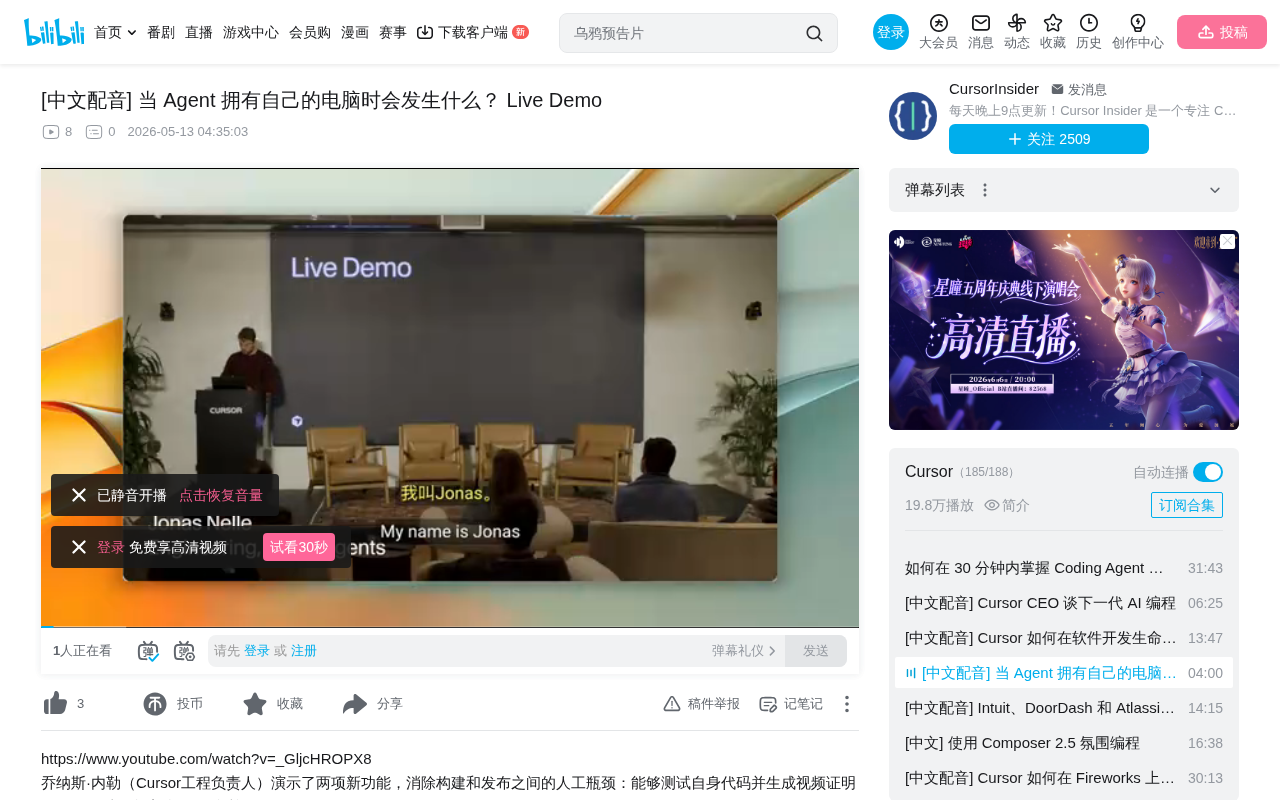
Cursor Cloud Agent Demo: Eliminating Bottlenecks Across the Entire Software Development Lifecycle
Deep analysis of Cursor's Cloud Agent demo showing how cloud VMs, automated test artifacts, and a full-chain control plane systematically eliminate human bottlenecks across the software development lifecycle.