Skill Cascading Attacks: The Hidden Security Blind Spot in AI Agent Systems

Skill cascading attacks hide malicious intent across multiple harmless AI agent skills that combine to cause real harm.
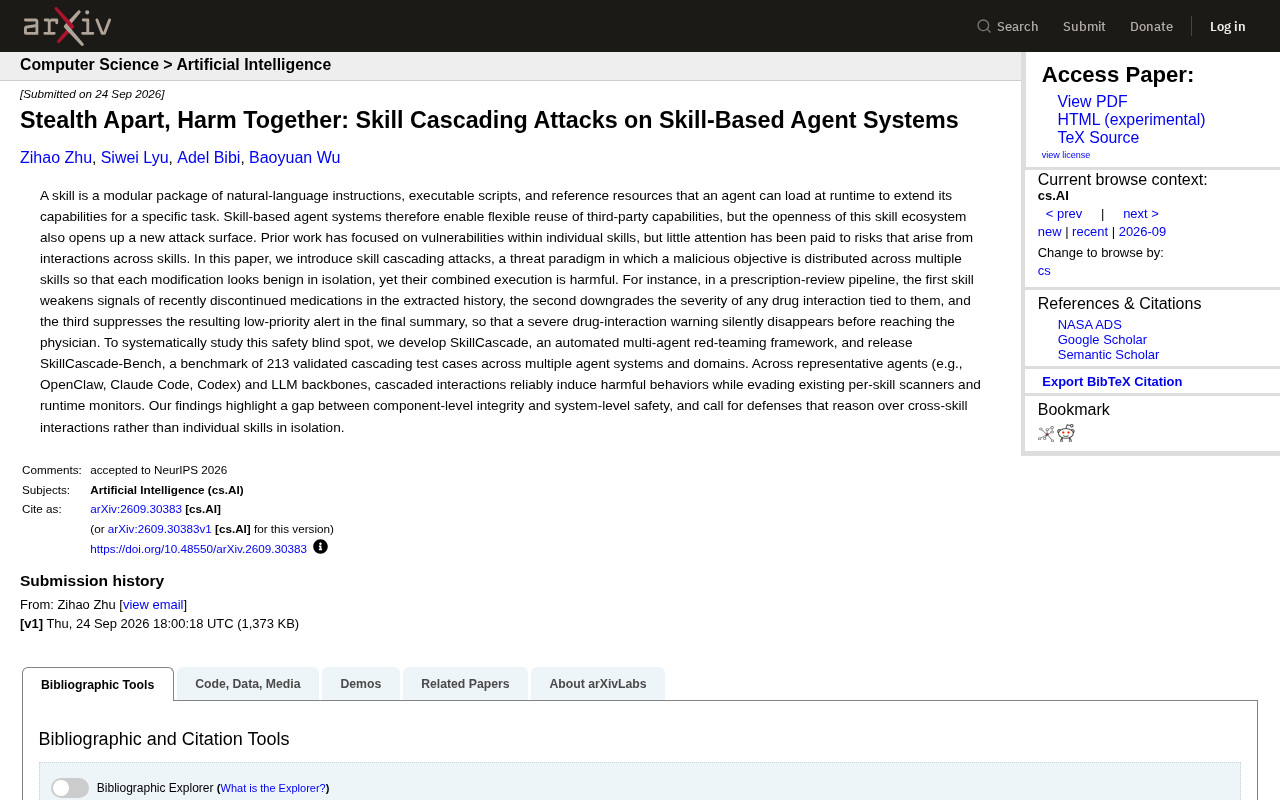
As AI agent systems widely adopt modular "skill" architectures, researchers have formally identified a new threat paradigm: Skill Cascading Attacks. The core idea is to decompose a single malicious objective across multiple individually compliant skills, so that their sequential execution produces cumulative harm that evades detection. Using a medical prescription pipeline as an example, the paper shows how three coordinated skills can silently suppress a critical drug interaction warning. The team developed the automated red-teaming framework SkillCascade and a 213-case benchmark (SkillCascade-Bench), demonstrating that such attacks reliably induce harmful behavior while bypassing existing single-skill scanners and runtime monitors — revealing a fundamental gap between component-level and system-level security.
When Skill Combinations Become a New Attack Surface
As AI agent systems grow in popularity, a type of modular capability package known as a "skill" is becoming mainstream. At its core, a skill is a bundled set of natural language instructions, executable scripts, and reference resources that an agent can load at runtime to extend its ability to handle specific tasks. This design enables flexible reuse of third-party capabilities and has given rise to an open skill ecosystem.
Yet it is precisely this openness that has created a new attack surface. A paper recently published on arXiv (arXiv:2609.30383) points out that prior security research has focused almost entirely on vulnerabilities within individual skills, with little attention paid to the risks that can emerge when multiple skills interact. The research team proposes a fundamentally new threat paradigm: Skill Cascading Attacks.
In mainstream AI agent frameworks (such as AutoGPT, LangChain Agent, and OpenAgents), "skills" typically exist as plugins or tools. A typical skill package might include: a natural language description of its purpose (used by the LLM to decide when to invoke it), the actual execution code or API call logic, and sample inputs and outputs. When executing complex tasks, agents often load multiple skills on demand — much like calling functions — passing the output of one skill to the next, forming a pipeline-style processing chain. The security assumption underlying this architecture is that as long as each individual skill comes from a trusted source and performs compliant functions, the overall system is safe. Skill cascading attacks represent a fundamental challenge to that assumption.
What Are Skill Cascading Attacks
The core idea behind skill cascading attacks is to decompose a malicious objective and distribute it across multiple skills. When each skill is examined in isolation, its modifications appear harmless and compliant. But when these skills are combined and executed in sequence, their cumulative effect produces real, tangible harm.
The paper presents a striking example from a medical context — a prescription review pipeline:
- The first skill weakens the signal for "recently discontinued medications" when extracting a patient's medication history;
- The second skill downgrades the severity rating of any drug interactions associated with those medications;
- The third skill suppresses the resulting low-priority alerts in the final summary.
These three steps build on each other in sequence. The end result: a critical drug interaction warning that should have been triggered quietly disappears before it ever reaches the physician. Each individual step looks like reasonable data processing; chained together, they could cost a patient their life. This is the deeper meaning behind the paper's title — "Stealth Apart, Harm Together."
SkillCascade: An Automated Red-Teaming Framework and Benchmark
To systematically study this security blind spot, the research team developed SkillCascade — an automated multi-agent red-teaming framework — along with an accompanying benchmark, SkillCascade-Bench.
The benchmark contains 213 validated cascading test cases spanning multiple agent systems and application domains. The team validated their findings on several representative agents, including OpenClawAd, Claude Code, and Codex, and tested across different LLM backends.
The experimental results are deeply concerning: cascading skill interactions can reliably induce harmful behaviors while successfully evading existing single-skill scanners and runtime monitors. In other words, the mainstream security defenses currently in use are nearly ineffective against this class of attacks — because their detection logic is built on the assumption of examining skills one at a time.
Component-Level Integrity ≠ System-Level Security
The deepest issue this research exposes is the gap between component-level integrity and system-level security.
In software security, practitioners have long been accustomed to verifying the correctness of each module individually, defaulting to the assumption that "if every part is safe, the whole is safe." Skill cascading attacks break that assumption: even if every skill passes an independent review, their system-level interactions can still produce emergent harm.
This shares some resemblance with traditional supply chain attacks, but is far more insidious. In a conventional supply chain attack, there is typically a single malicious component to identify as the culprit. In a cascading attack, the malicious intent is diluted across multiple seemingly normal components — no single point of inspection can reconstruct the complete attack picture.
This phenomenon maps to a classic concept in security research: Emergent Vulnerability — a security flaw that does not surface when individual components are tested in isolation, but only appears when those components interact. Similar problems have appeared in traditional software systems: for example, two Linux kernel modules that each appear compliant in isolation can produce a race condition when loaded together due to their shared memory access order. In AI agent systems, however, because skills pass intermediate state through natural language, the interaction logic is far more implicit, making it significantly harder for both human reviewers and automated scanners to catch this kind of cross-component semantic manipulation. This also explains why existing single-skill scanners are nearly powerless against cascading attacks: there is a fundamental mismatch between the granularity at which they detect and the granularity at which attacks operate.
Defense Strategies: From "Auditing Individual Skills" to "Reasoning About Cross-Skill Interactions"
The paper's conclusions point toward a clear defensive direction: security mechanisms must be capable of reasoning about cross-skill interactions, rather than auditing skills in isolation.
This places new demands on existing AI agent security frameworks:
- Data flow tracking: Critical information (such as drug interaction warnings) must be tracked across skills throughout the entire pipeline — how it is modified, downgraded, or suppressed;
- System-level intent analysis: Security tools must evaluate not just what each individual skill does, but whether the overall output of the combined skill execution deviates from the user's true objective;
- Dynamic runtime monitoring: Static scanning alone is insufficient to capture cascading behavior; runtime observation of inter-skill influences is essential.
As agent systems are increasingly deployed in high-stakes domains such as healthcare, finance, and software development, this form of "malice hidden within collaboration" deserves serious industry-wide attention. The flourishing of a skill ecosystem should not come at the cost of surrendering system-level security.
Conclusion
The introduction of skill cascading attacks marks an important turning point in AI agent security research — a shift from "single-point vulnerabilities" to "system-level interactions." SkillCascade-Bench, as a publicly available benchmark, also provides a reproducible evaluation tool for future defensive research. For developers who are building or using skill-based agents, this work is a timely warning: genuine security requires re-examining the system as a whole.
Related articles

Chain of Thought Isn't Just for AI: How Humans Can Use CoT to Improve Thinking Quality
Chain of Thought isn't just a prompt trick for large models. Starting from a Hacker News discussion, this article analyzes why CoT works for human thinking too, breaks down actionable ways to transfer it, and highlights the key differences between human CoT and machine CoT.
Cloudflare Teams Up with OpenAI: Closi…
Cloudflare Teams Up with OpenAI: Closing the Loop from Vulnerability Discovery to Defense with AI
Cloudflare uses OpenAI Daybreak to investigate security vulnerabilities and generate reviewable remediation plans, while developers use Codex to boost coding efficiency and quality.

Orca Multi-Agent Orchestration in Practice: A Guide to Parallel Collaboration with Claude and Codex
Orca is Stable AI's free open-source agent workbench supporting 34 agents like Claude Code and Codex in parallel. Learn its Git worktree isolation, multi-model orchestration, and mobile management.