Skill Pack-Driven AI Agents: An Efficient Alternative to Complex Workflows

Use modular Agent Skill packs to build stable, intelligent AI workflows without complex node diagrams.
Traditional AI workflows are brittle and hard to maintain. This article introduces a skill pack-driven approach where modular Agent Skills dynamically load capabilities into a lean workflow. It covers LLM limitations, how RAG and multimodality fill the gaps, the difference between traditional workflows and autonomous agents, and how the Scale Agent plugin enables no-code AI automation.
From Workflows to AI Agents: An Efficiency Revolution
As large language models grow increasingly powerful, more and more enterprises want AI to directly deliver production-ready outputs. The traditional approach—building complex workflow platforms—has one fatal flaw: too many nodes, and the moment any single step needs updating, the entire logic often has to be rebuilt from scratch.
This article draws on hands-on experience shared by a Bilibili creator to break down a more flexible and efficient workflow design philosophy: loading functionality through "Agent Skills" so that complex logic converges into a handful of core nodes, enabling automation that is both stable and intelligent.
What Agent Skills Can Actually Do
In the demo, the author's workflow has only five core nodes yet can complete tasks that traditionally require far more complex pipelines. All functionality is dynamically loaded as "skill packs," and users simply describe what they need. An AI (such as Kimi) then generates the corresponding skill pack, which the workflow automatically receives and integrates.
At their core, skill packs are modular configuration units that encapsulate domain-specific knowledge, execution logic, and output specifications. Technically, they typically consist of three layers: a System Prompt, a Tool Calling Schema, and output format constraints. This design borrows from the software engineering principle of "separation of concerns"—decoupling business logic from the workflow skeleton so that updating the rules for one domain doesn't require touching the entire orchestration structure.
Take the "tech chip analysis" skill as an example. After an AI analyzes Apple's M4 chip, it generates a highly standardized review report covering product overview, spec tables, architecture highlights, key technical features, gaming performance, and thermal/power consumption testing.
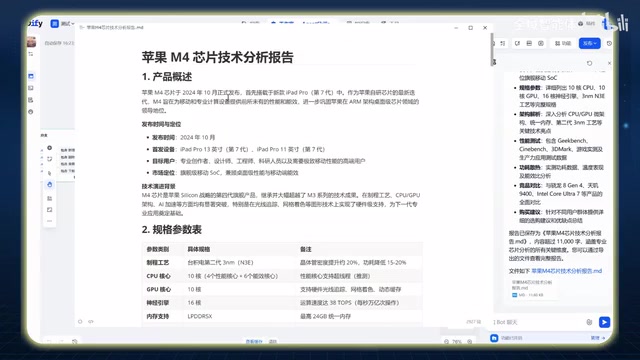
The greatest value of this approach is stylistic consistency: by strictly following the skill pack, no matter how many times you run the analysis or which chip you're analyzing, you get a report that's uniform in style and meets expectations—something traditional one-off prompts simply cannot guarantee.
Understanding Large Language Models: Capabilities and Three Key Limitations
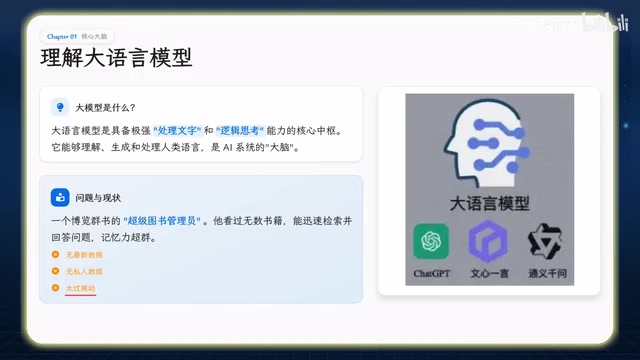
To build effective workflows, you first need to understand the core component you're working with: the large language model (LLM). The underlying mechanism is autoregressive prediction based on the Transformer architecture. Through pre-training on massive amounts of text, the model learns statistical associations between words and concepts, giving it the ability to understand text, reason logically, and generate content. It's essentially a hub for processing language and logic—capable of natural conversation—but it still has three notable limitations:
- Outdated knowledge: Model parameters are frozen once training is complete. The model cannot perceive events after its training data cutoff date, nor can it access real-time data like current market prices.
- No access to private data: It has no knowledge of your workflows, spending habits, or internal company documents, making personalized service difficult.
- Passive by nature: It requires users to initiate every request and cannot autonomously complete tasks in a continuous sequence.
Understanding these three limitations helps developers decide which tasks to delegate to model reasoning and which tasks must rely on external tools to fetch real-time data.
The Evolution of Prompt Engineering
Prompt Engineering emerged in the GPT-3 era (around 2020), when models were smaller and had weaker instruction-following capabilities. Researchers found that carefully crafted, "incantation-style" prompts—such as Chain-of-Thought prompting and Few-shot examples—could significantly boost model performance. This is the fundamental reason prompt engineering became so popular: it compensated for the model's limitations.
As GPT-4, Claude 3, Kimi, and other next-generation models dramatically improved their instruction-following capabilities, elaborate prompting techniques gradually gave way to more natural, descriptive interactions. Today, simply describing your product, core selling points, and target audience clearly—filling in the details to reduce guesswork—is enough to get high-quality output. There's no longer any need to "tame" the model. This shift itself reflects the rapid ascent of large model capabilities.
Bridging the Gaps: Multimodality, Web Search, and RAG
The industry has developed mature solutions for each of the three LLM limitations.
Multimodality: Giving AI Sight and Hearing
The core technical breakthrough in multimodal large language models (Multimodal LLMs) is cross-modal alignment—using contrastive learning methods like CLIP to map information from different modalities (images, audio, video) into a shared semantic space with text. The release of GPT-4V (September 2023) marked the official entry of multimodal capabilities into mainstream commercial use, followed by domestic products like Qwen-VL, Kimi Vision, and Doubao's visual edition.
From a workflow design perspective, the proliferation of multimodal capabilities means the data input layer expands from plain text to unstructured formats like screenshots, screen recordings, and charts—significantly broadening the business scenarios AI automation can handle. You can send a screenshot directly to AI for analysis, submit a video for summarization, or use models like Tongyi Wanxiang to generate images and video. Doubao's video call outfit recommendation feature is a prime example of this in action.
Web Search Solves the Knowledge Cutoff Problem
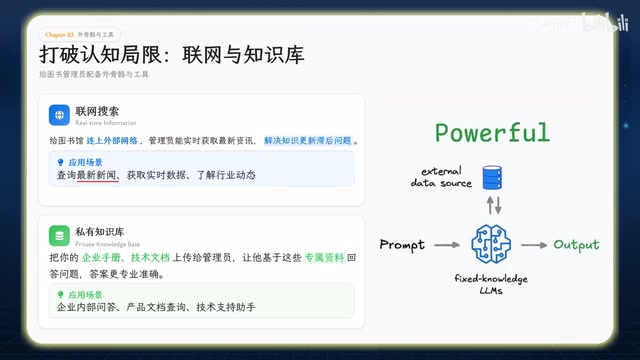
Connecting the model to the external web is the most direct solution to the knowledge cutoff issue. For needs like news and real-time data, web search ensures the AI always has access to the latest information, making its outputs more reliable.
RAG Solves the Private Data Problem
For the "it doesn't know you" problem, the solution is building a private knowledge base—organizing company manuals, technical documents, and other materials into a database. When a user asks a question, the system first retrieves relevant passages from the database and passes them to the LLM along with the question, enabling accurate, personalized answers.
This is precisely the core principle of RAG (Retrieval-Augmented Generation), formally introduced by the Meta AI research team in 2020. Its architecture has two phases: the retrieval phase uses a vector database (such as Chroma, Pinecone, or Milvus) to convert documents into high-dimensional semantic vectors; when a user poses a question, algorithms like cosine similarity retrieve the most relevant text passages. The generation phase injects retrieved results as context into the LLM, guiding it to answer based on private knowledge. Compared to fine-tuning the model directly, RAG's advantages include real-time knowledge base updates, extremely low cost, and improved answer credibility through source citations. This makes it widely applicable in enterprise Q&A, e-commerce customer service, logistics support, and personal assistant scenarios.
Workflow Orchestration: From Traditional Nodes to AI Agents
With these capability gaps filled, you're ready to orchestrate workflows.
The Limitations of Traditional Workflows
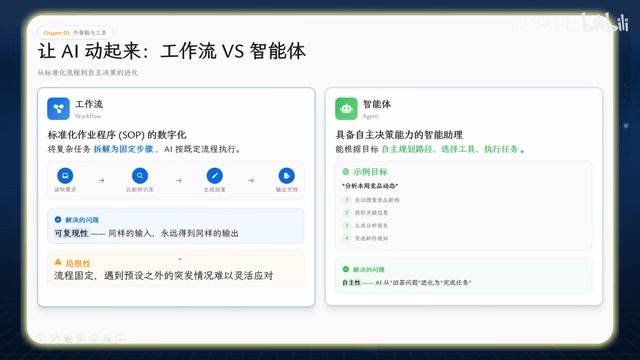
Traditional workflows turn every operation into a node, connected by drag-and-drop and executed sequentially from start to finish. The advantage is stability—identical inputs always produce identical outputs. But the downside is clear: AI is just one component in the workflow, with its autonomous decision-making capability completely untapped.
Introducing Agents for Autonomous Decision-Making
An Agent is an AI with autonomous decision-making capabilities. Modern LLM-based Agents typically follow a "perceive–plan–act" loop: the model first understands user intent, then uses the ReAct (Reasoning + Acting) framework to break complex tasks into sub-steps, and finally drives external APIs, databases, or code executors through Function Calling to complete specific operations.
The fundamental difference between an agent and a traditional workflow is this: a traditional workflow's execution path is fully determined at design time, whereas an Agent can dynamically adjust its subsequent action strategy based on intermediate results. Give it a single sentence like "analyze competitor activity this week," and it can decompose the task on its own: searching for information, extracting key content, generating an analysis report, and even sending you an email notification.
Combining an agent's autonomy with a workflow's stability yields an automation system that is both reliable and intelligent, capable of handling complex scenarios—and this is the core idea behind the approach described in this article.
Practical Implementation: The Scale Agent Plugin in Action
The key to realizing these capabilities is a plugin called Scale Agent. Low-code/no-code development platforms have surged in popularity in recent years alongside the explosion of enterprise digital transformation needs. Gartner predicts that by 2026, low-code application development will account for over 65% of enterprise application development. In the AI workflow orchestration space, open-source and semi-open-source platforms like Flowise, Dify, Coze, and n8n have already formed an emerging ecosystem.
Scale Agent, as a plugin within this ecosystem, is positioned as "fully open-source + locally deployable" and targets enterprise users with high data security requirements—organizations that often cannot upload internal documents to third-party SaaS platforms, making local deployment a non-negotiable hard requirement. Once installed in a low-code platform, it delivers three key advantages:
- Visual orchestration: Drag-and-drop configuration with no coding required, allowing non-technical business users to participate in AI automation initiatives.
- Fully open-source: No licensing fees, security you can verify, and suitable for internal enterprise deployment.
- Reusable skills: Download skill packs shared by others to learn from their experience, or use AI to help generate customized skill packs.
Three Essentials for Building a High-Quality Workflow
In summary, building a reliable AI workflow requires three key components:
- A capable LLM as the brain: Prioritize stronger models to handle complex tasks and deliver accurate responses.
- The Scale Agent plugin: Build workflows quickly using skill packs—no need to draw complex flowcharts.
- Agent-driven autonomous decision-making: Use skill packs to define the boundaries of AI behavior while fully leveraging AI's autonomous intelligence.
Regardless of your development background, this approach enables AI to deliver results you're satisfied with. The essence of workflow orchestration is platform as the container, skills as the standard, intelligence as the driver—combining all three is what builds a truly efficient automation system.
Key Takeaways
Related articles
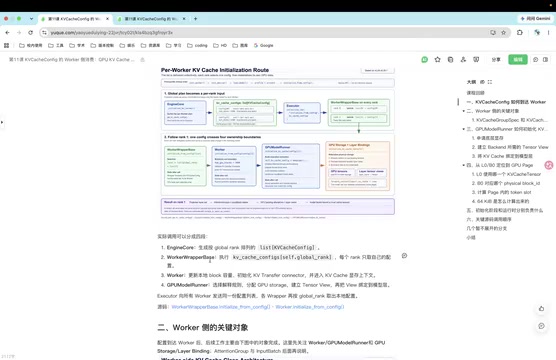
Deep Dive into vLLM Worker-Side GPU KV Cache Initialization
Deep dive into vLLM's Worker-side KV Cache GPU memory allocation, covering the full pipeline from KVCacheConfig generation to physical memory binding via ModelRunner.
Zepto Builds AI Customer Service with MLflow: An Evaluation-Driven Practice Guide
Deep dive into how Zepto built an evaluation-driven AI customer service system using MLflow and Databricks, achieving 60% faster responses and 40% less manual handling. From technical architecture to practical insights.

Iran Captures U.S. Underwater Drone in Strait of Hormuz: A Comprehensive Analysis
Iran announces capture of U.S. Navy underwater drone in Strait of Hormuz. In-depth analysis of the incident, strategic value of UUVs, U.S.-Iran geopolitical competition, and implications for global energy security and military dynamics.