Skill++: Routing-Aware Skill Refinement to Solve Routing Interference in Lifelong Agents

Skill++ mitigates routing interference in lifelong agents without training by rewriting new skill metadata.
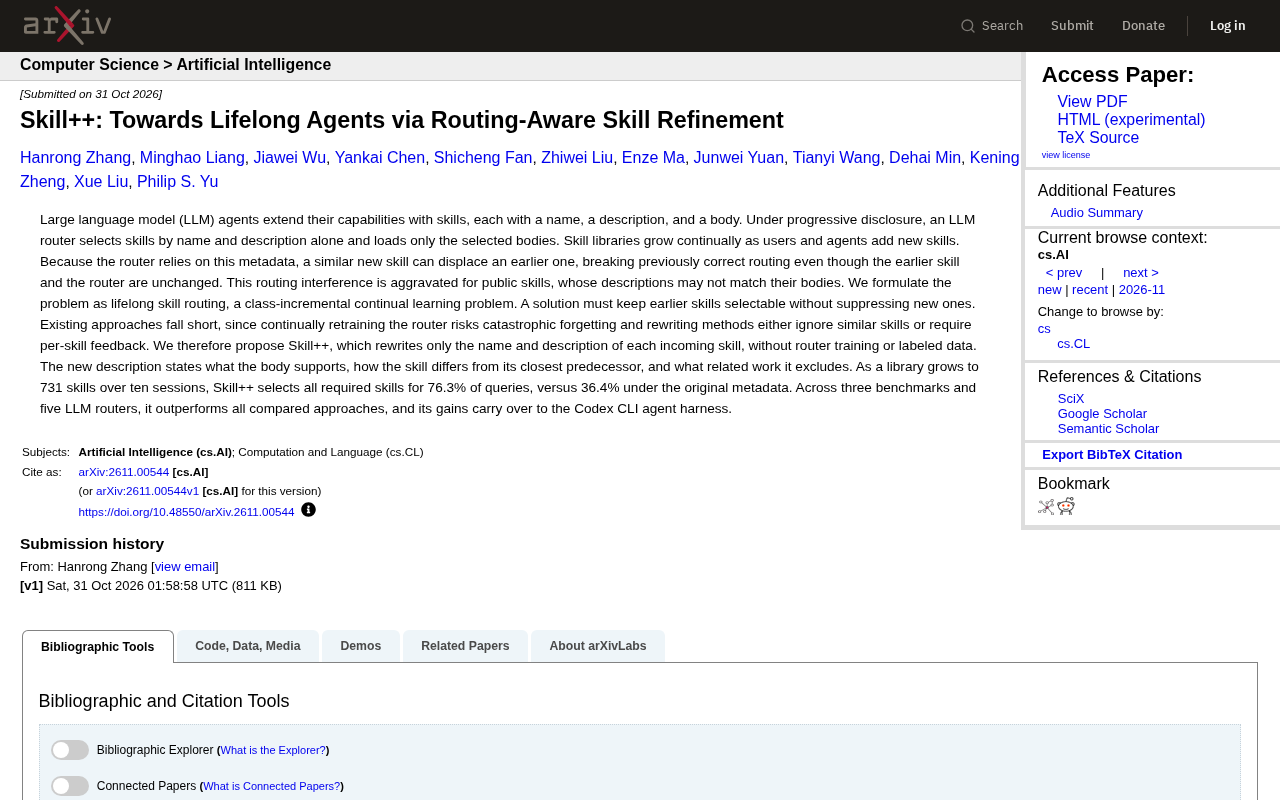
LLM agents expand capabilities through a skill library, and the router selects skills based only on names and descriptions. As the library grows, similar new skills may displace old ones at the metadata level, causing routing interference even when old skills and the router are unchanged. The research formalizes this as lifelong skill routing, a class-incremental continual learning problem. Existing continual router retraining risks catastrophic forgetting, while rewriting methods ignore similarity or need per-skill feedback. Skill++ rewrites only each new skill's name and description, emphasizing what the skill body supports, differences from the closest predecessor, and excluded related work. On a 731-skill library, Skill++ lets 76.3% of queries select all required skills versus 36.4% with original metadata, outperforming baselines across three benchmarks and five routers.
Large language model (LLM) agents expand their capabilities through skills, where each skill consists of a name, a description, and a skill body. Under the progressive disclosure mechanism, the LLM router selects skills based solely on names and descriptions, and only loads the skill body of the selected skill. As users and agents continuously add new skills, the skill library keeps growing. Since the router relies on this metadata, a similar new skill may displace a previous one and break an otherwise correct routing decision—even when neither the prior skill nor the router itself has changed. This routing interference is more severe for public skills, whose descriptions may not match their skill bodies.
The research from "Skill++: Towards Lifelong Agents via Routing-Aware Skill Refinement" formalizes this problem as lifelong skill routing, a class of class-incremental continual learning problems. A solution must keep old skills selectable without suppressing new ones. Existing methods fall short: continually retraining the router can lead to catastrophic forgetting, while rewriting methods either ignore similar skills or require per-skill feedback. To address this, the researchers propose Skill++, which rewrites only the name and description of each incoming skill, without training the router or requiring labeled data. The new description clarifies what the skill body supports, how the skill differs from its closest predecessor, and which related work it excludes.
Routing Interference: The Hidden Trap of Lifelong Learning
The continuous growth of the skill library is a sign of agent evolution, but it also plants hidden risks. Because the router makes decisions based solely on skill names and descriptions, when a new skill is highly similar to an old one at the metadata level, the router may mistakenly assign queries that should route to the old skill to the new one, causing the old skill to "disappear." This interference is not because the old skill is broken or the router has degraded, but because of competition at the metadata level. This is especially true for public skills, whose descriptions are often contributed by the community and may deviate from the actual functionality of the skill body, further amplifying the risk of routing interference.
The researchers model this scenario as a class-incremental continual learning problem: each new skill is equivalent to a new class, and the router must maintain selectability across all classes in an ever-expanding skill space. The core challenge is to make new skills routable without sacrificing old ones.
Class-incremental continual learning is a setting in continual learning where a model learns a sequence of tasks in order, each introducing new classes, and cannot access data from old tasks when learning a new one. Unlike joint training, which allows mixing data from multiple tasks, class-incremental learning requires the model to see only the current task's data at each step while retaining discriminative ability across all learned classes. Evaluation metrics typically include the final model's average accuracy over all classes and the degree of "backward transfer," i.e., how much performance on old classes drops relative to after they were first learned. In the skill routing scenario, each new skill is equivalent to a new class, and the router must maintain selectability across all classes in an expanding skill space; thus routing interference and catastrophic forgetting in class-incremental learning share the same problem structure.
Limitations of Existing Approaches
Faced with routing interference, two lines of thought exist but neither is ideal. One is to continually retrain the router so it adapts to the growing skill library. However, retraining easily triggers catastrophic forgetting—the model loses its ability to recognize old skills while adapting to new ones. The other is to rewrite skill descriptions to enhance distinguishability, but existing rewriting methods either ignore subtle differences between similar skills or rely on per-skill feedback signals, making them hard to scale.
Skill++'s starting point is precisely to bypass these traps: no router training, no reliance on labeled data, and mitigating interference solely by refining the metadata of incoming skills.
Catastrophic forgetting refers to the phenomenon where, when a neural network learns new tasks in sequence, parameter updates overwrite the representations that previous tasks relied on, causing a sharp drop in performance on old tasks. In the context of continually retraining a router, the router adjusts its parameters to adapt to new skills, which may dilute its feature memory of old skill names and descriptions and invalidate previously correct routing decisions. Classic approaches to mitigating catastrophic forgetting include Elastic Weight Consolidation (EWC, which penalizes changes to parameters important for old tasks), experience replay (retaining old data samples for mixed training), and parameter isolation (assigning separate subnetworks to different tasks). However, these methods either require storing training samples from old skills or introduce additional regularization computation, making them difficult to apply directly in agent scenarios where the skill library keeps growing and no labeled feedback is available.
Skill++'s Core Mechanism: Three-Element Description Rewriting
Skill++'s operation is simple: for each skill newly entering the skill library, rewrite its name and description without touching the skill body. The new description must contain three elements:
- What the skill body supports: explicitly describe the skill's actual functional scope to reduce mismatches between description and skill body.
- Difference from the closest predecessor: point out how the skill differs from the most similar old skill in the library, helping the router distinguish the two.
- Which related work it excludes: proactively state which adjacent domains the skill does not cover, preventing the router from misusing it for unrelated queries.
This "routing-aware" rewriting strategy essentially builds a more discriminative metadata fingerprint for new skills, giving them a clear boundary against old skills in the router's eyes. Because no training is required, Skill++ can be lightweight integrated into existing agent frameworks.
Metadata in the context of skill routing specifically refers to the two fields "name" and "description" of a skill, which are distinguished from the "skill body" containing the concrete implementation or instructions. The router reads only metadata when making selections; the skill body is loaded only after selection, and this progressive disclosure design reduces context overhead. The quality of metadata therefore directly determines the signal-to-noise ratio of routing: if descriptions accurately reflect skill body functionality and are distinguishable from other skills, the router is more likely to make correct choices; conversely, vague or overlapping descriptions cause competition among similar skills. Skill++ refines only metadata without modifying skill bodies, precisely exploiting the structural feature that metadata is the sole input to routing, thereby influencing routing decisions with minimal changes.
Experimental Performance: A Major Boost in Routing Success Rate
The researchers evaluated Skill++ on a skill library that grew to 731 skills across ten sessions. Results show that Skill++ selects all required skills for 76.3% of queries, compared with only 36.4% under the original metadata—more than a twofold improvement. Across three benchmarks and five LLM routers, Skill++ outperforms all comparison methods, and its gains transfer to the Codex CLI agent framework.
Interestingly, this improvement is achieved without training the router or using labeled data, highlighting the leverage effect of metadata refinement in continual learning scenarios.
Implications for Lifelong Agents
Skill++ reveals an important direction: lifelong learning for agents is not only about updating model parameters but also about metadata governance of the skill library. As the number of skills grows, routing interference will become a bottleneck constraining agent reliability. Through routing-aware skill refinement, the selectability of the skill library can be maintained without touching the model's internals, offering a new approach for building scalable, sustainably evolving agents. In the future, how to automatically generate high-quality three-element descriptions and how to handle dynamic consistency between skill bodies and descriptions remain questions worth exploring.
One-line Summary
Skill++ mitigates routing interference in lifelong agents without training by rewriting new skill metadata.
Paragraph Summary
LLM agents expand capabilities through a skill library, and the router selects skills based solely on skill names and descriptions. As the library grows, similar new skills may displace old ones at the metadata level, causing "routing interference" even when neither the old skills nor the router has changed. The research formalizes this as lifelong skill routing, a class-incremental continual learning problem. Existing continual router retraining easily causes catastrophic forgetting, while rewriting methods either ignore similarity or rely on per-skill feedback. Skill++ rewrites only the name and description of each new skill, emphasizing what the skill body supports, how it differs from its closest predecessor, and which related work it excludes. On a 731-skill library, Skill++ enables 76.3% of queries to select all required skills versus only 36.4% with original metadata, and outperforms comparison methods across three benchmarks and five routers.
Related articles
 Tech Frontiers
How Do You Stop AI Agent Emails From Sounding Like AI? One Developer's Solution
AI agent emails always sound like AI? A developer shares reright: a rewrite step that validates numbers, names, and links, preventing humanizers from tampering with key info. Test data and integration details inside.
 Tech Frontiers
Starlink Mobile: SpaceX's Carrier Ambitions and the 5G Deployment Challenge
SpaceX plans to make Starlink Mobile a mainstream carrier, deploying thousands of direct-to-cell satellites and building a terrestrial 5G network to challenge AT&T, Verizon, and T-Mobile. This article analyzes its dual-track strategy, 5G deployment challenges, and the competitive landscape.
 Tech Frontiers
OpenAI Raises Another $11 Billion, Valuation Hits $1.25 Trillion
OpenAI has raised an additional $11 billion in a new funding round at a valuation of $1.25 trillion. The deal is not yet closed and is expected to be completed in the coming weeks, further consolidating its leading position in AI.