Skillbox: A Unified Skill Library for AI Agents, Synced Across All Coding Agents

Skillbox syncs AI skills to multiple coding agents via a unified library, with diff review and injection scanning.
Skillbox is a developer tool launched on Product Hunt that addresses skill configuration fragmentation when using multiple AI coding agents. It provides a centralized skill library that syncs skills to mainstream agents like Claude Code, Cursor, and Codex. Positioned as a skill layer above agents, it turns skills into versionable, synchronizable assets rather than private configurations locked in a single tool. Beyond syncing, it supports following GitHub sources for continuous updates, reviewing skill version diffs, and scanning each version for prompt injection risks, adding a security gate at the distribution stage. A built-in Trim feature compresses verbose command output to save context window and extend agent sessions. The article finds the approach valuable but notes that sync reliability, conflict handling, and scanning accuracy still need empirical verification.
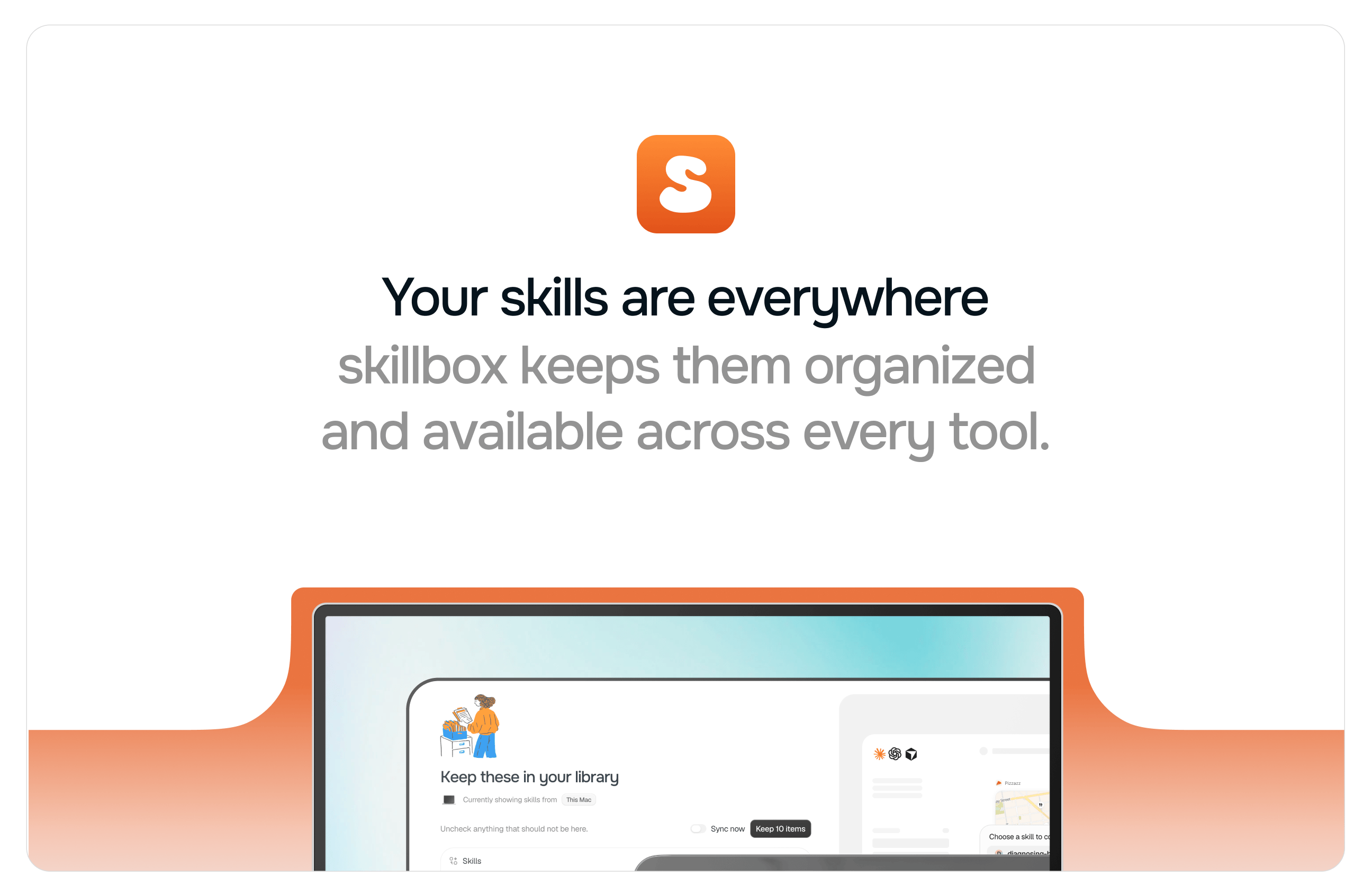
AI coding assistants are evolving from single-point tools into an ecosystem of multi-agent collaboration, but a practical problem has emerged: skills you've carefully tuned in Claude Code have to be reconfigured when you switch to Cursor or Codex. Skillbox, launching on Product Hunt, aims to solve this fragmentation pain point—using a centralized skill library to sync AI skills across all major coding agents.
The Skill Fragmentation Dilemma in the Multi-Agent Era
The current norm for developers using AI coding agents is "multi-line parallel": some use Claude Code for refactoring, Cursor for daily completions, and Codex for scripting tasks. Each agent has its own way of defining and storing skills, which means the same set of prompt engineering or workflow logic needs to be repeatedly ported between different tools.
Skillbox's approach is direct: extract these skills, manage them in a unified library, and distribute them to each agent through a synchronization mechanism. From its product positioning, it doesn't try to replace any agent but rather serves as a "skill layer" above agents. This layered approach is similar to configuration management in the container orchestration space—skills become versionable, synchronizable assets rather than private configurations locked inside a particular tool.
AI coding agents refer to AI systems capable of autonomously executing multi-step coding tasks. Unlike traditional code completion tools, they can read files, run commands, modify codebases, and iteratively correct themselves. Claude Code, Cursor, and Codex come from Anthropic, Anysphere, and OpenAI respectively, each adopting different skill/rule definition formats: Claude Code uses CLAUDE.md and slash commands, Cursor uses .cursorrules or a rules directory, and Codex relies on conventions like AGENTS.md. These format differences stem from each company's distinct design philosophy for controlling agent behavior, and they also mean that skill assets are naturally platform-locked—cross-tool reuse requires format conversion and semantic alignment.
Follow GitHub Sources, Review Diffs, Scan for Injection Risks
Beyond skill management, Skillbox offers three practically meaningful capabilities.
Following GitHub sources means the skill library can continuously sync updates from code repositories. If your team has a shared skill set, or you follow a community-maintained skill repository, Skillbox can stay in sync like a subscription, saving the hassle of manual pulls.
Reviewing diffs brings the code review habit from software engineering into skill management. Skill files are essentially combinations of prompts and configurations, and modifying a skill can significantly change agent behavior. Diff review makes these changes visible and traceable.
Scanning for prompt injection is the most security-oriented feature. Skill files flow through the sync pipeline, and if an upstream repository is maliciously tampered with, injected instructions could be directly executed by agents. Skillbox scans every version for injection, essentially adding a security gate at the skill distribution stage. This design echoes the current hot topic of AI supply chain security—when skills and prompts become reusable software assets, they also need protection mechanisms similar to vulnerability scanning for dependency packages.
Prompt injection is a class of attacks against large language models: attackers disguise malicious instructions as data content embedded in text the model reads, inducing the model to deviate from its intended task, leak information, or perform unexpected operations. In the skill library context, the risk is particularly acute—skill files are themselves sets of instructions that agents load and follow, and once an upstream GitHub repository is tampered with or poisoned, the sync mechanism will automatically distribute malicious instructions to all downstream agents. Scanning for prompt injection typically combines pattern matching, semantic detection of instruction-data boundaries, and model-assisted judgment, but balancing false positives and false negatives remains an open problem, and there is currently no universally recognized complete protection solution.
Trim: Compressing Redundant Output to Extend Session Duration
Beyond the main skill library thread, Skillbox also includes a feature called Trim. The original description is "shortens noisy command output so sessions last longer."
The motivation behind this feature is easy to understand: the context window of AI coding agents is a scarce resource, and verbose command-line logs and test outputs quickly consume token budgets, causing sessions to hit their limits prematurely. Trim compresses this output, leaving context for genuinely important reasoning content. For long-running agent tasks, this kind of context optimization often has a more direct impact on actual experience than improvements in model capability.
The context window refers to the maximum number of tokens a model can process in a single session, including system prompts, conversation history, tool call results, and model output. It is a hard budget for a session; once exceeded, earlier content is truncated or compressed, causing the agent to forget previous decisions. Command output (such as test logs, build errors, dependency installation information) often contains large amounts of repetitive and low-information-density text, making it one of the main sources of context consumption. Common context optimization methods include output summarization, deduplication filtering, structured truncation, and key-line extraction; Trim belongs to the approach of pre-compressing tool output before it enters the context, which is complementary to, rather than a replacement for, model-side long-context capabilities.
Who Should Use It, and What to Watch For
Looking at Product Hunt data, Skillbox received 79 votes and 4 comments, ranking 9th for the day—a steady performance among niche developer tools. Its target users are quite clear: developers or teams using multiple AI coding agents simultaneously who have already accumulated a certain amount of skill assets.
What needs attention is the actual reliability of the sync mechanism—whether syncing between the skill library and each agent is bidirectional, how conflicts are handled, and whether version rollback is smooth. These determine whether it can become a daily dependency. The coverage and false-positive rate of prompt injection scanning also remain to be empirically verified. Additionally, the value of skill management tools depends heavily on ecosystem support; how the skill format differences among Claude Code, Cursor, and Codex are abstracted and unified is a long-term technical challenge for the product.
For developers currently troubled by the maintenance costs of multi-agent skills, Skillbox offers a solution path worth watching. It elevates skills from tool appendages to manageable first-class assets—this idea itself may be more valuable than the specific features.
Related articles

RePlan-VLA: Progress-Aware Replanning Breakthrough for Long-Horizon Robotic Manipulation
The RePlan-VLA framework converts VLA models' short-horizon capabilities into reliable long-horizon execution through progress-aware adaptive replanning, improving success rates by 21.9% and 10.4% on RoboCasa365 and CALVIN, and validating real-world deployment on a Franka Research 3 robot.

Geometric Bridge Flow Matching: A New Breakthrough in Blind Rigid Motion Correction
Geometric bridge flow matching enables blind rigid motion correction in head CBCT, achieving 37.1 dB PSNR and 0.27 mm RPE on simulated data in ~9.1 minutes, outperforming existing methods.

Google Releases Gemini 4 Hydrogen: 2.5x Faster Without Sacrificing Intelligence
Google releases the lightweight Gemini 4 Hydrogen: 2.5x faster task completion, AA Intelligence Index of 54 beating its flagship sibling, 7.3s single-step on Agent Arena faster than Claude and GPT rivals, four thinking levels with pay-as-you-need pricing, now available across AI Studio and more.