Skriptr: A Deep Dive into the AI Learning Workspace That Won't Do Your Homework

Skriptr is a student AI workspace that guides thinking with traceable sources and Socratic questions instead of doing homework for you.
Skriptr is an AI workspace for students that covers research, writing, and learning. Its standout features include RAG-powered answers with exact page citations, Socratic counter-questioning to promote deep thinking, and a firm commitment that "the thinking stays yours." Unlike tools that replace learning, Skriptr augments it — positioning itself as a compliant, educator-friendly alternative in the growing AI education space.
What Is Skriptr: An AI Collaborative Workspace Built for Students
In an era overflowing with AI writing tools, products that "do your homework for you" are nothing new. Yet Skriptr, which recently launched on Product Hunt, proposes a contrarian philosophy — "It works with you, not for you." Positioned as an "AI workspace for students," the product garnered 97 upvotes and 10 comments after launch, landing at #10 on the daily leaderboard across the Writing, Education, and Online Learning categories.
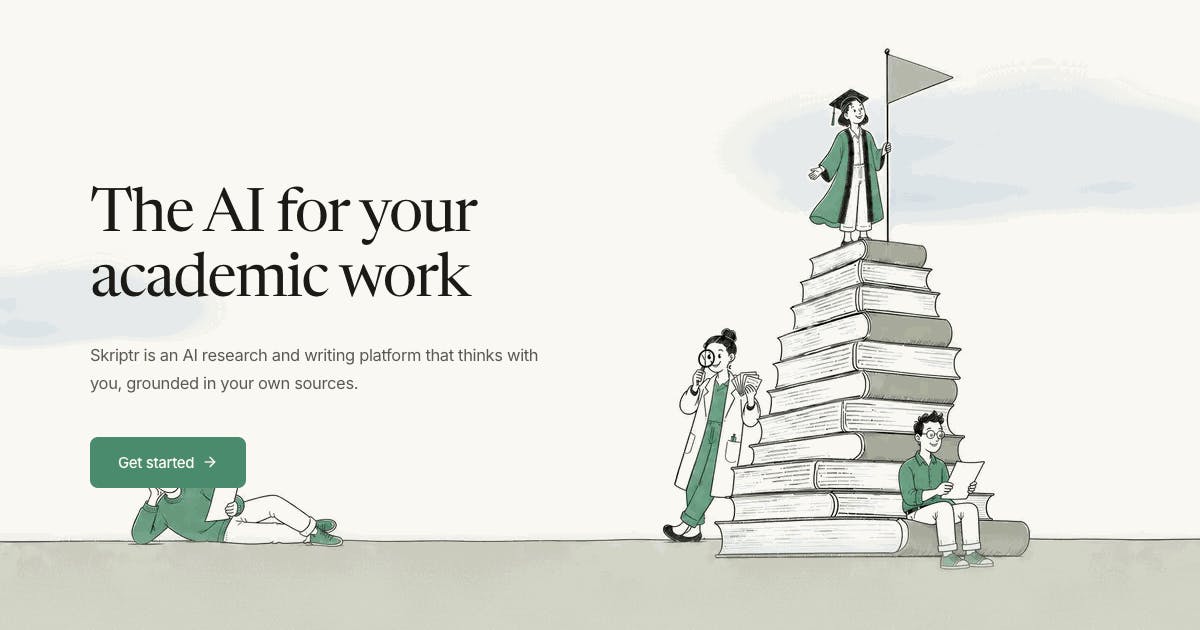
Skriptr's core promise is to cover three major scenarios across the entire student learning workflow: research, writing, and learning. Rather than delivering isolated answers, it attempts to reconstruct how students interact with their materials and knowledge.
Skriptr's Three Core Features: Traceable Sources, Socratic Questions, and Preserved Ownership of Thought
Feature One: Reads Your Sources and Precisely Annotates Where Answers Come From
One of Skriptr's most noteworthy features is that it "reads your sources" and shows the exact page behind every answer.
This design directly addresses the biggest pain point of current generative AI — "hallucination." AI hallucination refers to large language models outputting factually incorrect, unverifiable, or entirely fabricated information with high confidence. This problem is especially dangerous in academic contexts — in 2023, an American lawyer was sanctioned by a court for citing fake case law fabricated by ChatGPT, causing a major uproar. The fundamental cause of hallucination is that language models predict the next token based on statistical probability rather than retrieving facts from structured knowledge bases. The model "doesn't know what it doesn't know" but still fluently produces seemingly reasonable content.
By anchoring responses to specific pages of user-uploaded documents, Skriptr makes every statement verifiable and traceable. The technical foundation for this design is Retrieval-Augmented Generation (RAG) architecture — before the model generates a response, it first retrieves relevant passages from user-provided documents as context, ensuring the AI's answers are strictly grounded in existing materials rather than conjured from thin air. For students writing papers or conducting literature reviews, this not only enhances credibility but also dramatically reduces the time spent cross-referencing sources.
Feature Two: Socratic Counter-Questions That Guide Deep Thinking
Another counterintuitive design choice: Skriptr asks questions back.
Most AI assistants operate in a one-way "you ask, it answers" mode, where users often stop thinking once they receive a response. Skriptr actively poses questions to guide students toward deeper reflection and exploration. This approach originates from the teaching practice of the ancient Greek philosopher Socrates — the core principle of the Socratic Method is that the teacher doesn't directly transmit knowledge but instead guides students to independently discover answers and logical gaps through continuous questioning. In modern educational psychology, this method is classified as a form of "constructivist learning," and extensive research shows it effectively promotes metacognition — students' awareness and regulation of their own thinking processes. When students are asked "Why do you think that?" or "What's the counterargument to this point?" they are forced to examine their own reasoning chains rather than passively accepting pre-made conclusions.
The technical challenge of embedding the Socratic method into an AI product is that the system needs to understand the student's current cognitive state and knowledge gaps to ask targeted questions rather than generic ones. This requires considerable sophistication in the underlying prompt engineering and context management. It transforms AI from an "answer vending machine" into a "learning sparring partner."
Feature Three: The Thinking Stays Yours
A phrase Skriptr repeatedly emphasizes — "The thinking stays yours."
This sentence crystallizes the entire product philosophy. At a time when AI ghostwriting has sparked widespread academic integrity debates, Skriptr proactively draws a boundary: it provides research assistance, material organization, and inspiration — not a substitute for students' thinking and creation.
The backdrop to this positioning is that global education systems face an unprecedented AI integrity crisis. Since ChatGPT's release, numerous top universities have urgently issued AI usage policies ranging from complete bans to conditional permissions. While traditional plagiarism detection tools like Turnitin have introduced AI-generated content detection features, their high false-positive rates — particularly problematic for non-native English speakers — have sparked fairness controversies. Against this backdrop, edtech products face a dilemma: pursuing user growth often means providing stronger "ghostwriting" capabilities, but this invites resistance or outright bans from educational institutions.
Skriptr's positioning as a "responsible AI education tool" both addresses educators' concerns about AI cheating and attempts to find a balance between tool efficiency and the essence of learning. It's effectively competing for a more sustainable market niche — becoming a "compliant tool" that teachers are willing to recommend and schools are willing to procure, rather than being seen as a "cheating device" that needs to be guarded against.
Skriptr's Product Philosophy: Why This Direction Deserves Attention
The Paradigm Shift from "Replacing Learning" to "Augmenting Learning"
Skriptr represents an important philosophical pivot in AI education products. Early AI writing tools pursued "one-click generation of complete assignments," essentially replacing the student's learning process. The "augment rather than replace" model that Skriptr advocates aligns more closely with education's fundamental purpose — developing capabilities, not producing outputs.
This philosophy dovetails with the "Zone of Proximal Development" (ZPD) theory in education. Proposed by Soviet psychologist Lev Vygotsky, the theory holds that the most effective learning occurs in the zone where students "cannot accomplish something alone but can achieve it with assistance." Skriptr's product design — providing clues rather than answers, posing questions rather than ghostwriting — positions AI precisely in this "facilitator" role, helping students push one step beyond the boundaries of their own abilities.
For educators, a tool that encourages student thinking, offers traceable sources, and can withstand scrutiny around academic integrity is clearly more likely to be embraced in classrooms and teaching systems than a "cheating device."
Traceable AI Is Becoming an Industry Standard
Here's a notable detail: the ability to "precisely cite sources" is shifting from a nice-to-have to a must-have for AI applications. Whether it's Perplexity's citation-based search or various enterprise-grade RAG products, the emphasis on answer verifiability is universal.
RAG technology has become one of the most important paradigms in the AI application layer since 2023 because it elegantly solves two fundamental limitations of large language models: the knowledge cutoff date problem and the hallucination problem. Its basic principle is to retrieve relevant document fragments from an external knowledge base before the model generates a response, injecting them as context into the prompt so the model's answers have a factual basis. Perplexity AI is the benchmark for this paradigm in consumer-grade search — it attaches web source links to every statement, allowing users to verify with one click. In enterprise scenarios, various internal knowledge base Q&A products also widely adopt RAG architecture to ensure answer accuracy and auditability.
Skriptr applies RAG to students' private uploaded document libraries, essentially bringing this enterprise-grade capability down to the personal academic level, making students' PDFs, papers, and textbooks the sole factual source for AI responses. This approach captures the growing demand among young users for information credibility — Gen Z, having grown up in an internet environment rife with misinformation, may have a sharper awareness of "where does this information come from" than previous generations.
Challenges and Open Questions Facing Skriptr
Despite its excellent philosophy, Skriptr still faces several real-world tests:
-
Depth of document processing capability: Whether it can accurately parse PDFs, scanned documents, and multilingual literature will directly determine how well it delivers on its "exact page number" promise. Academic document formats are highly varied — double-column journal papers, STEM literature filled with mathematical formulas, older materials with inconsistent scan quality — each poses different technical requirements for the document parsing pipeline. If page positioning frequently fails, user trust will erode rapidly.
-
Intelligence of the questioning feature: If the counter-questions are too mechanical or superficial, they'll disrupt the learning flow rather than enhance it. Quality is highly dependent on the underlying model capabilities and prompt engineering. Good Socratic questioning requires understanding conversational context, assessing the student's current cognitive level, and finding appropriate points of cognitive conflict — far harder to achieve than simple Q&A pairs.
-
Competitive market pressure: Skriptr's space already has formidable competitors. Notion AI offers general-purpose writing assistance but lacks academic specificity; Perplexity excels at cited information retrieval but doesn't focus on learning workflows; Elicit and Semantic Scholar specialize in paper discovery but don't cover writing; Quillbot and Grammarly focus on language polishing but don't involve research assistance. Skriptr attempts to integrate research, writing, and learning into a single workspace — this "full-workflow coverage" strategy is both a differentiating advantage and a challenge, as each component needs to meet the baseline of specialized tools to satisfy users. Surrounded by Notion AI, Perplexity, and various specialized academic tools, Skriptr needs to prove the irreplaceability of its "student-dedicated workspace."
Conclusion: Skriptr Points Toward the Maturation of AI Education Tools
Skriptr's emergence signals a maturation of AI education tools. Rather than catering to the temptation of "help me quickly submit my assignment," it chose a harder but more valuable path: using traceable rigor and Socratic guidance to safeguard students' own thinking processes.
In an era where AI capabilities grow ever stronger and boundaries ever blurrier, the simple slogan "The thinking stays yours" may be precisely the core principle that edtech products should uphold. Whether this product can gain a firm foothold in an intensely competitive market remains to be seen, but the direction it points toward — making technology serve human growth rather than replace human capability — undoubtedly deserves deep reflection across the entire industry.
Related articles

Chain of Thought Isn't Just for AI: How Humans Can Use CoT to Improve Thinking Quality
Chain of Thought isn't just a prompt trick for large models. Starting from a Hacker News discussion, this article analyzes why CoT works for human thinking too, breaks down actionable ways to transfer it, and highlights the key differences between human CoT and machine CoT.
Cloudflare Teams Up with OpenAI: Closi…
Cloudflare Teams Up with OpenAI: Closing the Loop from Vulnerability Discovery to Defense with AI
Cloudflare uses OpenAI Daybreak to investigate security vulnerabilities and generate reviewable remediation plans, while developers use Codex to boost coding efficiency and quality.

Orca Multi-Agent Orchestration in Practice: A Guide to Parallel Collaboration with Claude and Codex
Orca is Stable AI's free open-source agent workbench supporting 34 agents like Claude Code and Codex in parallel. Learn its Git worktree isolation, multi-model orchestration, and mobile management.