SkyPilot: Unified Scheduling for Slurm, K8s, and Cloud GPU Workloads

SkyPilot unifies Slurm, K8s, and cloud GPU scheduling through one YAML config with automatic failover.
SkyPilot is an open-source framework that solves compute fragmentation for ML teams by providing a unified scheduling abstraction across Slurm clusters, Kubernetes, and cloud GPUs. Users write a single YAML configuration, and SkyPilot automatically finds available capacity across all connected backends, dispatches tasks, and handles failover when nodes or instances fail — significantly improving GPU utilization and training job completion rates.
The Compute Fragmentation Problem for ML Teams
As machine learning workloads continue to grow in scale, more and more teams face the same awkward situation: compute resources scattered across multiple disconnected systems. Some teams have inherited several Slurm clusters from the high-performance computing (HPC) side, others run one or two Kubernetes (K8s) clusters, and some rent cloud GPUs on an ad-hoc basis as overflow capacity when resources run tight.
High-Performance Computing and Slurm Clusters: High-performance computing (HPC) refers to the field of using supercomputers and parallel processing techniques to solve complex computational problems. Slurm (Simple Linux Utility for Resource Management) is one of the most popular open-source cluster management and job scheduling systems in the HPC space, developed by Lawrence Livermore National Laboratory. It handles resource allocation, job queue scheduling, and task execution monitoring within compute clusters. Many research institutions and enterprises have inherited Slurm-based infrastructure from traditional HPC environments. These systems are typically optimized for batch processing and long-running scientific computation tasks, and differ significantly from modern cloud-native architectures.
Kubernetes Container Orchestration Platform: Kubernetes (commonly abbreviated K8s, since there are 8 letters between K and s) is an open-source container orchestration platform originally created by Google that has become the de facto standard for cloud-native application deployment. It provides automated container deployment, scaling, load balancing, and failure recovery capabilities. Unlike Slurm, which targets traditional HPC workloads, K8s was initially designed for microservices architectures, but has gradually enhanced its support for ML workloads in recent years through projects like Kubeflow and Volcano. Many ML teams choose K8s because it integrates well with modern DevOps toolchains and supports containerized applications and cloud-native deployment patterns — but this also contributes to a technology stack split with traditional HPC systems.
Cloud GPUs and Resource Elasticity: Cloud GPUs refer to on-demand GPU compute instances offered by cloud providers like AWS, Azure, and GCP, typically based on NVIDIA A100, H100, or AMD MI series accelerators. These resources can be rented by the hour, providing elastic scaling capabilities that are particularly suited for handling burst computing demands. Spot instances (AWS terminology; Azure calls them Spot VMs, GCP calls them Preemptible VMs) are surplus capacity offered by cloud providers at steep discounts (typically 60-90% off), but they can be reclaimed at any time. ML teams frequently use Spot instances to reduce costs but must handle the possibility of task interruption. The on-demand nature of cloud GPUs complements the fixed capacity of on-premises clusters, but also introduces new challenges around multi-cloud management, cost control, and data transfer.
The problems caused by this fragmentation are obvious: each system has its own scheduling logic, submission methods, and configuration formats. When researchers want to run a training job, they often have to manually check which cluster has available resources, then write different scripts for different backends. The result is that precious GPU time sits idle while engineers get trapped in the tedious cycle of "find a machine, modify the config, resubmit."
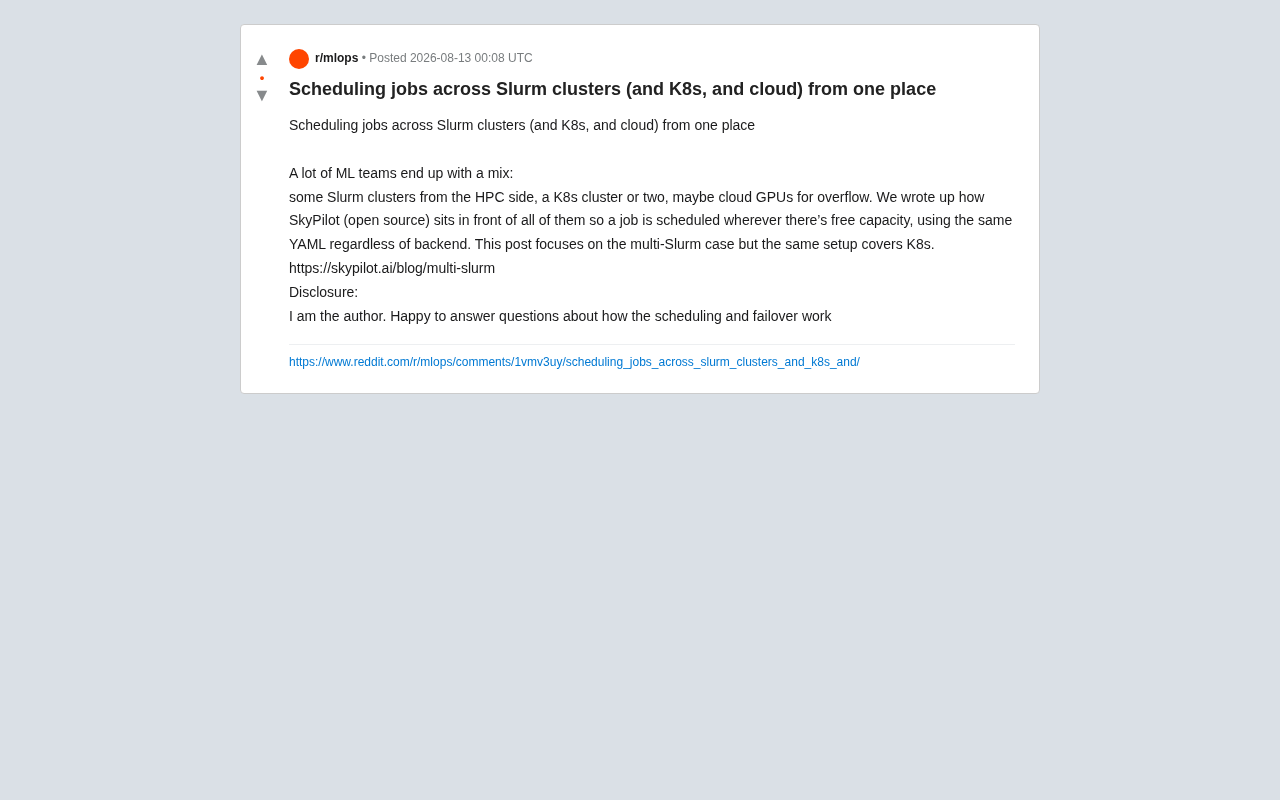
To address this pain point, the creators of the open-source project SkyPilot recently shared a solution on Reddit. The core idea is: place a unified scheduling abstraction layer in front of Slurm, K8s, and cloud GPUs, routing everything through a single entry point.
Architectural Significance of a Scheduling Abstraction Layer: A scheduling abstraction layer is a unified interface built on top of multiple heterogeneous compute backends that hides the complexity of the underlying infrastructure and provides a consistent API and user experience. This architectural pattern is very common in distributed systems, similar to how an operating system shields applications from hardware differences. For ML workloads, the core value of a scheduling abstraction layer lies in achieving the goal of "write once, run anywhere." It needs to solve several key problems: resource discovery and selection (finding available capacity), configuration translation (converting unified descriptions into backend-specific formats), state synchronization (tracking task status across backends), and failure handling (detecting failures and retrying or migrating). This abstraction not only simplifies the user experience but also gives organizations the flexibility to avoid vendor lock-in.
How SkyPilot Unifies Multi-Backend Scheduling
One YAML Config Across All Compute Backends
SkyPilot's key design principle is this: regardless of whether the underlying infrastructure is a Slurm cluster, a K8s cluster, or cloud instances, users only need to write a single YAML configuration to describe their task. This YAML defines the resources required by the task (such as GPU count, memory, and dependency environments) and the execution commands, without any concern about which backend it will ultimately run on.
YAML Configuration File Format: YAML (YAML Ain't Markup Language) is a human-readable data serialization format widely used in configuration files and cloud-native tools. It uses indentation to represent hierarchical structure and is more concise and readable than JSON. In the cloud computing and container orchestration space, YAML has become the standard format for declarative configuration — all Kubernetes resource definitions, Docker Compose files, Ansible playbooks, and more use YAML. SkyPilot chose YAML as its unified task description format because it can be easily written and understood by humans while being accurately parsed by programs, and the ML community is already very familiar with this format. A single YAML configuration can declaratively describe all necessary information about a task, including resource requirements, runtime environment, and execution commands.
The authors emphasized in their post that this particular share focuses on the multi-Slurm cluster scenario, but the same mechanism also covers K8s. In other words, SkyPilot acts as a "scheduling frontend" that sits in front of all compute systems, receives task descriptions in a unified format, and dispatches tasks to wherever free capacity exists based on actual conditions.
Automatically Finding Available GPU Capacity
For ML teams, the most valuable capability is automatic scheduling to backends with available resources. When a user submits a task, SkyPilot searches for available free capacity across all connected clusters and cloud resources, and schedules the task there — without requiring anyone to manually check the load status of each cluster.
This means that when one Slurm cluster has a long queue, tasks can automatically flow to another idle Slurm cluster, or overflow to K8s or even cloud GPUs. For research teams that frequently face resource contention, this "throw the task in and let the system figure out where to run it" experience can significantly reduce operational overhead and coordination costs.
The Core Value of Scheduling and Failover
From Multi-Slurm Clusters to Hybrid Compute Environments
You might not have noticed, but the authors deliberately distinguished two levels: first, multi-Slurm horizontal scaling — aggregating multiple HPC-side Slurm clusters under unified scheduling; and second, cross-heterogeneous-backend hybrid scheduling — bringing Slurm, K8s, and cloud resources into the same system.
The value of this layered approach lies in incremental adoption. Teams can start by unifying the management of their existing Slurm clusters. Once they're comfortable with the workflow, they can naturally integrate K8s and cloud GPUs as well, without modifying any task configurations they've already written.
Failover Ensures Training Job Stability
The authors specifically mentioned in their post that they were happy to answer questions about how scheduling and failover work, which suggests that SkyPilot is not merely passively dispatching tasks — it also has the ability to retry or migrate tasks when they or their nodes fail.
Failover Mechanism in Detail: Failover is a critical reliability mechanism in distributed systems, referring to the ability to automatically switch to backup resources and continue execution when primary resources or services fail. In ML training scenarios, failures can come from multiple levels: hardware failures (GPU faults, node crashes), network issues, cloud instance preemption, or resource quota exhaustion. Effective failover requires three elements: fault detection (promptly discovering task anomalies), state preservation (saving training progress through checkpoint mechanisms), and intelligent rescheduling (selecting new available resources and resuming from the breakpoint). For long-running training tasks, the absence of failover means that a single point of failure could waste hours or even days of computation. SkyPilot's failover capability allows it to automatically migrate failed tasks to other available clusters or cloud resources, significantly improving the completion rate of training jobs.
For ML training tasks that routinely run for hours or even days, failover is an extremely important feature. If a cluster experiences a failure or preemption (especially with cloud Spot instances), the system can automatically migrate the task to other available resources to continue execution. This directly impacts training job completion rates and overall compute utilization efficiency.
Practical Significance as an Open-Source Project
SkyPilot is an open-source project, which is particularly appealing to teams that want to maintain control over their own infrastructure. It doesn't lock users into any specific cloud vendor or scheduling system; instead, it serves as a neutral scheduling layer that lets teams maintain flexibility in mixed, heterogeneous compute environments.
From an industry trend perspective, ML teams' compute layouts are becoming increasingly "multi-cloud + multi-cluster" hybrid. On one hand, legacy Slurm clusters from HPC environments are still in active use; on the other, K8s has become the de facto standard for containerized workloads; and cloud GPUs provide elastic overflow capacity. A tool that can tie all three together under a single unified abstraction fits squarely with today's real-world needs.
Multi-Cloud and Hybrid Cloud Architecture Trends: Multi-cloud refers to an organization's strategy of using multiple cloud providers simultaneously, while hybrid cloud refers to the combination of on-premises infrastructure with public cloud. In the ML space, this trend is driven by several factors: first, avoiding vendor lock-in and maintaining negotiating leverage; second, leveraging specific advantages of different cloud providers (such as the availability or pricing of certain GPU types); third, meeting data sovereignty and compliance requirements; and finally, coping with capacity limitations of any single cloud provider. However, multi-cloud architecture also introduces significant complexity: each cloud platform has different APIs, pricing models, regional availability, and service characteristics. A unified scheduling layer is designed to reduce this complexity while preserving multi-cloud flexibility. For ML teams, hybrid cloud architecture also means balancing the fixed costs of on-premises clusters against the variable costs of cloud resources.
It should be noted that the content of this article is primarily based on SkyPilot's creators sharing their own work on Reddit (they explicitly disclosed their identity), making it a single-source piece of information. The specific implementation details of scheduling and failover described here should be further verified by consulting the official blog and conducting actual testing. Readers interested in learning more can refer to the complete documentation on multi-Slurm scenarios in the official blog.
Summary
For ML teams struggling with compute fragmentation, SkyPilot offers a clear path to consolidation: describe tasks with a unified YAML, and let the system automatically find available capacity across Slurm, K8s, and cloud resources while handling failover. If your team is simultaneously maintaining multiple scheduling systems and struggling with cross-cluster job submission, this kind of unified scheduling layer is worth evaluating.
Related articles

Cross-App Access for AI Agents: Three Identity Vendors Converge on the Same Architecture Pattern in 8 Days
Okta, Auth0, and Descope all shipped Cross App Access within 8 days. This article breaks down the two-layer access pattern behind AI Agent identity management.

Dense Models Too Slow to Run Locally? How MoE Architecture Breaks Through the Performance Bottleneck
Dense models are slow on local hardware due to memory bandwidth limits. Learn how MoE sparse activation architecture dramatically boosts local inference speed and the future of local AI deployment.

Storm Summoner: A MIDI Controller Built Specifically for Guitar Effects Pedals
A deep dive into the Storm Summoner open-source MIDI controller for guitar effects pedals—covering design philosophy, technical architecture, and how it compares to commercial solutions.