SLICE: Sequential Likelihood-Free Inference via Conformal E-Values

SLICE builds anytime-valid confidence sequences for intractable-likelihood models via conformal e-values and test martingales.
Many scientific models can generate simulated data but lack a computable likelihood function, making traditional frequentist inference tools hard to apply. SLICE (Sequential Likelihood-Free Inference via Conformal E-Values) combines conformal inference with e-value theory to construct statistically rigorous, continuously-monitorable confidence sequences for such models. Its core mechanism conformally transforms simulated data into conditional e-values, multiplies them into a test martingale, and inverts over parameter space to obtain confidence sequences — with validity independent of score quality. The oracle likelihood ratio score is theoretically optimal, so in practice an amortized neural ratio estimator approximates it. SLICE is validated on synthetic benchmarks, LLM API model routing audits, and real gravitational microlensing data, with neural scoring efficiency matching exact likelihood ratios.
When Scientific Models Can Simulate But Not Compute a Likelihood
Many scientific models can be simulated but lack a computable likelihood function (intractable likelihood). This is ubiquitous in astrophysics, systems biology, and complex mechanistic modeling — we know how to generate data from model parameters, but cannot directly evaluate the probability density of an observation given those parameters. This makes frequentist uncertainty quantification extremely difficult, since traditional confidence interval construction typically relies on an explicit likelihood.
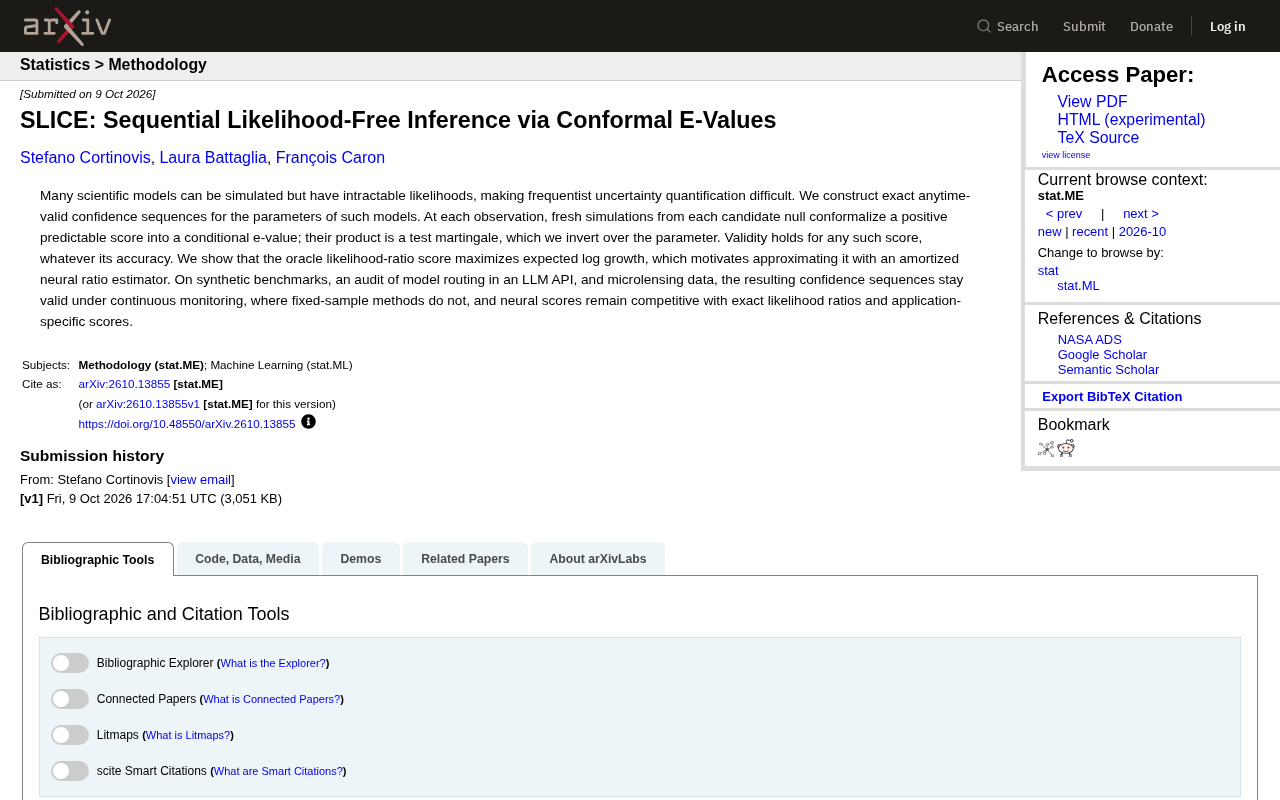
A new approach called SLICE (Sequential Likelihood-Free Inference via Conformal E-Values) offers a different path: by combining conformal inference with e-values, it constructs exact, anytime-valid confidence sequences for the parameters of such models.
Intractable likelihood means: given model parameter θ and observed data x, a probability density p(x|θ) exists in principle, but cannot be computed in closed form or by efficient numerical methods — due to high-dimensional integrals, complex stochastic processes, or chaotic dynamics. Take gravitational microlensing as an example: the physical process from gravitational field parameters to a light curve can be accurately simulated, but computing the probability of observing that light curve under a given set of parameters requires integrating over all possible intermediate states — which is infeasible in practice.
Classical likelihood-based inference methods — including maximum likelihood estimation, Bayesian posterior sampling (e.g., MCMC), and likelihood-ratio-based confidence intervals — all face fundamental obstacles here. Likelihood-free inference or simulation-based inference (SBI) was designed precisely for this situation: as long as we can sample from p(x|θ), even without a closed-form density, we can learn about parameters from data. SLICE goes a step further, requiring that inference conclusions also come with rigorous frequentist uncertainty guarantees.
Core Mechanism: From Scores to Test Martingales
The construction logic of SLICE is tightly interlocked. Each time a new observation arrives, the method generates fresh simulated data from the corresponding model for each candidate null hypothesis parameter value. These simulations are used to conformalize a "positive predictable score," transforming it into a conditional e-value.
The key step comes next: multiplying these conditional e-values together yields a test martingale. By inverting this test martingale over the parameter space, one obtains a confidence sequence for the parameter.
This mechanism has an especially attractive property — validity is independent of the accuracy of the score. No matter how crude or precise the scoring function, the resulting confidence sequences are statistically rigorous. In other words, score quality only affects the width of intervals (i.e., statistical efficiency), not the coverage guarantee. This cleanly separates the concerns of "correctness" and "efficiency."
E-values are a concept that has gained traction in statistics in recent years. They can be thought of as a measure of how compatible the data is with the null hypothesis, with the core property that if H₀ is true, the expected value of an e-value is at most 1. This makes e-values safe to multiply: if each step produces a conditional e-value, the product forms a test martingale — a stochastic process whose expected value does not increase. When this product exceeds the threshold 1/α, we reject the corresponding null hypothesis at level α.
Compared to traditional p-values, the key advantage of e-values is composability: the product of multiple independent e-values is still an e-value, which is the mathematical foundation supporting anytime-valid inference. Traditional p-values suffer from inflated Type I errors under repeated testing or continuous monitoring due to multiple comparisons, whereas test-martingale-based methods are designed to avoid this problem by construction — no matter when or how you stop collecting data, error rate control remains valid.
Conformal inference provides a general mechanism for converting any scoring function into a valid p-value or e-value, with validity depending only on exchangeability rather than any parametric distributional assumptions. SLICE uses this conformalization step to transform raw neural network scores into statistically rigorous conditional e-values.
Why Use a Neural Ratio Estimator
Since any score guarantees validity, what score works best? The research gives a clear answer: the oracle likelihood ratio score maximizes the expected log growth rate. Among all admissible scores, the true likelihood ratio causes the test martingale to grow fastest, thereby most quickly ruling out incorrect parameters and tightening the confidence sequence.
This theoretical result directly points to a practical strategy — since the true likelihood ratio is unavailable, use an amortized neural ratio estimator to approximate it. This is precisely the mainstream tool in the simulation-based inference (SBI) literature. The neural network provides a score as close to the oracle as possible, while the conformal e-value framework acts as a safety net in the background, ensuring that even if the neural network's estimates are biased, the final inference conclusions remain trustworthy.
An amortized neural ratio estimator is one of the core components of the SBI toolbox. The basic idea is to train a classifier to distinguish samples drawn from the joint distribution p(x, θ) from samples drawn from the product of marginals p(x)p(θ). Bayes' theorem guarantees that the output of the optimal classifier is proportional to the likelihood ratio p(x|θ)/p(x|θ'), so the neural network indirectly learns the quantity we cannot compute directly.
"Amortized" means the estimator is trained across the entire parameter space, and once trained, it can be applied to any new observation x and parameter θ via a single forward pass — no need to re-run inference for each new data point. This contrasts with traditional MCMC, which requires re-running a costly Markov chain for each dataset. The cost of amortization is the upfront need for large-scale simulation to train the network, but in scenarios requiring repeated inference on the same model (such as continuous monitoring of LLM API routing), this investment pays off.
Validation Across Three Experimental Settings
The research evaluates the method across three quite different scenarios:
Synthetic Benchmarks
On controlled synthetic data, SLICE's confidence sequences remain valid under continuous monitoring, while traditional fixed-sample methods fail under the same repeated testing. This reveals the practical value of the anytime-valid property: you can observe results as data accumulates, stop at any time, and not risk inflating your error rate by "peeking" at the data.
LLM API Model Routing Audits
A particularly relevant real-world application is auditing model routing in large language model APIs. Many commercial APIs silently route requests to different models behind the scenes. SLICE can provide statistically guaranteed inference about routing behavior in such settings — demonstrating the method's potential for AI system transparency and compliance auditing.
Microlensing Data
The method also works on real gravitational microlensing data in astrophysics. This is a quintessential example of the "can simulate, can't compute likelihood" challenge, validating the method's applicability to hard scientific problems.
Experiments also show that neural scoring efficiency is on par with exact likelihood ratios and application-specific custom scores, indicating that the strategy of approximating the oracle with a neural network incurs no meaningful efficiency penalty in practice.
Significance and Positioning
The value of SLICE lies in weaving together several independently developed threads: simulation-based inference, conformal prediction, e-value and test martingale theory, and anytime-valid inference. It provides a rigorous yet flexible inference framework for "simulate-only" scientific models — rigorous in its unconditional validity guarantees, and flexible in its ability to plug in any scoring function (including powerful neural networks).
For scenarios that require decision-making under continuous monitoring while keeping error rates under control — whether in physics experiments or AI system audits — anytime-valid methods provide guarantees that traditional fixed-sample frameworks cannot easily match. As simulation-based inference tools mature, work like this that combines modern deep learning with classical statistical guarantees may become an important paradigm for scientific inference.
Related articles

Chain of Thought Isn't Just for AI: How Humans Can Use CoT to Improve Thinking Quality
Chain of Thought isn't just a prompt trick for large models. Starting from a Hacker News discussion, this article analyzes why CoT works for human thinking too, breaks down actionable ways to transfer it, and highlights the key differences between human CoT and machine CoT.
Cloudflare Teams Up with OpenAI: Closi…
Cloudflare Teams Up with OpenAI: Closing the Loop from Vulnerability Discovery to Defense with AI
Cloudflare uses OpenAI Daybreak to investigate security vulnerabilities and generate reviewable remediation plans, while developers use Codex to boost coding efficiency and quality.

Orca Multi-Agent Orchestration in Practice: A Guide to Parallel Collaboration with Claude and Codex
Orca is Stable AI's free open-source agent workbench supporting 34 agents like Claude Code and Codex in parallel. Learn its Git worktree isolation, multi-model orchestration, and mobile management.