SlideLab: AI Multi-Agent Framework Auto-Generates Research Slides with 77% Human Preference Rate

SlideLab uses a multi-agent framework to turn papers into slides, beating existing systems with 77% human preference and 1/4 the inference cost.
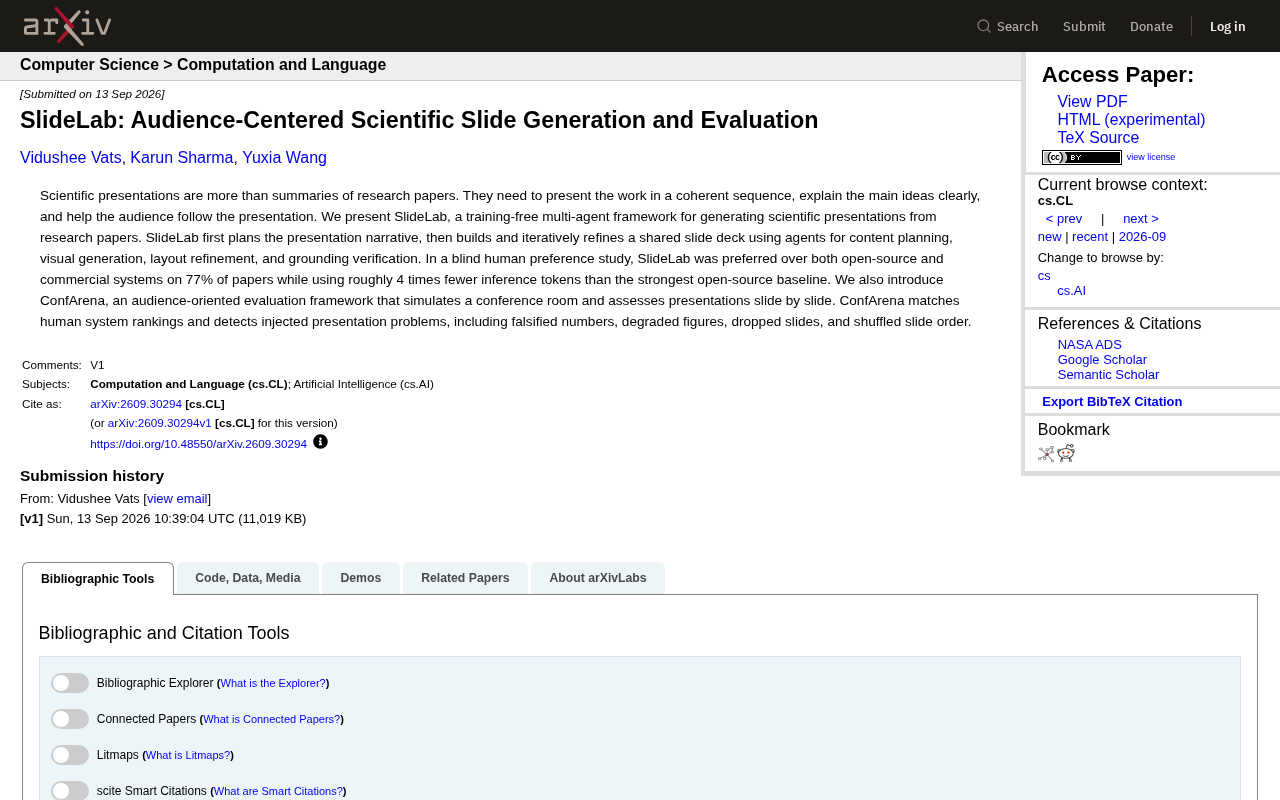
SlideLab is a training-free multi-agent framework that automatically converts research papers into well-structured, visually optimized scientific presentations. Four specialized agents handle content planning, visual generation, layout optimization, and grounding verification — with the last directly countering LLM hallucinations. In blind human preference studies, SlideLab outperformed open-source and commercial systems on 77% of papers while consuming only one-quarter the tokens of the strongest open-source baseline. The team also introduces ConfArena, an evaluation framework that simulates conference room settings to assess slides page by page and detect fabricated data, degraded figures, missing slides, and ordering errors.
The Pain Point Behind Research Presentations — and How SlideLab Was Born
Transforming a research paper into a clear, compelling academic talk has never been a simple summarization task. A great scientific presentation demands a coherent narrative arc, crisp articulation of core ideas, and visual design that helps audiences keep pace. All of this takes considerable time and effort from researchers.
SlideLab is a direct response to that challenge. It is a training-free multi-agent framework that automatically generates scientific presentation slides directly from research papers. Rather than relying on large volumes of labeled data and fine-tuning, SlideLab distributes the work across multiple collaborating agents — bypassing the cost barrier of model training entirely.
The training-free framework is an important design trend in large model applications. Traditional automated generation systems typically require fine-tuning on large domain-specific datasets — a process that is expensive, data-hungry, and often weak at generalization. Training-free frameworks instead rely entirely on the general capabilities of pretrained large language models (such as instruction following, reasoning, and content organization), accomplishing complex tasks through carefully engineered prompts and multi-agent architectures — no additional training required. The advantages are a low deployment barrier and rapid adaptability to new scenarios, though they place higher demands on prompt engineering and system architecture. SlideLab's choice of this approach is fundamentally about leveraging the academic comprehension and content organization capabilities that modern LLMs already possess, rather than training a dedicated model from scratch.
How SlideLab Works: A Multi-Agent Collaborative Pipeline
SlideLab's core design philosophy is to decompose slide generation into a clear pipeline. It begins by planning the narrative structure of the entire presentation — determining how content should unfold in logical sequence, rather than mechanically mirroring the paper's section order.
Multiple specialized agents then collaboratively build and iteratively refine a shared slide document, each with a distinct role:
- Content Planning Agent: Decides what core information each slide should carry
- Visual Generation Agent: Handles figures, diagrams, and other visual elements
- Layout Optimization Agent: Adjusts the layout to improve readability
- Grounding Verification Agent: Checks that all content is genuinely sourced from the original paper, preventing hallucinations or fabrications
This "division of labor + iteration" model ensures that the final output maintains both logical coherence and visual quality. The grounding verification step is particularly critical — it directly addresses the hallucination and factual drift problems common in LLM-generated content.
Grounding verification is a targeted countermeasure against the "hallucination" problem in large language models. When generating text, LLMs can sometimes produce content that sounds plausible but has no actual basis — fabricating experimental data, misattributing citations, or blending conclusions from unrelated papers into the current context. In the scientific slide generation setting, such errors are especially dangerous, as they can cause presenters to display information that contradicts their own paper. The grounding verification agent systematically compares each generated statement against the source paper text, ensuring that every data point and conclusion on the slides can be traced back to a real source. This mechanism embeds credibility assurance directly into the generation pipeline, rather than leaving it to users for manual post-hoc review.
Key Results: 77% Preference Rate and Lower Inference Cost
SlideLab's most compelling achievement is its performance in a blind human preference study. Compared against both open-source and commercial systems, SlideLab was preferred by human evaluators on 77% of papers — a substantial win rate that demonstrates its generation quality surpasses existing mainstream approaches.
Equally noteworthy is the efficiency dimension. SlideLab achieves this while consuming approximately one-quarter the token count of the strongest open-source baseline. This means it delivers not only higher quality but also significantly lower operating costs. For real-world applications requiring large-scale generation or iterative refinement, this combination of quality and cost efficiency carries strong practical value.
ConfArena: An Evaluation Framework That Simulates the Conference Room
Alongside the generation system itself, the research team also introduces ConfArena, an audience-centered evaluation framework. Its distinguishing feature is that it simulates a real conference room setting and evaluates presentation quality slide by slide, rather than assigning a single holistic score.
ConfArena's effectiveness is demonstrated in two ways:
First, the system rankings it produces align with those from human evaluators, confirming the credibility of its assessments. Second, it can detect deliberately injected presentation flaws, including: fabricated numbers, degraded figures, missing slides, and slides presented out of order. This sensitivity makes ConfArena not merely a scoring tool, but a quality gatekeeper capable of diagnosing specific defects.
Automatically evaluating the output quality of generative AI has long been one of the field's core challenges. Existing methods typically rely on text-overlap metrics like BLEU and ROUGE, or use LLMs directly as judges (LLM-as-judge) — but both approaches have clear limitations when evaluating presentations. Text similarity metrics cannot capture the quality of narrative logic or visual layout, while single holistic scores struggle to pinpoint defects on specific slides. ConfArena's "slide-by-slide evaluation + conference room simulation" design attempts to more closely mirror how human audiences actually perceive presentations — a process that is inherently sequential and cumulative. By injecting controlled flaws (such as fabricated numbers and reordered slides) into the evaluation set, the researchers can verify the framework's sensitivity to various quality issues — an important methodological approach for establishing the reliability of any evaluation tool.
Significance and Outlook
The combination of SlideLab and ConfArena represents a pragmatic direction for AI-assisted research workflows: solving both the "how to generate" and "how to evaluate" problems in tandem. For researchers who deal with papers and presentations daily, an automated tool that requires no training, runs at controllable cost, and delivers human-validated quality can meaningfully reduce the time spent preparing talks.
Of course, as a newly published arXiv paper, SlideLab's real-world generalizability, adaptability across different research disciplines, and long-term performance at actual academic conferences still await broader validation. But its audience-centered design philosophy — along with its dual breakthrough in preference rate and efficiency — already offers a highly instructive paradigm for the niche field of automated scientific slide generation.
Related articles

Felix Rieseberg Personal Homepage
Felix Rieseberg's personal homepage sparks attention on Hacker News. This article covers the Slack engineer's technical background, the rise and fall of nativefier, and the value of a developer homepage as a tech calling card.

@ai-sdk/vue 3.0.306 Patch Release Syncs with [email protected] Update
@ai-sdk/vue 3.0.306 released, synced with [email protected]. A routine patch release for the Vercel AI SDK ecosystem with no public API changes; the Vue adapter layer stays version-aligned with the core package.

Gemini 4 Argon API Launches: The Era of Million-Token Output Begins
Google launches Gemini 4 Argon with sparse MoE architecture, up to 1M output tokens, and a 68.90% Vals Index score, available across API, AI Studio, and the Gemini app.