slop-grader: A Rule-Based CLI Tool That Hunts Down AI-Generated Filler Content

A CLI tool that scores and flags AI-generated filler copy using custom rules, then drives Agent-based auto-rewrites.
slop-grader is a CLI tool by developer Lukas, launched on ProductHunt to combat the "slop" problem created by generative AI. It runs documents through user-defined rulesets to produce an overall score and line-by-line flags, turning subjective copy quality into a quantifiable process. Crucially, it outputs fix prompts alongside its flags — ready to feed into a downstream AI Agent — creating a detect→flag→prompt→rewrite automation loop. Key use cases include cleaning AI filler from launch copy, stripping landing page buzzwords, and scoring launch email narrative flow. Its lightweight, composable CLI design fits developer scripting workflows naturally, earning it 82 upvotes and an 11th-place ranking on ProductHunt.
In an era flooded with AI writing tools, a new problem has emerged: content generated by large language models is often packed with clichés, filler phrases, and hollow marketing buzzwords. The industry has started calling this kind of content "slop." A CLI tool called slop-grader, spotted on ProductHunt, is built specifically to tackle this pain point. Created by developer Lukas, it earned 82 upvotes and 10 comments after launch, ranking 11th — categorized under Writing, Advertising, Artificial Intelligence, and GitHub.
What slop-grader Actually Does
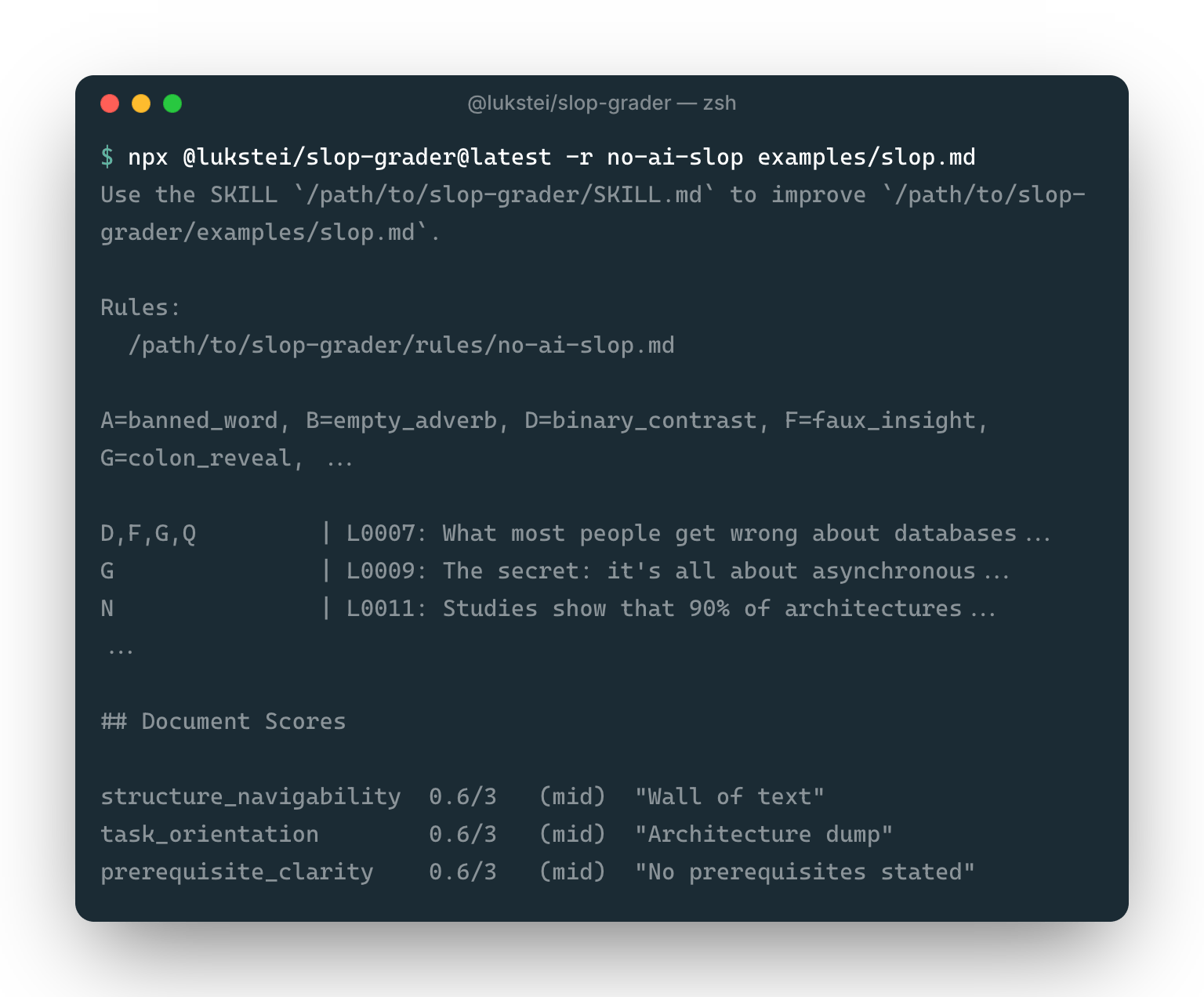
slop-grader is a rule-based CLI tool. Its core logic is straightforward: run a document through a custom ruleset and produce two types of output — an overall score for the entire document, and line-by-line flags highlighting specific problems.
In practice, this means you can define what "good copy" looks like for your team or project — for example, banning certain trendy marketing buzzwords, requiring a clear narrative rhythm, or flagging AI-style filler sentences. slop-grader then scans the document line by line against these rules, assigns a score, and marks where the issues are. This approach transforms "copy quality" — which is inherently subjective — into a quantifiable, repeatable evaluation process.
Auto-Fix via AI Agent Integration
What makes slop-grader genuinely interesting isn't the scoring itself — it's the interface it leaves open for downstream AI Agent-based remediation.
As the tool flags problematic lines, it simultaneously outputs prompts that can be fed directly into an AI Agent, which can then draft sharper replacement copy. The full pipeline becomes: rule detection → line-by-line flagging → prompt generation → Agent rewrite. This means slop-grader isn't just a standalone "checker" — it's a component that can be embedded in an automated writing pipeline.
For developers who live in command-line and scripting workflows, this design fits naturally. It bridges human editorial judgment (encoded in the ruleset) with AI generative capability (expressed through Agent rewrites) — humans set the standards, machines execute and iterate.
AI Agent, in this context, refers to an LLM invocation framework capable of autonomously receiving instructions and executing multi-step tasks — such as LangChain Agent, AutoGen, or Claude with tool use. Unlike a standard one-shot LLM call, an Agent can loop through tool outputs and decide what to do next based on feedback. slop-grader's line-by-line flags and fix prompts map naturally onto an Agent's observe-act loop: the Agent reads the flag list, calls a writing model to generate replacement copy for each flagged line, then runs the rule engine again for a second-pass score — repeating until the score meets the threshold. This "detect → generate → re-detect" closed loop is, at its core, an automation of the human editorial review process, enabling quality control to run unattended inside a CI/CD or content publishing pipeline.
Typical Use Cases
According to the official description, slop-grader targets a few concrete needs:
- Catching AI filler in launch copy: Product launch announcements are particularly prone to hollow phrasing — the tool surfaces those bloated passages.
- Scrubbing buzzwords from landing pages: Strip out the high-sounding-but-information-free buzzwords that clutter landing pages.
- Evaluating narrative flow in launch emails: Score the narrative rhythm of launch emails to assess whether the writing is coherent and punchy.
These scenarios share a common thread: they're all content types that marketing and growth teams produce frequently, with wildly inconsistent quality. slop-grader aims to install a quality gate at each of these touchpoints.
Quick Take: A Small Tool That Hits a Real Pain Point
slop-grader's value proposition is clear — in a world where generative AI is deeply embedded in content production, "detecting AI flavor" is becoming a genuine need. Rather than building another bloated writing suite, it opts for a lightweight, composable CLI form factor, exposing its evaluation capability through custom rules. That makes it adaptable across different teams and different style standards.
That said, as an early-stage tool, its real-world effectiveness depends heavily on the quality of the ruleset: well-crafted rules produce meaningful scores; sloppy rules produce misleading ones. The 82-vote result on ProductHunt suggests it resonated with a meaningful slice of users — but whether it becomes lasting infrastructure for teams will depend on how the rules ecosystem and Agent integration mature.
For marketing and documentation teams drowning in AI-generated content, slop-grader offers an interesting perspective: rather than complaining that AI writes hollow copy, use rules and another layer of AI to systematically govern it.
The choice of a CLI form factor is also worth noting. Compared to GUI-based writing suites, a CLI tool can integrate directly via pipes and scripts with git hooks, GitHub Actions, and CMS publishing scripts — enabling "check copy quality as part of the commit." This composability reflects the Unix tool philosophy: do one thing well, and collaborate with other tools through standard input/output. For engineering teams already accustomed to embedding linters and formatters into their development workflow, the adoption cost for slop-grader is minimal — which is part of why it resonated in the developer-heavy ProductHunt community.
Related articles

Chain of Thought Isn't Just for AI: How Humans Can Use CoT to Improve Thinking Quality
Chain of Thought isn't just a prompt trick for large models. Starting from a Hacker News discussion, this article analyzes why CoT works for human thinking too, breaks down actionable ways to transfer it, and highlights the key differences between human CoT and machine CoT.
Cloudflare Teams Up with OpenAI: Closi…
Cloudflare Teams Up with OpenAI: Closing the Loop from Vulnerability Discovery to Defense with AI
Cloudflare uses OpenAI Daybreak to investigate security vulnerabilities and generate reviewable remediation plans, while developers use Codex to boost coding efficiency and quality.

Orca Multi-Agent Orchestration in Practice: A Guide to Parallel Collaboration with Claude and Codex
Orca is Stable AI's free open-source agent workbench supporting 34 agents like Claude Code and Codex in parallel. Learn its Git worktree isolation, multi-model orchestration, and mobile management.