Slowave: A Local Memory Layer That Lets Coding Agents Maintain Their Own Memory
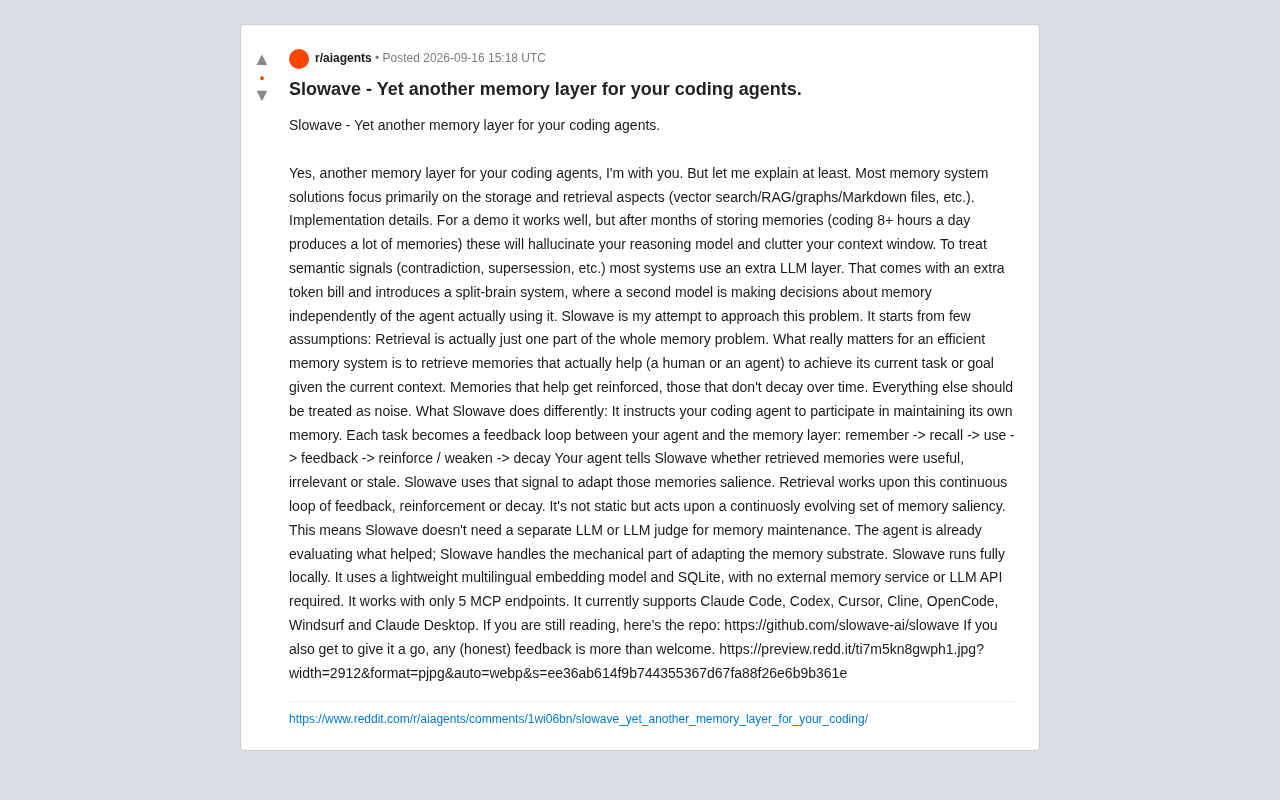
Slowave lets coding agents self-maintain memory via a feedback loop of reinforcement and decay, eliminating the need for a separate LLM judge.
Slowave is an open-source local memory layer for coding agents, designed to address two key pain points in existing solutions: context pollution from accumulated historical memories, and the token waste and decision disconnect caused by using a standalone LLM as a "memory judge." Its core innovation is returning memory curation to the agent itself — after each task, the agent tells Slowave which memories were useful, irrelevant, or outdated, and the system adjusts each memory's salience score accordingly. Useful memories are reinforced; long-unused ones decay away. The system runs entirely locally via a lightweight multilingual embedding model and SQLite, exposing just 5 MCP endpoints with no external API required, and supports Claude Code, Cursor, Cline, and other major AI coding tools.
Yet Another Memory Layer for Coding Agents — But With a Different Approach
The author of the open-source tool Slowave opens candidly on Reddit: "Yes, yet another memory layer for coding agents. I get your skepticism." In a landscape already saturated with RAG pipelines, vector retrieval, knowledge graphs, and Markdown files, memory solutions are hardly in short supply. But what Slowave aims to address are the real pain points that emerge from long-term, intensive daily use.
The author argues that most memory systems pour their energy into the storage and retrieval layer — which vector database to use, how to implement RAG, how to structure a graph. These are ultimately implementation details. They work well for demos, but once you're coding 8+ hours a day and accumulating months of memory, problems surface: bloated historical memories start polluting the context window and even triggering hallucinations in reasoning models.
The "Split-Brain" Problem in Traditional Memory Systems
To handle semantic signals between memories — contradictions, supersessions, and so on — most systems introduce an additional LLM layer to make judgments. This comes at two costs.
The first is extra token overhead: every memory maintenance operation requires an additional model call. The second is more subtle. The author calls it a "split-brain" system: a separate model decides which memories to keep or update on your behalf, yet it is disconnected from the agent actually doing the work. The model making memory decisions doesn't understand what the task-executing agent actually needs in the moment.
This is a genuinely sharp observation — the value of a memory should be defined by the one who uses it, not a detached third-party observer.
RAG (Retrieval-Augmented Generation) is currently the dominant approach to memory: historical conversations, code snippets, and other information are vectorized and stored in a database, with the most relevant chunks retrieved and injected into the context before each inference. Vector retrieval relies on embedding models that convert text into high-dimensional numerical vectors, then finds semantically similar memory entries by computing cosine similarity. Knowledge graph approaches go further, using nodes and edges to express relationships between memories — for example, "Function A depends on Library B." The shared shortcoming of all these approaches is that they only solve the "can it be found" problem, not the "is what's found actually useful" problem. As the number of memory entries grows into the thousands or tens of thousands, noisy entries flood the retrieval results, filling the context window with irrelevant history and interfering with the model's judgment on the current task. Introducing a separate LLM as a "memory judge" is a band-aid solution — but that judge doesn't participate in the actual coding work and has no first-hand experience from task execution to determine which memories are truly valuable.
Slowave's Core Premise: Retrieval Is Only Half the Problem
Slowwave rethinks the memory system from a few core assumptions. The most critical one: retrieval is only part of the memory problem.
What truly matters isn't whether a relevant memory can be retrieved — it's whether the retrieved memory actually helps with the current task and goal. Built on this philosophy, Slowave introduces a mechanism analogous to biological memory:
- Memories that prove helpful get reinforced
- Memories that don't help decay over time
- Everything else is treated as noise
This "use it or lose it" design means the memory store is no longer a grow-only archive, but a dynamically evolving, living system.
Letting the Agent Participate in Maintaining Its Own Memory
Slowwave's most distinctive design choice is having the coding agent actively participate in maintaining its own memory. Each task forms a feedback loop between the agent and the memory layer:
remember → recall → use → feedback → reinforce/weaken → decay
Concretely, the agent tells Slowwave whether the retrieved memories were useful, irrelevant, or outdated. Slowave adjusts the "salience" of each memory entry based on this signal. Retrieval is built on top of this continuous feedback–reinforce–decay cycle, so it isn't static — it operates on a constantly evolving set of memory salience scores.
The direct benefit of this design: no separate LLM or LLM judge is needed to maintain memory. Since the agent is already evaluating which memories helped, Slowwave only handles the "mechanical" part — translating those signals into underlying memory adjustments. This eliminates both the token waste and the split-brain problem described earlier.
Fully Local, Lightweight, and Privacy-Friendly
On the engineering side, Slowwave is built to run entirely locally:
- Uses a lightweight multilingual embedding model
- Stores data in SQLite
- Requires no external memory service or LLM API
For developers concerned about data privacy who don't want their code memories flowing to third-party services, this is a pragmatic choice. The entire system works through just 5 MCP endpoints, keeping the integration barrier low.
Slowwave currently supports a comprehensive roster of clients, covering the major AI coding tools: Claude Code, Codex, Cursor, Cline, OpenCode, Windsurf, and Claude Desktop. The project is open-sourced on GitHub (slowave-ai/slowwave), and the author sincerely invites users to share real-world feedback.
MCP (Model Context Protocol) is an open protocol introduced by Anthropic to standardize the interaction interface between AI models and external tools and data sources. Think of it like a USB interface — as long as a tool implements the MCP spec, any compatible AI client can call it directly without needing custom integration code for each client. Slowwave exposes only 5 MCP endpoints (corresponding to core operations like remember, recall, and feedback), meaning the memory layer's external interface is extremely lean, requiring almost no extra configuration on the client side. The choice of SQLite as the storage backend reflects the same lightweight philosophy: it's a serverless, embedded database that lives as a single file on the local disk, requires no separate database process, and has minimal startup and read/write overhead — an ideal fit for personal developer tooling in local environments.
Quick Take: A Paradigm Attempt for Memory Systems
Slowwave's value doesn't lie in which new vector library it uses — it lies in offering a different answer to the question of who should maintain a memory system. Returning the authority to judge memory value back to the agent that actually uses the memory, and simulating biological memory's natural selection through reinforcement and decay, is an approach that genuinely sidesteps the cost and disconnection introduced by a standalone LLM judge.
Of course, whether this design can perform reliably over real long-term use still requires validation from more developers — particularly around the accuracy of an agent's self-assessment of memory usefulness, and whether the decay mechanism might inadvertently discard memories that are genuinely important but temporarily unused. For developers who collaborate intensively with coding agents every day, this is an open-source project worth watching and giving a hands-on try.
Related articles

AI Agent Developer Job Hunt Guide: Four Hard Standards to Clear Before You Apply
A practical guide for landing AI Agent developer roles: four measurable standards — project runs, problems debuggable, solution explainable, interviews survivable.
Multi-Agent Development Guide: From Monolithic AI to Team Collaboration in Practice
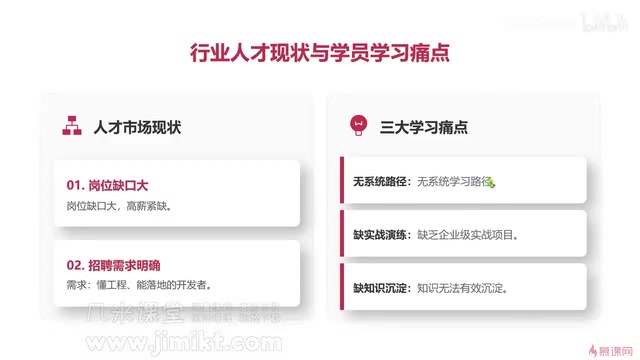
A beginner's guide to multi-agent development covering core advantages, common learning pain points, enterprise tech stacks, and engineering methodology for AI developers.

Agent Skill Routing: Retrieval vs. LLM vs. Two-Stage Architecture Compared
Retrieval or LLM for Agent skill routing? Compare coarse-filter vs. fine-select architectures on latency, accuracy, and cost — with 4 key production considerations.