Slowing Down the AI Frontier: Anthropic Proposes a Three-Step Industry Deceleration Plan

Anthropic calls for AI deceleration, pledging employee-level system access to third-party safety evaluators.
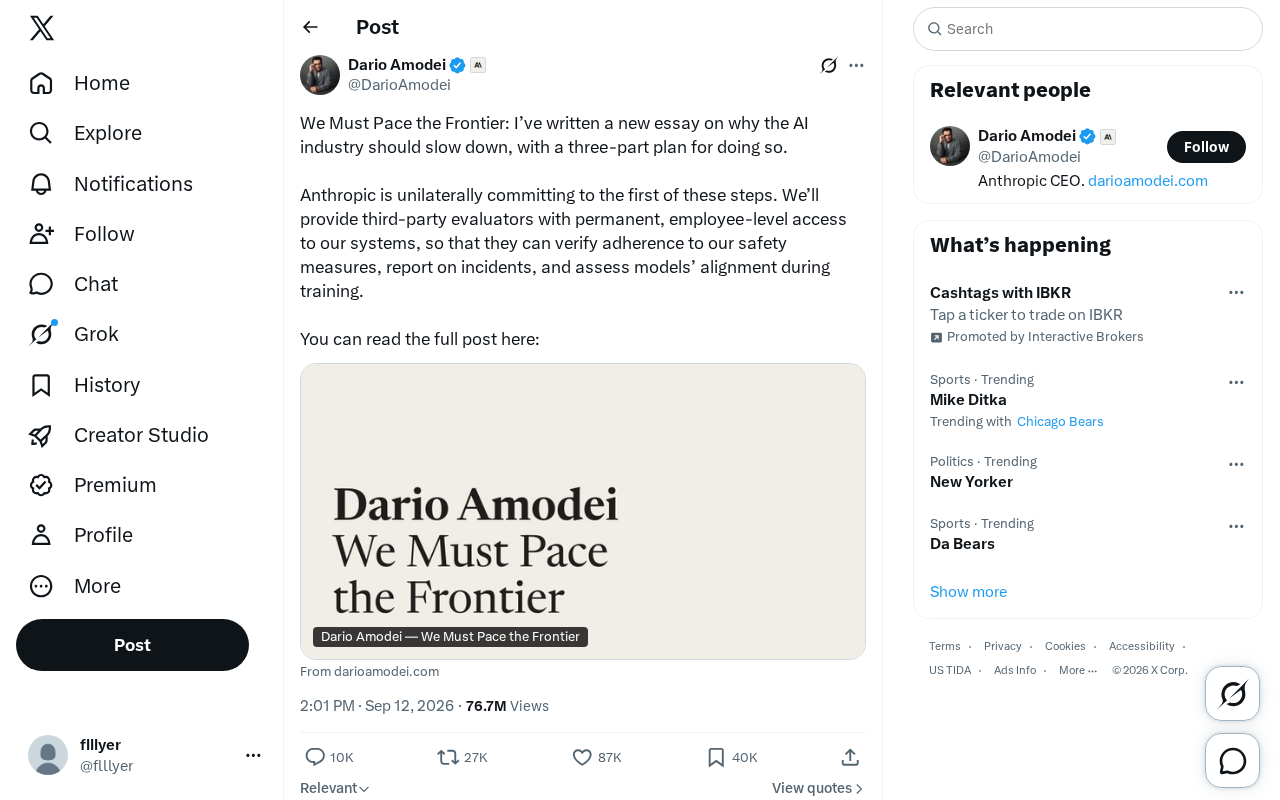
Against the backdrop of an accelerating AI capability race, Anthropic published 'We Must Pace the Frontier,' arguing for voluntary industry deceleration and outlining a three-step action plan. The company is immediately acting on step one: granting third-party evaluators permanent, employee-level system access to verify safety measures, report incidents, and assess model alignment during training — shifting safety review from post-launch inspection to end-to-end oversight. The piece identifies the structural 'race to the bottom' dilemma as the root cause of the industry's inability to self-regulate, and Anthropic hopes unilateral standard-setting can reshape collective incentives.
A Manifesto Calling for AI Industry Deceleration
Amid an intensifying race to push AI capabilities forward, a statement from Anthropic has sparked discussion. The company published an article titled We Must Pace the Frontier, making a straightforward and counter-mainstream argument: the AI industry should voluntarily slow down — and it has laid out a three-part action plan to do exactly that.
This stance stands out in an industry where everyone is chasing larger models, faster release cycles, and greater market share. Anthropic isn't just calling on others to decelerate — it's announcing that it will be the first to unilaterally implement the plan's opening step.
Step One: Opening Systems to Third-Party Evaluators
According to the statement, Anthropic is committing to provide third-party evaluation organizations with "permanent, employee-level" access to its systems. This is the most concrete step in the three-part plan — and the first to be acted upon.
What does this kind of openness actually mean? Traditionally, AI companies guard the inner workings of their models, training processes, and safety mechanisms closely, making it nearly impossible for external parties to verify whether a company is living up to its safety commitments. "Employee-level access" sets a remarkably high bar for transparency — it allows external evaluators to go as deep into the system as an internal employee would, rather than seeing only a curated, surface-level view.
Anthropic outlines three purposes for this access:
- Verifying that safety measures are actually implemented: Confirming that the safety standards a company publicly commits to are genuinely in practice, not just on paper.
- Reporting safety incidents: Allowing independent third parties to document and disclose issues as they arise.
- Evaluating model alignment during the training phase: Intervening during the formation of a model, rather than waiting until after release to course-correct.
The third point is especially noteworthy. Moving evaluation upstream into the training phase transforms safety review from "post-launch inspection" into "end-to-end oversight" — a significantly more rigorous requirement from a technical governance standpoint.
A note on "alignment": Alignment is a core concept in AI safety. It refers to ensuring that an AI system's behavior, goals, and values remain consistent with human intentions. A misaligned model might appear to perform well on the surface, yet produce unexpected or even harmful behaviors in specific contexts — behaviors its developers never anticipated. Evaluating alignment during training matters because a model's "worldview" and behavioral tendencies take shape throughout that process; once solidified, they are extremely costly to correct after the fact. Common alignment techniques currently used in the field include RLHF (Reinforcement Learning from Human Feedback) and Constitutional AI (Anthropic's own methodology). But regardless of the approach, the effectiveness of these methods has historically lacked mechanisms for independent external verification. Anthropic's commitment to training-phase access essentially cracks open this "black box" to outside oversight.
Why Choose to Slow Down in the Middle of a Race
Anthropic's position stems from a long-standing concern: when multiple companies are fiercely competing at the capability frontier, safety and caution tend to be the first casualties. Whoever slows down for safety evaluations risks falling behind in the market — a structural pressure that makes it nearly impossible for the industry to voluntarily decelerate on its own.
The phrase "Pace the Frontier" cuts to the heart of the issue — it's not about stopping progress, but about setting a controllable pace for it. Anthropic has long positioned safety as its core identity, and this article is consistent with its public stance: attempting to shift the industry's incentive structure by setting standards and making unilateral commitments.
That said, it's worth noting that the original statement primarily conveys a position and delivers on step one. The remaining two steps of the three-part plan are not elaborated in the content covered here. A full understanding of Anthropic's deceleration framework requires reading the complete article it published.
The structural dilemma behind this: In game theory, this kind of situation is known as a "race to the bottom" or a security dilemma: when market participants all expect their competitors not to slow down voluntarily, any party that chooses to act cautiously first ends up at a structural competitive disadvantage — creating a collective rationality trap where "whoever slows down loses." The current competitive landscape of the AI industry — with top companies racing each other on model release cadence, parameter scale, and benchmark scores — is widely regarded by safety researchers as a real-world manifestation of exactly this dilemma. Anthropic's previously introduced Responsible Scaling Policy (RSP) was also an attempt to address this problem. Its core logic is to convert safe behavior from "voluntarily sacrificing competitive advantage" into a credible industry signal, by pre-committing to verifiable safety standards — thereby influencing the decision-making of other participants.
The Significance and Remaining Questions
Unilaterally opening systems to third-party evaluation is a concrete, verifiable action — not an empty slogan. It offers the industry a potential reference template: if independently verifiable safety review becomes the norm, external trust in AI companies no longer has to rest solely on their self-reported claims.
But several critical questions remain to be watched: How will the independence and authority of third-party evaluators be guaranteed? Will other leading companies follow with similar openness commitments, or will Anthropic become an isolated case? And without unified industry standards or regulatory mandates, can unilateral deceleration truly "pace the frontier" — or will it simply put Anthropic at a disadvantage in the race?
The answers to these questions will determine whether this article marks a turning point in AI governance, or whether it remains an idealistic, solitary appeal. Either way, in an environment where acceleration is the universal default, publicly advocating for deceleration and backing it with concrete commitments is itself a signal worth recording.
Related articles

WorkBuddy Full Guide: How an AI Coworker Takes Over Workplace Automation
What is WorkBuddy? This article analyzes the core capabilities of this full-scenario AI agent: autonomous execution with deliverable results, local file processing, multi-agent parallelism, and workplace automation workflows, helping you judge its essential difference from ordinary AI chat tools.

The Truth About AI Agents: A Hundred Lines of Code + an LLM, Deconstructing the Agent's Underlying Logic
AI agents aren't a new AI species—just a language model plus tools, a loop, and a goal. Here's the underlying logic: how 100 lines of Python hit a 75% fix rate, why the harness beats the model, and Gartner's "agent washing."

AI Agent Deployment: Three Things Developers Should Do
AI Agent deployment doesn't require rushing into multi-agent systems. This article outlines an actionable deployment path and engineering acceptance thresholds for developers, covering human baselines, bounded single-agent scope, and a controlled code-modification loop.