smart #1 Test Drive: How the 'Little Giant Killer' Is Rewriting the Cheap EV Impression

The smart #1 rewrites the cheap small-EV image with segment-defying driving quality and a refined cabin.
A Bilibili test drive shows the smart #1 exceeding small-car expectations in steering, ride quality, and power delivery. Its front MacPherson and rear five-link suspension delivers refinement on rough roads, throttle response is linear in Comfort mode, and full-charge range reads 410 km. Cabin details like ambient lighting and the angled center screen create a premium feel, shifting small-EV competition from "good enough" to "quality first."
In an era when small electric vehicles have long been branded as "cheap runabouts," the smart #1 feels like a deliberate act of rebellion. In a Bilibili test-drive video, the host repeatedly calls this little car a "stunning killer" and "giant killer," his tone laced with obvious delight. That reaction isn't unfounded—when an urban car with limited length starts talking about steering feel, chassis refinement, and audio wattage, it has already left the traditional small-car narrative behind.
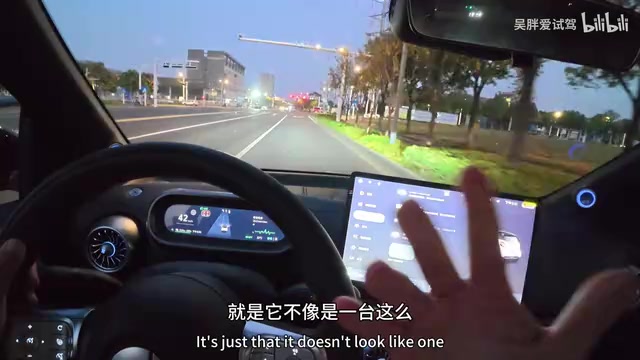
Driving Feel: Nothing Like "Such a Small Car"
The reviewer opens by pointing out the core contradiction: the steering feel "doesn't feel like something such a small car would give you." He references the GKX he once owned and the MINI he bought for his husband years ago, making clear this comparison isn't rhetorical—it's based on real driving experience. Steering feel can be adjusted to personal habits, driving modes split into Simple and Initial, and regenerative braking offers four adjustable levels—settings that let a small car deliver customization approaching that of larger-segment vehicles.
Ride quality is another point that exceeds expectations. Going over manhole covers, "the bounce isn't very large." The chassis uses a front MacPherson and rear five-link setup, paired with tires featuring thicker sidewalls, producing a comfortable overall response on rough roads. The reviewer specifically notes that on iron-plate road sections "the sense of refinement is also very good," attributing this to a combination of lightweight body construction and tuning expertise.
Front MacPherson and rear five-link suspension is the technical foundation for the chassis performance described in the article. The MacPherson structure is simple and space-efficient, a common front-suspension form in small cars; the rear five-link independent suspension typically appears in higher-segment vehicles, as it better controls wheel alignment parameters, reduces excess bouncing on rough roads, and improves comfort and handling stability. The smart #1 adopts this combination within a limited body size, paired with tires featuring thicker sidewalls, achieving the "small bounce" and "refinement" mentioned in the article. However, suspension form is only the hardware foundation—the final ride quality depends more on tuning expertise, which is why the reviewer credits "lightweighting + tuning."
Power and Handling: Linear, Controllable, Full of Surprises
In Comfort mode, throttle response is linear. The reviewer's assessment is refreshingly honest: "You don't need to worry about pressing too much, because given its size, it won't be fitted with a very high-power motor." But he immediately adds: "Acceleration still satisfies me very much." The message here: absolute power isn't ferocious, but the output character makes you willing—and confident—to press the pedal.
Body posture stays stable during lane changes, with no "soggy feeling"—the term is likely dialect or a slip of the tongue, but the meaning is clear: no sloppiness. Brake feel is linear but not adjustable, which counts as a minor regret. What really excites the reviewer is the overall dynamics: "You even want to race a super-large bus, because it's genuinely fun to drive."
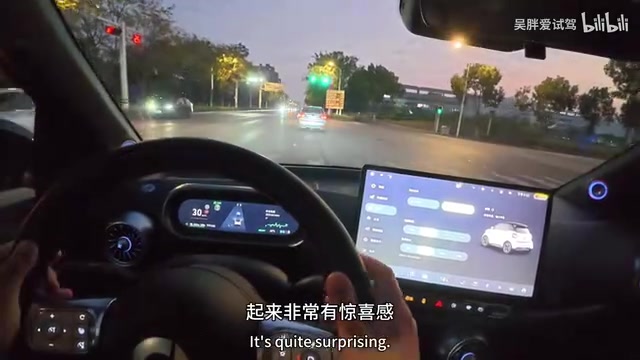
Range and Charging: 410 km on a Full Charge for Daily Confidence
At the time of the test drive, the vehicle was fully charged with 410 km showing on the display. The reviewer isn't sure whether this is dynamic range or the nominal figure, but emphasizes "can you believe it," indicating the number exceeded his expectations for this size class. For urban commuting and short trips, this range level means charging frequency can be kept low, with daily convenience assured.
Displayed range typically follows one of two calculation logics: nominal range (such as the CLTC cycle) is a theoretical value under a fixed laboratory cycle, while dynamic range adjusts in real time based on recent driving habits, air-conditioning use, road conditions, and more. The reviewer isn't sure which category the 410 km falls into, but either way it's a high level for a small EV. For reference, early models in the same class typically had nominal ranges around 300 km; 410 km means one charge per week in urban commuting scenarios, significantly easing range anxiety. Note that actual range is heavily affected by driving style and temperature, with some loss in winter or at highway speeds.
Cabin Experience: Refinement by Design
The interior's layered feel and nighttime ambient lighting are mentioned repeatedly. "As soon as you sit in, it's a smart." The panoramic sunroof with manual sunshade—its nighttime transparency is a design the reviewer particularly likes. The center screen is angled for easier viewing and operation when driving alone.
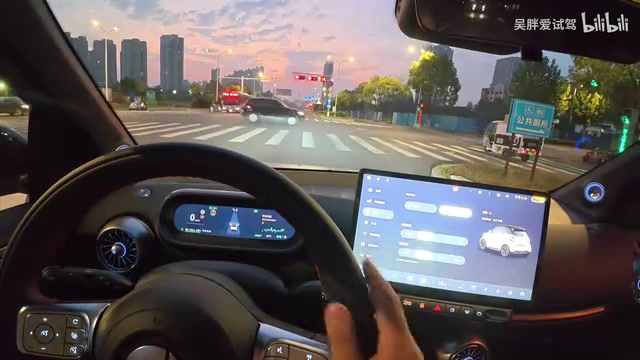
The air vent design reminds the reviewer of the Mercedes-Benz C-Class, and the little fox character in the UI is described as "quite cute." Audio wattage is "pretty top-tier," with solid sound quality. None of these details is revolutionary on its own, but together they create an overall impression that "everything tells you this car was genuinely tuned with care."
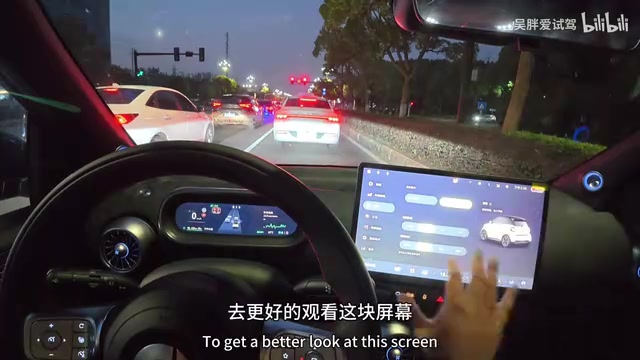
Four adjustable regenerative braking levels is an important driving characteristic that distinguishes EVs from combustion vehicles. Regenerative braking refers to the motor working in reverse during deceleration, converting kinetic energy into electricity stored back in the battery while producing a braking effect. The more levels available, the better the driver can balance "coasting like a combustion car" and "strong one-pedal recuperation" according to road conditions and personal habits. For small cars, adjustable recuperation levels affect not only range but also ride comfort directly—strong recuperation tends to cause a dragging sensation, while weak recuperation is smoother. smart offering four levels shows it's trying to accommodate different drivers' habits, consistent with the "sense of customization" noted in the article.
What Exactly Is This Car Rewriting?
The reviewer poses a sharp question: "Who are small combustion cars supposed to be sold to?" His logic: if earlier small EVs were synonymous with cheapness, the smart #1 is rewriting that chapter. This judgment may not apply to all price-sensitive users, but it points to a real trend: competition among small EVs is shifting from "good enough" to "quality first."
The cute turn-signal sound, deliberately simplified driving-mode names, four adjustable regenerative braking levels—these choices all send the same signal: smart didn't build this car as an upgraded "elderly runabout," but redefined the product according to premium small-car logic. Whether the market buys in depends on how many people are willing to pay a premium for "fun to drive."
At least judging from the feedback in this test drive, the smart #1 succeeds in making drivers feel "refreshed." In an era dominated by large vehicles, a small car that makes you want to race is itself proof of product strength.
One-line Summary
The smart #1 rewrites the cheap impression of small EVs with segment-defying driving quality and a refined cabin.
Paragraph Summary
A Bilibili test-drive video shows the smart #1 exceeding small-car expectations in steering feel, chassis ride quality, and power delivery. The front MacPherson and rear five-link suspension with comfort-oriented tuning delivers noticeable refinement on rough roads; in Comfort mode the throttle is linear and controllable, and lane changes are stable. Full-charge displayed range is 410 km, outstanding for its size class. Cabin details like ambient lighting, the panoramic sunroof, and the angled center screen create a premium small-car feel. The reviewer believes smart is shifting small-EV competition from "good enough" to "quality first," making drivers want to race—clearly positioning the product as a premium small car rather than a cheap runabout.
Related articles

The AI Agent Era: Building a New Product Paradigm with Evals
AI Agents are becoming the next users of products. This article explains how to use Evals to observe Agent usage behavior, test changes before launch, and compare new model performance, helping product teams establish a development methodology for the Agent era.

Microsoft Global Email Outage Leads to Chlorine Leak at German Hotel, Injuring 15
A Microsoft 365 and Outlook global outage prevented a chlorine safety alert from reaching a German Phantasialand hotel, injuring 15 guests and exposing the fragility of cloud-dependent safety systems.
iPhone Duo to Support Face Unlock Using Only the Front Camera
Apple is developing front-camera-only face unlock for the iPhone Duo, now testing in the iOS 27.3 beta. We analyze the technical approach, user experience, and security trade-offs.