smart Elf #2 Launches at 99,900 Yuan: L2 Assisted Driving Added

The smart Elf #2 launches starting at 99,900 yuan, with L2 assisted driving and branded audio as the biggest surprises.
The smart Elf #2 officially launches, with the Premium Luxury Edition starting at a limited-time price of 99,900 yuan. As a boutique two-door, two-seat compact car, it exceeds expectations with L2 assisted driving including Lane Change Assist (LCA) and seven DeepSea Audio speakers. Under 3 meters long, just over 3-meter turning radius, 410 km CLTC range — basically one charge per week. Target users: singles/couples for urban commuting, and families with an existing large car needing a second short-distance vehicle.
A Small Car That Maxes Out Both "Refinement" and "Value"
The smart Elf #2 officially launched today, with the Premium Luxury Edition starting at a limited-time promotional price of 99,900 yuan, while the high-customization version is priced at 12,999 (yuan). For users following this two-door, two-seat compact car, the release of the configuration list brought surprises beyond expectations — a Bilibili creator mentioned in a video that they had already placed a deposit and locked in their order, and after seeing the configurations and benefits, felt that "this wait was worth it."
The positioning of this car is very clear: it's not a family mainstay vehicle pursuing large space, but a boutique compact car focused on urban commuting, easy to drive and park, and sufficiently distinctive.
Configuration Highlights: L2 Assisted Driving and Premium Audio Trickle Down
What surprised the creator most was the appearance of an L2-level assisted driving system in the configuration list. This isn't just basic ACC vehicle following — even Lane Change Assist (LCA) is included. For a two-door compact car in the 100,000 yuan range, such intelligent driving configuration can be considered a "dimensional strike."
Audio is equally generous, with seven DeepSea Audio speakers equipped directly on the Luxury Edition. The creator described the generosity of this configuration lineup as "genuinely surprising."

L2-level assisted driving means the vehicle can simultaneously control both lateral and longitudinal movement (i.e., taking over both steering and acceleration/deceleration at the same time), but the driver must still monitor at all times and be ready to take over — this differs from L3, which requires the driver to take their eyes off the road. Among these, ACC (Adaptive Cruise Control) is responsible for automatically accelerating and decelerating to follow the vehicle ahead at a set speed; LCA (Lane Change Assist) typically assists the vehicle in completing a lane change after the turn signal is activated, and is a higher-tier function than basic ACC. Providing both on a 100,000-yuan-class two-door compact car means its perception hardware (cameras/radar) and domain controller configuration are above the average level in its class — which is why the original text calls it a "dimensional strike."
Basic Information: Classic Layout and City-Friendly Dimensions
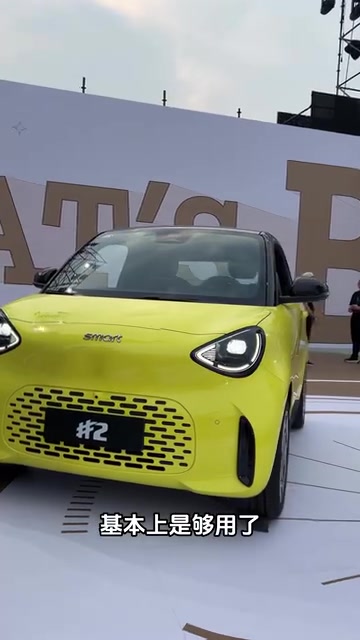
The smart Elf #2 continues the classic two-door, two-seat layout, designed by the Mercedes-Benz global design team. The body length is under 3 meters, with a turning radius of just over 3 meters, giving it obvious advantages in narrow city roads and parking scenarios.
In terms of range, the CLTC combined range is 410 kilometers, which at typical daily commuting intensity basically means one charge per week. Classic design elements such as the two-stage split tailgate and the through-type continuous bench seat have also been retained, giving it a strong sense of heritage.
CLTC is the abbreviation for China Light-duty Vehicle Test Cycle, formulated under the leadership of the Ministry of Industry and Information Technology, and has gradually replaced the previous NEDC cycle since 2021. CLTC was developed based on actual driving data from 41 cities across the country covering over 30 million kilometers, with a lower average speed and higher idle proportion, making it closer to domestic urban congestion conditions. However, its test environment uses ideal conditions such as normal temperature and air conditioning turned off, so actual range is usually lower than the rated value — with even more noticeable reduction in low winter temperatures. Therefore, the 410 km CLTC range can be used as a reference for daily commuting, but cross-city trips require reserving a margin.
Who It's For: Two Clear User Profiles
The creator provided clear user profiles in the video. The first category is single users or young couples using it for daily urban commuting — easy to drive and park, and distinctive enough. The second category is families that already have a large car, adding a second vehicle for short-distance errands — flexible and hassle-free for grocery shopping, picking up kids, and getting around the city.
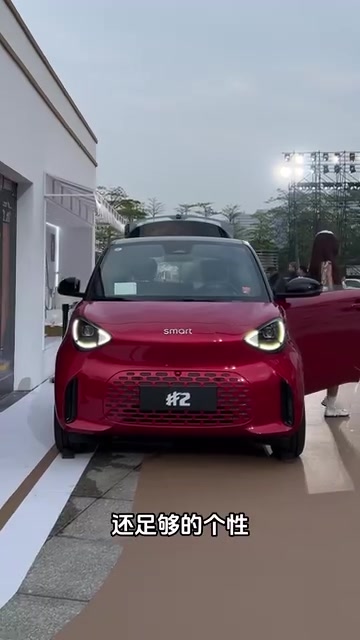
The core selling points can be summarized as: compact and refined, easy to use, and stylish to look at. The limited-time promotional price of 99,900 yuan brings the threshold for a "refined two-seat compact car" to a rather attractive position.
Two-door, two-seat layout (also known as dual-seat layout) from an engineering perspective means eliminating the rear seats and the large section of body behind the B-pillar, allowing wheelbase and body length to be significantly compressed in exchange for a smaller turning radius and more flexible parking capability; the trade-off is a maximum capacity of two people, unable to accommodate multi-person travel. The smart brand's early fortwo model was the representative of this layout, and its "compact and refined" product perception was established from this. For family users, it is more suitable as a supplementary second vehicle rather than the only car.
Summary
The smart Elf #2 has played a differentiation card in the 100,000-yuan-class market with L2 assisted driving, branded audio, and classic design elements. It doesn't try to satisfy everyone, but for its target users, the match between configuration sincerity and price positioning is quite high. As for whether this compact car fits your needs, it's worth experiencing in person at a dealership.
One-line Summary
The smart Elf #2 launches starting at 99,900 yuan, with L2 assisted driving and branded audio trickling down as the biggest surprises.
Paragraph Summary
The smart Elf #2 has officially launched, with the Premium Luxury Edition starting at a limited-time promotional price of 99,900 yuan. As a boutique two-door, two-seat compact car, it delivers sincerity beyond expectations in its configuration: L2-level assisted driving includes not only ACC following but also Lane Change Assist (LCA), and seven DeepSea Audio speakers are also equipped directly on the Luxury Edition. With a body length under 3 meters, a turning radius of just over 3 meters, and a CLTC range of 410 kilometers, daily commuting basically requires just one charge per week. The target users are clear: singles or couples for urban commuting, and families that already have a large car looking for a second short-distance vehicle. Overall, with its compact refinement, ease of driving and parking, and differentiated configuration, it has carved out a unique position in the 100,000-yuan-class market.
Related articles

FBI and USDA Hit by Cyberattacks: Critical Infrastructure Security Alarms Sound Again
FBI and USDA reportedly hit by cyberattacks; the FBI was breached for the second time in recent months, this time targeting the National Crime Information Center (NCIC). This article analyzes the incident details, NCIC's strategic value, and common security challenges facing government agencies.
How Do UK Grid Battery Storage Systems Make Money?
How UK grid battery storage makes money: stacking frequency response, capacity market, and wholesale arbitrage revenue, plus operational trade-offs and market risks.
Riemann Hypothesis Formally Verified in Lean? Joint Statement Sparks Heated Debate
The Lean community blog published a joint statement on formal verification of the Riemann Hypothesis, sparking heated discussion on Hacker News with 359 points and 263 comments. This article analyzes the background of Lean and mathlib formal verification, polarized community reactions, and why one should not conclude the Riemann Hypothesis has been proven before reading the original text.