SME Spatial Memory Engine: The Open-Source AI Memory Plugin That Topped Long-Term Memory Benchmarks

Open-source SME Spatial Memory Engine scores 96.7% in blind benchmarks, beating MEM0 and other top AI memory solutions.
SME (Spatial Memory Engine) is an open-source AI long-term memory plugin built by an independent developer to solve the "forgets everything" problem in LLMs. It manages memory through spatial partitioning, dynamic decay, and 8-signal explainable retrieval. In a 40-question blind evaluation with three random seeds, SME scored 96.7% — beating MEM0, GRAFFITY, and three other leading solutions — and improved from 92.5% to 95% accuracy across three conversation replays. Engineering benchmarks show 1.79× write throughput, 7.4× batch processing, and 127–159× faster graph retrieval, with bi-temporal modeling and MCP protocol support. The project is Apache 2.0 licensed, though evaluation data is currently self-reported and awaits independent community validation.
One of the most frustrating limitations of today's large language models is their tendency to "forget everything after the conversation ends" — tell them something today, and tomorrow they'll have no recollection of it. One independent developer decided to tackle this problem single-handedly, releasing an open-source memory plugin called SME (Spatial Memory Engine) that claimed first place in a blind multi-solution comparison. This article breaks down its core mechanisms, benchmark results, and engineering performance.
From "Forget It All" to "Gets Smarter the More You Chat"
SME's core idea is to manage AI memory as an administrable "space." The author uses a "large island" zoning metaphor — memories are partitioned into different spatial regions, paired with a dynamic decay mechanism that naturally phases out old, low-value information while retaining and reinforcing what matters.
On the retrieval side, SME introduces a "near-far fusion" multi-signal strategy, claiming to integrate 8 distinct signals for explainable retrieval. This means every recalled memory comes with a clear rationale rather than being silently injected into context as a black-box operation. In practice, explainability is often more valuable than raw recall rates — both for debugging and for building user trust.
Blind Evaluation: 96.7% to Claim First Place
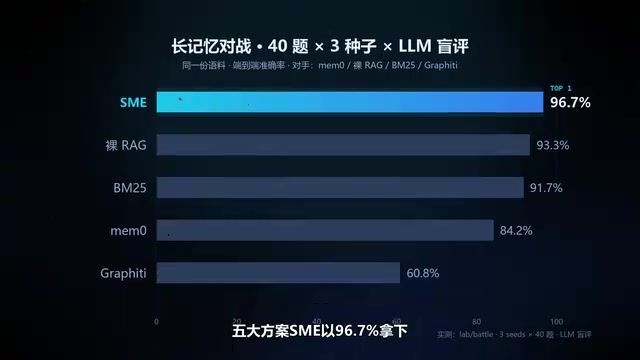
The benchmark section is the most compelling part of the case for SME. The author designed a 40-question evaluation with three random seeds, using an LLM-as-judge blind evaluation setup to pit SME head-to-head against five mainstream memory solutions including MEM0 and GRAFFITY. SME came out on top with a score of 96.7%.
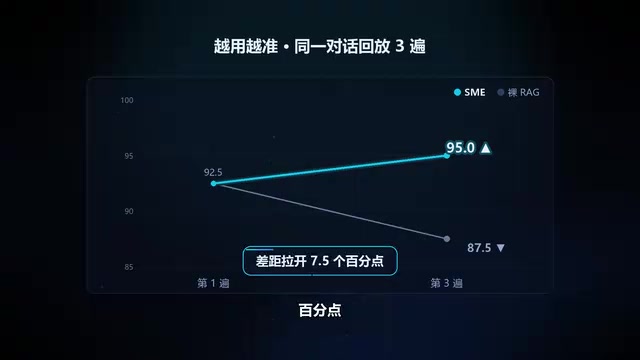
Even more noteworthy is the "gets better with use" characteristic. Replaying the same conversation three times, SME's performance climbed from 92.5% all the way to 95%; meanwhile, the competing solution LORAC dropped from a high score down to 87.5%, creating a gap of a full 7.5 percentage points. This data suggests that SME's memory consolidation mechanism self-reinforces through repeated use rather than degrading as context grows.
It's worth noting that all these figures come from evaluations designed by the author himself, without independent third-party replication. Readers may want to wait for community validation before drawing firm conclusions.
Engineering Performance: Significant Gains in Read/Write and Retrieval
Beyond quality, SME also presents a set of engineering benchmarks. According to the author, SME achieves approximately 1.79× improvement in write throughput, 7.4× improvement in batch ingestion, and a remarkable 127 to 159× speedup in graph retrieval. For agent use cases that require frequent memory reads and writes, these performance gaps directly impact response experience.
At the infrastructure level, SME supports BITEMPRO bi-temporal modeling and PPR graph expansion. Bi-temporal modeling means it can simultaneously track "when an event occurred" and "when the memory was recorded" — a critical capability for handling time-sensitive conversations.
A note on the underlying technologies: BITEMPRO bi-temporal modeling is a classic database concept with particularly important applications in memory engines. Traditional systems only record "transaction time" (when something was stored), while bi-temporal modeling additionally maintains "valid time" — the period during which an event actually occurred in the real world. For example, if a user tells an AI in March "I changed jobs last month," bi-temporal modeling can simultaneously tag the fact "changed jobs in February" with its real-world timestamp and "recorded in March" as its ingestion timestamp. This allows the system to correctly answer time-sensitive questions like "how long have you been at your new job?" without confusing when events happened with when they were written to memory. PPR (Personalized PageRank) graph expansion is a graph database association-diffusion algorithm that starts from a memory node and propagates outward along knowledge graph edges with weight decay, helping the system surface background memories that are indirectly related to a query but critical for understanding user intent.
Idle-Time Auto-Consolidation and Plug-and-Play Integration
SME also includes a built-in "idle-time auto-consolidation" mechanism — when the system is idle, it automatically organizes, merges, and archives memories to prevent the memory store from growing chaotically over time. This design directly supports the "gets better with use" behavior described earlier.
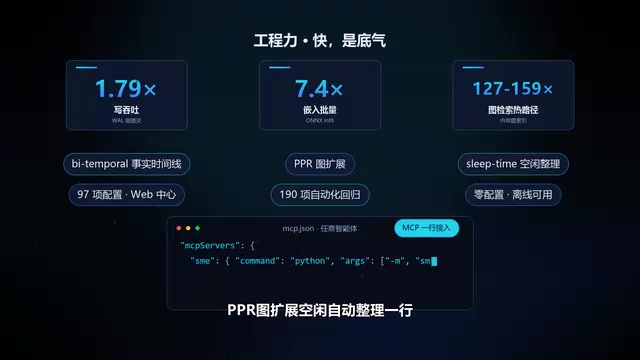
For integration, SME connects to any agent via the MCP (Model Context Protocol), theoretically enabling plug-and-play long-term memory for any Agent framework. The project is open-sourced under the Apache 2.0 license and comes with 190 automated regression tests to safeguard code quality. Interested developers can search for "Spatial Memory Engine" on GitHub to access the source code and test it themselves.
About MCP: MCP (Model Context Protocol) is an open protocol proposed by Anthropic in late 2024 and adopted by the community, designed to provide a standardized context injection interface between large models and external tools or data sources. Its core idea is similar to a universal USB standard: tool developers simply expose their capabilities according to the protocol, and any MCP-compatible AI client (such as Claude Desktop or Cursor) can call them without additional adaptation. By choosing MCP as its integration layer, SME means developers don't need to write separate integration code for different Agent frameworks — theoretically lowering the barrier to adoption significantly. This is also why more and more memory plugins and search tools are prioritizing MCP support: ecosystem compatibility has become a key competitive advantage at the tooling layer.
Conclusion
SME is a classic example of an independent developer going up against larger teams. It presents impressive self-reported numbers in memory retrieval, blind evaluation scores, and engineering performance — with the "gets better with use" property being particularly intriguing. That said, these figures currently come primarily from the author's own testing, and their true weight still needs to be validated through large-scale community testing. For developers struggling with agent memory challenges, this is an open-source option well worth trying out firsthand.
Related articles

Felix Rieseberg Personal Homepage
Felix Rieseberg's personal homepage sparks attention on Hacker News. This article covers the Slack engineer's technical background, the rise and fall of nativefier, and the value of a developer homepage as a tech calling card.

@ai-sdk/vue 3.0.306 Patch Release Syncs with [email protected] Update
@ai-sdk/vue 3.0.306 released, synced with [email protected]. A routine patch release for the Vercel AI SDK ecosystem with no public API changes; the Vue adapter layer stays version-aligned with the core package.

Gemini 4 Argon API Launches: The Era of Million-Token Output Begins
Google launches Gemini 4 Argon with sparse MoE architecture, up to 1M output tokens, and a 68.90% Vals Index score, available across API, AI Studio, and the Gemini app.