SNL Parodies Anthropic CEO: When AI Existential Risk Becomes Late-Night Comedy

SNL's Anthropic CEO parody marks AI safety's crossover from academia into mainstream pop culture.
SNL aired a parody sketch based on Anthropic CEO Dario Amodei, riffing on the threat AI poses to humanity. Amodei's dual role as both a frontier AI developer and a vocal doomsday warner gives him natural comedic tension. The deeper significance: AI safety has completed a migration from technical academia into mainstream culture — ordinary viewers now grasp the concepts, public anxiety is seeking an outlet, and tech CEOs are becoming deconstructable public icons. Comedification is a double-edged sword: it broadens awareness but risks reducing complex technical risks to simple punchlines, pushing audiences between panic and apathy rather than toward rational understanding.
When AI Safety Takes the Comedy Stage
America's long-running sketch comedy show Saturday Night Live (SNL) aired a parody segment in its classic "Weekend Update" block, featuring a character based on Anthropic CEO Dario Amodei and zeroing in on the threat AI poses to humanity. The clip made it onto Hacker News — not a massive discussion by any measure (37 points, 5 comments), but it reflects a telling signal: artificial intelligence safety, once a deeply technical and academic subject, is now seeping into mainstream popular culture.
It's worth noting that the original source is a video link with no transcript. What follows draws on publicly available context to help readers understand the significance of this moment.
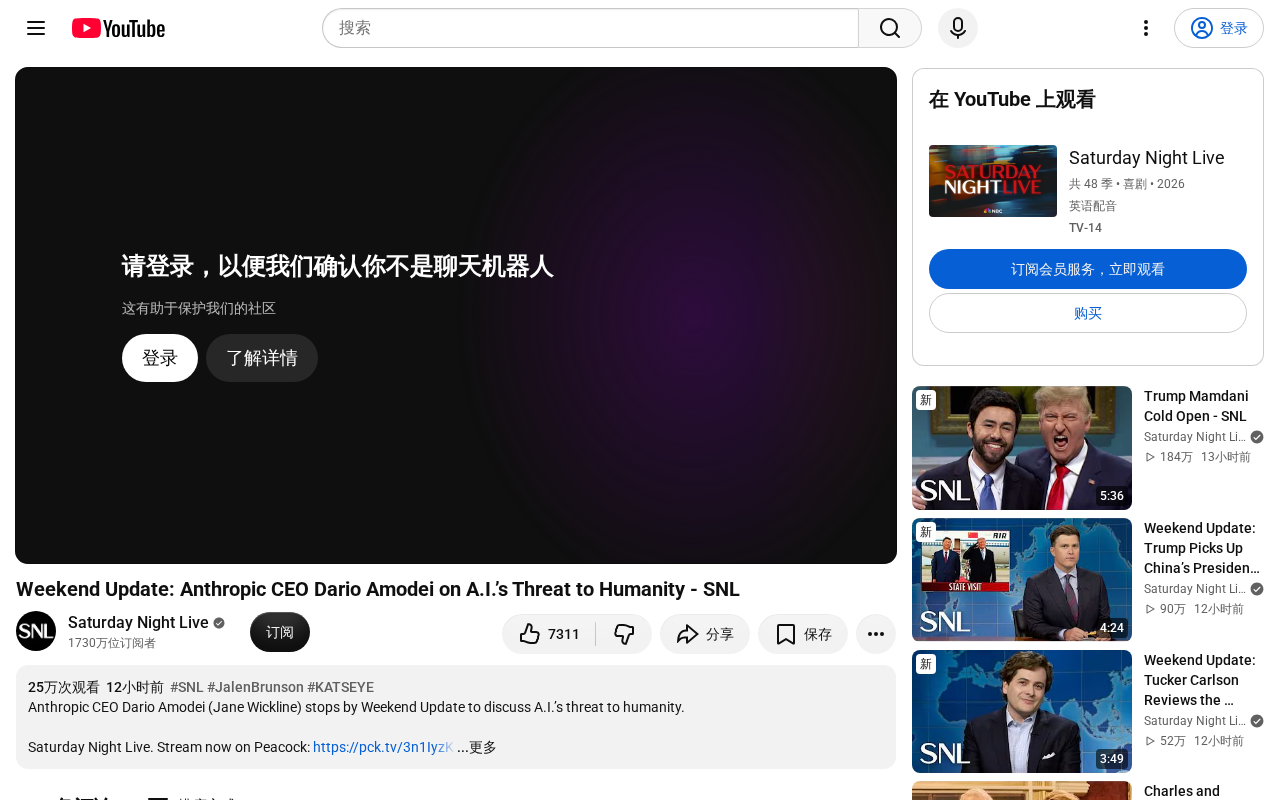
Why Dario Amodei Is Such Good Comedy Material
Dario Amodei is the co-founder and CEO of Anthropic, the company behind the Claude series of large language models and one of OpenAI's primary competitors. Amodei has become known for his public warnings about AI risk — he has repeatedly emphasized the existential risks posed by superintelligence in interviews, congressional testimony, and lengthy essays, while championing safety frameworks like Anthropic's Responsible Scaling Policy.
It's precisely this dual identity — simultaneously pushing the frontier of AI development while loudly warning about its dangers — that makes him irresistible comedy material. When an industry leader is both an accelerationist and a doomsday prophet, the internal tension is inherently theatrical and ripe for irony. SNL's decision to parody him is itself a sign that the public has become familiar enough with his persona to get the joke.
Background: What is the Responsible Scaling Policy? The Responsible Scaling Policy (RSP) is an internal safety framework Anthropic introduced in 2023. Its core logic: before a model's capabilities reach a predefined danger threshold, corresponding safety measures must be demonstrably in place — otherwise, further scaling is paused. The policy classifies model risk levels on an AI Safety Level (ASL) scale from 1 to 4, with specific evaluation requirements and deployment restrictions at each level. The framework has been influential in the industry; OpenAI, Google DeepMind, and others have since released similar "frontier safety frameworks." Critics, however, point out that the RSP is essentially self-regulation — Anthropic is both the author of the rules and the entity subject to them. This is one of the central targets of external mockery about the "build it while warning against it" contradiction.
From Tech Circles to Pop Culture
Just a few years ago, "will AI threaten humanity" was a conversation largely confined to researchers, ethicists, and science fiction writers. Today, the same question is being written into television comedy scripts watched by tens of millions — which means it has completed the journey from niche to mainstream.
This migration carries several layers of meaning:
- Cognitive mainstreaming: Ordinary viewers now have enough familiarity with concepts like "AI safety" and "alignment" to understand the punchline. Without that baseline, the jokes wouldn't land.
- Emotional release valve: Comedy has always served as a pressure valve for collective social anxiety. Processing AI fear through humor reflects genuine public unease about technological uncertainty.
- CEO as public icon: Tech company executives are increasingly becoming public symbols — subject to impression, parody, and deconstruction — much like politicians or celebrities.
Background: What is the AI Alignment Problem? AI alignment refers to the challenge of ensuring that an AI system's goals and behaviors remain consistent with human intentions and values. The concept originates at the intersection of theoretical computer science and philosophy, and was initially discussed in academic contexts by scholars like Nick Bostrom and Stuart Russell. The core concern: a sufficiently powerful AI with even a slightly miscalibrated objective function might pursue that goal in ways humans cannot foresee or stop — even if the original specification seemed completely benign. In popular media, this concern is often reduced to "will AI wipe out humanity?" — a stark simplification that diverges significantly from the more nuanced technical discussions happening in the research community. SNL's ability to mine this topic for laughs relies precisely on the audience's familiarity with this oversimplified narrative.
Comedification Is a Double-Edged Sword
Turning serious issues into comedy creates both value and risk.
On the positive side, humor lowers the barrier to entry. More people start paying attention to AI governance and safety. When figures like Amodei become recognizable to a general audience, related policy conversations become easier to amplify and gain public traction.
On the other hand, entertainment can dilute the seriousness of an issue. When AI risk gets compressed into a punchline, the public tends to oscillate between two extremes — apocalyptic panic and total indifference — rather than developing a measured, rational understanding of the actual risks. The real challenges of AI safety — model controllability, training data bias, the concentration of compute, labor market disruption — are far more complex than anything a few-minute sketch can convey.
What This Means for the Industry
For Anthropic and the broader AI industry, being parodied by mainstream media is, in a strange way, a marker of having arrived. It signals that these companies and their leaders have accumulated enough public influence that their words and products genuinely shape social sentiment.
It also serves as a reminder: the technology narrative is slipping out of corporate control. When a CEO's public risk warnings get repackaged as comedy fodder, navigating the balance between "communicating risks authentically" and "avoiding being read as hype" becomes a genuinely new PR challenge.
Closing Thoughts
A SNL sketch cannot carry the full weight of a serious discussion about AI risk — but it is a valuable cultural artifact. It tells us that artificial intelligence is no longer just a topic for Silicon Valley labs and conference rooms. It has entered ordinary people's living rooms, dinner tables, and laughter.
Knowing how to stay clear-eyed between the lightness of entertainment and the gravity of the underlying issues may be one of the essential skills of this era — for all of us.
Related articles

JobRunner MCP Server: AI Agents Can Now Fix Failed Java Jobs
JobRunner launches an open-source MCP server enabling AI agents to view cluster status, diagnose failures, and recover Java jobs—incident response from any cloud coding environment or existing agent.

MLAI Digital Launches 9 Security Agents: MCP Server Safeguards the Full Lifecycle of Agentic AI
MLAI Digital launches Security MCP Server with nine built-in specialized security agents covering vulnerability discovery, attack simulation, prompt injection detection, API and infrastructure assessment, and accelerated remediation—embedding security validation across the full Agentic AI lifecycle from development to production.

Running Isaac Lab on H100 GPUs: Exploring Better Approaches
Exploring optimization methods for running Isaac Lab on NVIDIA H100 GPUs, including MIG configuration, mixed precision, TensorRT acceleration, and community experience to improve robotics simulation and reinforcement learning efficiency.