SO(3)-Equivariant Kernel Methods: Making Neural Operators Truly Rotation-Invariant

IKNO encodes SO(3) equivariance directly into its architecture, matching TFN accuracy with 5.6× fewer parameters.
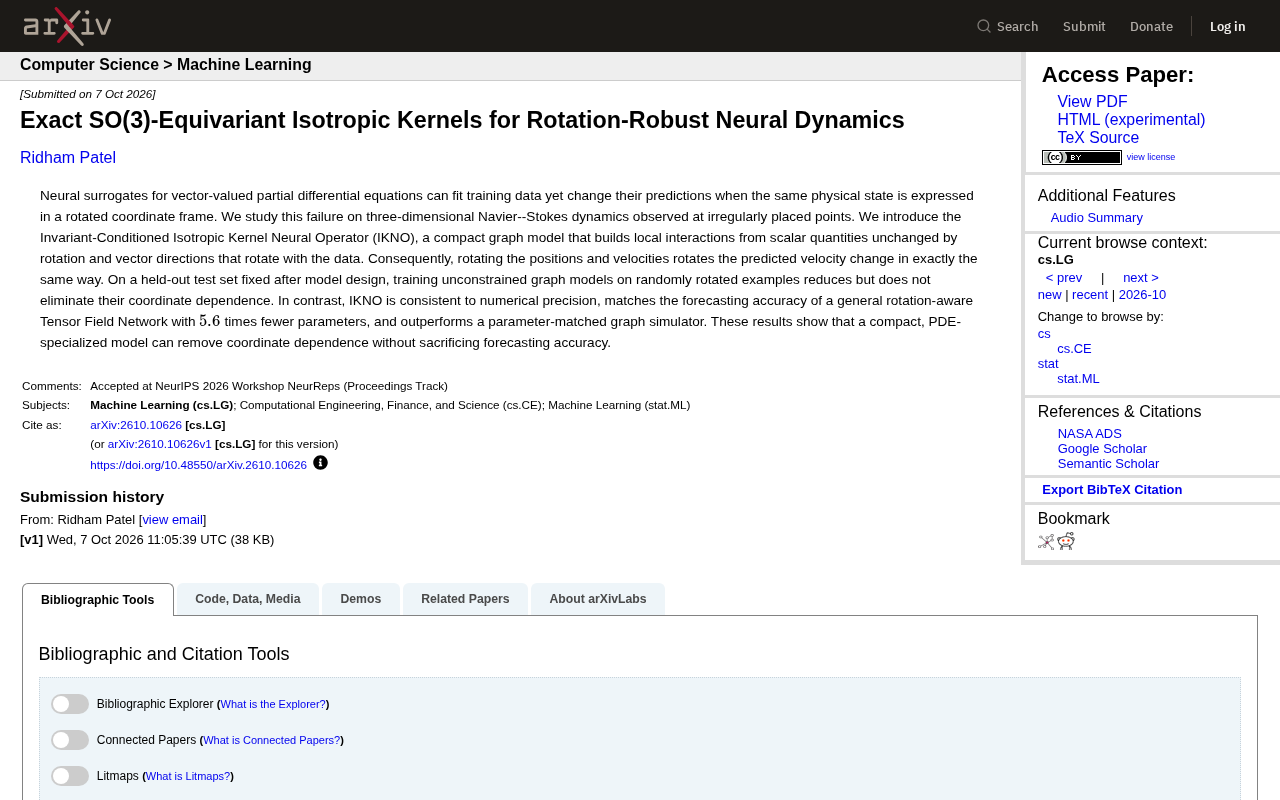
To address the physical consistency flaw where neural surrogates produce different predictions under rotated coordinate frames, the paper proposes the Invariant-Conditioned Isotropic Kernel Neural Operator (IKNO). Experiments show that random rotation data augmentation can only reduce — not eliminate — coordinate dependence; the real fix must come from the model architecture itself. IKNO achieves strict SO(3) equivariance to numerical precision by constructing local interactions from rotation-invariant scalars and co-rotating vector directions. On 3D Navier–Stokes benchmarks, IKNO matches the accuracy of Tensor Field Networks (TFN) using only ~1/5.6 the parameters, while outperforming graph simulators of comparable size.
A Long-Overlooked Physical Consistency Problem
Using neural networks to approximately solve partial differential equations (PDEs) has become a hot topic in scientific computing — these models are known as neural surrogates. They can fit training data and deliver fast predictions, but there's a long-overlooked vulnerability: when the same physical state is expressed in a rotated coordinate system, the model's predictions change.
This clearly violates the laws of physics. For a real fluid system, no matter how you rotate the observation coordinate frame, the underlying dynamics should remain unchanged. A recent arXiv paper (arXiv:2610.10626) addresses exactly this issue, focusing on dynamics modeling for 3D Navier–Stokes equations on irregularly sampled points.
Why Random Rotation Data Augmentation Isn't Enough
The most common approach to handling coordinate dependence is data augmentation — randomly rotating samples during training and hoping the model learns rotation invariance on its own. But the paper's experimental results are quite compelling: on a fixed test set evaluated after model design, unconstrained graph models trained with randomly rotated samples do reduce coordinate dependence, but cannot eliminate it entirely.
This means relying on data augmentation is only an approximate, statistical patch — the model can still be fundamentally sensitive to the choice of coordinate frame. For scientific computing tasks that demand physical rigor, this residual error is unacceptable. The real solution should guarantee rotational equivariance at the architectural level, not compensate for it through training tricks.
IKNO: Baking Rotational Symmetry into the Model Architecture
The core method proposed in the paper is called the Invariant-Conditioned Isotropic Kernel Neural Operator (IKNO). It is a compact graph model whose design philosophy can be summarized as: build local interactions using scalar quantities that remain invariant under rotation, and vector directions that rotate together with the data.
This construction yields an elegant mathematical property: when you rotate the input positions and velocities, the predicted velocity changes rotate in exactly the same way. This is the strict definition of SO(3) equivariance — where SO(3) is the group of all rotations in three-dimensional space. In other words, IKNO doesn't approximate rotation invariance; it achieves strict consistency to numerical precision.
The Key Difference Between Approximate and Exact
An unconstrained model with data augmentation produces rotation robustness that is "learned and imperfect"; IKNO produces rotation equivariance that is "structurally guaranteed and exact." This distinction is highly significant in practice: the former's errors surface when the input distribution shifts, while the latter is inherently immune to any bias introduced by coordinate frame transformations.
SO(3) equivariance deserves a brief elaboration. SO(3) is the special orthogonal group in three dimensions, comprising all 3×3 orthogonal matrices with determinant +1 — intuitively corresponding to rotations about any axis in 3D space (excluding reflections). "Equivariant" versus "invariant" is an important distinction: invariance means the output doesn't change under rotation (e.g., a molecule's total energy), while equivariance means the output transforms in the same way as the input — if the input velocity field rotates by angle θ, the predicted velocity should rotate by exactly the same θ. Fluid dynamics modeling needs equivariance, because velocity is a vector field whose direction carries physical information. Isotropic kernels are the key building block for achieving this property: isotropy means the kernel function depends only on the distance between two points and scalar features that remain invariant under rotation — not on absolute coordinates — thereby naturally satisfying rotational symmetry at the architectural level.
No Accuracy Trade-off, but Far Fewer Parameters
A common concern is whether strict symmetry constraints come at the cost of predictive accuracy. The paper's experimental results dispel this worry.
IKNO matches the predictive accuracy of a general rotation-aware model — Tensor Field Networks (TFN) — while using only about 1/5.6 of the parameters. At the same time, compared to graph simulators with a comparable parameter count, IKNO performs even better. This set of comparisons sends a clear message: a compact, PDE-specific model can completely eliminate coordinate dependence without sacrificing predictive accuracy.
From another angle, specialized design demonstrates an efficiency advantage over general equivariant architectures. TFN, as a general-purpose framework, must handle all kinds of symmetries, while IKNO is structurally tailored to the specific problem of Navier–Stokes, allowing it to achieve equivalent results with far fewer parameters.
Tensor Field Networks (TFN), proposed in 2018, are a class of general-purpose equivariant graph neural networks whose core idea is to expand features using spherical harmonics, making the network strictly equivariant to SO(3) rotations. Spherical harmonics are a set of orthogonal basis functions defined on the sphere, characterized by "order" l to describe angular momentum: l=0 corresponds to scalars (rotation-invariant), l=1 to vectors (linearly transformed under rotation), and higher orders to tensor representations. TFN's expressiveness increases with the maximum order considered, but the computational and parameter overhead rises sharply as well — this is the fundamental reason why general equivariant architectures tend to have high parameter counts. IKNO circumvents the overhead of high-order tensors by restricting the model to the physical structure of the Navier–Stokes problem, retaining only the necessary invariant scalars and l=1 vector features, achieving the same equivariance guarantee through a much leaner pathway.
Implications for Scientific Machine Learning
The value of this work lies not just in a new model, but in re-emphasizing the weight of inductive bias in scientific machine learning. When we know explicitly what symmetries a physical system must obey, it's far better to directly encode them into the network architecture than to let the model "guess" these patterns from vast amounts of data.
For researchers working in fluid simulation, weather prediction, molecular dynamics, and related fields, IKNO's approach offers a replicable paradigm: exact equivariance + compact structure + no accuracy loss. These PDE-specific models may not be able to "do it all" like general large models, but for specific scientific problems, the physical consistency and parameter efficiency they demonstrate are precisely what general-purpose methods struggle to match.
Of course, the paper's validation currently focuses on the specific scenario of 3D Navier–Stokes dynamics, and whether the method generalizes to a broader range of vector-valued PDE problems remains to be verified by follow-up research. But it clearly proves one thing: coordinate dependence is not an inescapable fate for neural operators.
Inductive bias refers to assumptions about the structure of the target problem that are pre-embedded at the model design stage, with the goal of narrowing the hypothesis space and improving sample efficiency. In classical machine learning, the translational equivariance of CNNs for images is a typical example of inductive bias. For physical systems, conservation laws, symmetries, and differential structure are known and precise prior knowledge — encoding them into model architecture theoretically yields three simultaneous benefits: reducing the training data needed to achieve a given accuracy, improving generalization on out-of-distribution inputs, and ensuring physically self-consistent predictions. IKNO's work is a concrete realization of this idea, and together with Physics-Informed Neural Networks (PINNs), Hamiltonian/Lagrangian neural networks, and similar directions, it forms a representative body of work within the "physics-structure embedding" research paradigm.
Related articles

How Big Can Stars Really Get? The Physical Limits of the Largest Stars
Red supergiants are the largest stars by volume, with radii up to 2,000 times the Sun, engulfing the inner solar system. But there is no precise upper limit on stellar size—models predict up to 15,000 solar radii. The most massive blue stars are far smaller than red supergiants—biggest and heaviest are two different things.

Apple HomeView Smart Display Full Feature Breakdown: Wall-Mount or Desktop, $299
Apple launches HomeView, a $299 smart display with wall-mount and desktop options, 12MP camera for facial recognition, smart home control, music playback, and recipe step-by-step cooking. Full breakdown of watch faces, apps, privacy, and cooking integration.

Where Did the Promised New Studio Go? Craft Computing Answers After Five Years
Craft Computing's host responds to viewer questions: the new studio promised five years ago was shelved as construction costs soared from $30,000 to $75,000, and was replaced by a 168-square-foot garage conversion.