SoftBank's $3 Billion Gas Turbine Order Fails, Dealing a Blow to AI Power Ambitions

SoftBank pre-ordered gas turbines to power AI data centers but lost over $3 billion, warning the industry about expansion risks.
SoftBank pre-ordered natural gas turbines for AI data centers, recording losses exceeding $3 billion, exposing deep contradictions between AI computing expansion and the power supply chain. AI cluster power density far exceeds traditional data centers, and natural gas is viewed as transitional baseload power due to rapid deployment and stable output, but the pre-order model forces buyers to bear dual risks of equipment price fluctuations and demand changes. This rare loss may prompt other developers to reassess financing conditions and procurement strategies, shifting from large-scale pre-orders to long-term agreements, phased procurement, or gas-storage combinations. The article argues that natural gas's role in AI power supply won't end, but breakneck expansion will be constrained by capital discipline, and the industry may move toward more mature energy planning.
SoftBank pre-ordered natural gas turbines for AI data centers but recorded losses exceeding $3 billion. This massive loss not only exposes the power bottleneck in AI infrastructure expansion but may also cool down the roaring "natural gas + AI" narrative.
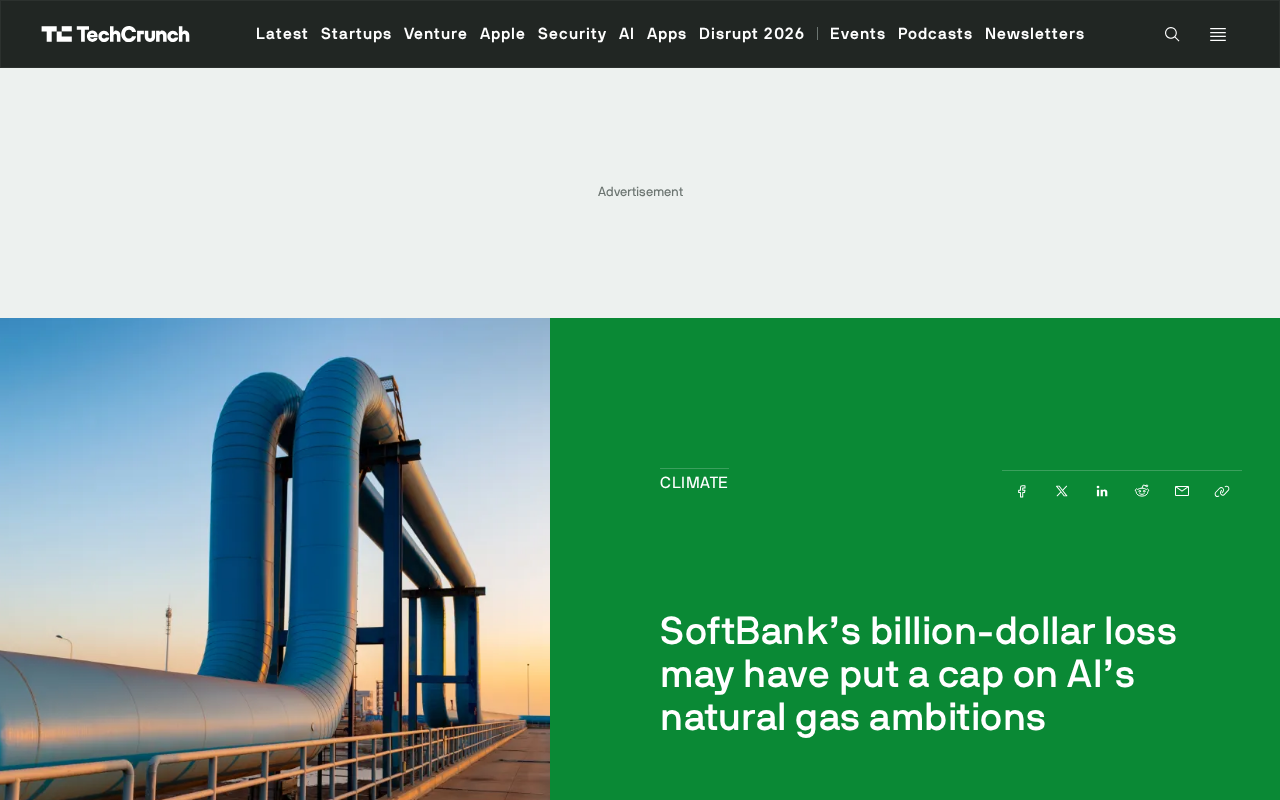
A Costly Bet on Power
According to RSS sources, SoftBank's pre-order for natural gas turbines resulted in losses exceeding $3 billion. The order was originally intended to provide stable power for power-hungry AI data centers and was a key component of SoftBank's AI infrastructure blueprint. However, the pre-order model is uncommon in energy markets—it requires buyers to bear the risks of price fluctuations and demand changes before equipment delivery. When market conditions or project timelines fall short of expectations, massive prepayments can turn into sunk costs.
This loss scale is quite rare in energy procurement, and it directly reflects the impact of AI computing expansion on the power supply chain: demand is arriving too fast, while the delivery cycles and cost structures of power infrastructure struggle to keep pace.
AI Data Centers' Power Hunger and Natural Gas Dependence
The power density of AI training and inference clusters far exceeds that of traditional data centers. To meet ever-rising power demands, tech companies have been forced to look beyond solar and wind for rapidly deployable baseload power. Natural gas, with its relatively short construction cycle and stable output, is viewed as a realistic transitional choice. SoftBank's gas turbine pre-order is an extreme manifestation of this logic—locking in equipment in advance to ensure data centers are powered on schedule.
The problem is that natural gas prices and supply are affected by multiple factors including geopolitics, seasonal demand, and pipeline capacity. Pre-ordering turbines does not equal locking in fuel costs, nor does it mean the project can smoothly connect to the grid. SoftBank's loss demonstrates that converting AI's power anxiety into a high-stakes bet on gas equipment carries risks far higher than expected.
Baseload power and peaking power are key distinctions for understanding power supply choices for AI data centers. Baseload power refers to power sources that can deliver continuous, stable output 24/7 without fluctuating with day-night cycles or weather, such as natural gas, coal power, and nuclear power; peaking power is used to handle load spikes, such as natural gas peaking units and pumped-storage hydroelectricity. AI training clusters have relatively smooth power curves but extremely high baselines—a large data center's continuous load can reach hundreds of megawatts, requiring baseload power as a backstop. Solar and wind are intermittent sources that require energy storage to play a baseload role, and current storage costs and duration still struggle to cover data centers' around-the-clock needs—this is the practical reason natural gas is viewed by tech companies as "transitional baseload."
Grid Interconnection is the invisible bottleneck for AI data center power deployment. Even if companies build their own gas-fired generation, they still need to coordinate grid access with regional power grids, accept dispatch, and meet reliability standards. In the United States, grid interconnection queues for large data centers in some regions have stretched to years, and grid operators are increasingly strict in approving massive new loads. Pre-ordering turbines only solves the equipment side—it cannot bypass grid capacity, transmission upgrades, and regulatory approvals, which is the structural reason why SoftBank-style "high-stakes bets" have amplified risks.
What It Means for Power Markets
This loss could have ripple effects. For other developers planning to follow the "natural gas + AI" model, SoftBank's case is a warning: pre-ordering large turbines requires bearing enormous balance sheet risk, and financial institutions and investors will reassess financing conditions for such projects. On the power market side, if similar orders decline, the growth rate of new natural gas turbine orders may slow in the short term, and grid operators and utilities will be more cautious in approving AI load connections.
However, this does not mean the end of natural gas's role in AI power supply. More likely is an adjustment in procurement strategy—shifting from large-scale pre-orders to more flexible long-term agreements, phased procurement, or combining gas generation with storage and renewable energy to diversify risk. SoftBank's loss is more like a "ceiling signal": AI's natural gas ambitions won't disappear, but breakneck expansion will be constrained by capital discipline.
Long-term Power Purchase Agreements (PPAs) and phased procurement are common risk mitigation tools in energy markets, fundamentally different from the logic of pre-ordering equipment. A PPA is a multi-year fixed or indexed electricity price contract between a buyer and a power generator—the buyer locks in prices but does not bear equipment asset risk; phased procurement places orders in batches according to project progress, reducing one-time sunk costs. SoftBank's pre-order model requires buyers to bear equipment price fluctuation and demand change risks before delivery, essentially front-loading asset risk onto the balance sheet. If the industry shifts from pre-orders to PPAs or "gas + storage + renewables" combinations, it means risk transfers from tech companies to professional power generation operators, and financing structures will adjust accordingly—this is precisely the procurement strategy migration direction that SoftBank's loss may trigger.
The Beginning of Rational Expansion
SoftBank's $3 billion tuition fee reminds the industry that the AI infrastructure race is not just about chips and algorithms—it's also a contest of energy supply chains and risk management capabilities. Power won't automatically become cheap and reliable just because AI needs it, and natural gas turbines won't eliminate market volatility just because they're labeled "AI-specific." For companies aiming to build large-scale computing clusters, how to balance speed, cost, and risk in power procurement will become a more realistic competitive dimension than model parameters.
This loss may put the brakes on some aggressive natural gas pre-order plans, but it also pushes the industry toward more mature energy planning—which may not be a bad thing.
One-line Summary
SoftBank pre-ordered natural gas turbines to power AI data centers but lost over $3 billion, warning the industry about expansion risks.
Paragraph Summary
SoftBank pre-ordered natural gas turbines for AI data centers, recording losses exceeding $3 billion, exposing deep contradictions between AI computing expansion and the power supply chain. AI cluster power density far exceeds traditional data centers, and natural gas is viewed as transitional baseload power due to rapid deployment and stable output, but the pre-order model forces buyers to bear dual risks of equipment price fluctuations and demand changes. This rare loss may prompt other developers to reassess financing conditions and procurement strategies, shifting from large-scale pre-orders to long-term agreements, phased procurement, or gas-storage combinations. The article argues that natural gas's role in AI power supply won't end, but breakneck expansion will be constrained by capital discipline, and the industry may move toward more mature energy planning.
Related articles

Prompt Engineering for Beginners: From Writing Prompts to Engineering Thinking
Starting from the essence and four functions of prompts, this article systematically explains the six-step process, four success criteria, learning value, and practical limitations of prompt engineering to help you build a complete understanding.

Anthropic Launches Nasdaq IPO: AI Giant's Listing and Risk Disclosures
Anthropic officially launches its Nasdaq IPO under ticker ANT, with market valuation expected to potentially exceed SpaceX's record. The prospectus devotes nearly 100 pages to AI risks, while first-half revenue grew over 14x but net losses widened sharply, reigniting the AI bubble debate.

Rust cURL Clone Uses 4,832 unsafe Blocks—Is the Memory Safety Myth Broken?
A Rust cURL clone uses 4,832 unsafe keywords, challenging Rust's memory safety narrative. We analyze what unsafe really means, compare Fil-C, and examine rewrite motives.