Solar Panels Aren't Enough: How the Anker Solix X1 Solves Power and Water Outages

Anker Solix X1 with ATS gateway keeps solar running during blackouts, solving a rural property's water pump problem.
This article covers a home energy storage upgrade on a rural property outside Toowoomba, Australia. The household relied on an electric pump for water supply, making blackouts a serious problem. Despite having 7 kW of rooftop solar, the grid-tied system had to shut down during outages. The upgrade centers on the Anker Solix X1 with a 20 kWh battery, 8 kW inverter, and PowerDock Pro ATS gateway, enabling solar to continue operating during blackouts. One month of data showed 92% self-sufficiency, though Mark cautions this reflects grid usage share rather than bill savings — and the system has yet to face a real storm.
The Overlooked Problem: No Water When the Power Goes Out
On a rural property outside Toowoomba, Australia, Mark from the Self Sufficient Me channel documented a real-world challenge faced by many families in the countryside and remote areas. His sister and brother-in-law live on a farmstead surrounded by large trees, with power lines running through the countryside. Every time a major storm hits, trees fall on lines and outages can last for hours.
The real problem isn't the loss of lighting — it's the loss of water. Their home is supplied by a large rainwater tank, but getting that water into the house requires an electric pump. When the power goes out, the pump stops, and suddenly showering, running the taps, and even flushing the toilet all become impossible.
The brother-in-law had come up with a clever workaround — a DIY battery-and-inverter unit mounted on a trolley that he could wheel over and connect to the pump as needed. Mark acknowledged it as a "smart DIY solution," but the exposed wiring and the need for manual deployment made it anything but reliable, especially when a storm was raging and the grid had already gone down.
Why Doesn't Solar Power Help During an Outage?
This case highlights a critical misconception: having solar panels does not mean you'll have electricity when the grid goes down.
The property already had around 7 kW of solar panels and a 5 kW inverter — a fairly new and decent-quality system. But they lacked a home battery, and the excess power they exported to the grid earned them only about three to four cents per kilowatt-hour — almost worthless. More importantly, a conventional grid-tied solar system is required to automatically disconnect during a blackout. This is a safety measure to protect utility workers repairing lines from being exposed to back-fed current.
In other words, without the right storage and switching equipment, solar panels are essentially useless during a power outage. That's exactly the core problem this upgrade was designed to solve.
The fundamental reason grid-tied solar systems must disconnect comes down to the "islanding" protection mechanism. When the grid goes down, if a PV inverter continues to feed power into the local lines, utility workers may assume the lines are dead and make contact — with potentially fatal results. Electrical regulations in most countries therefore require grid-tied inverters to shut down within a few hundred milliseconds of detecting grid failure — a function known as "anti-islanding protection." This rule exists for good reason, but it also creates the frustrating situation where you have sunlight, you have a battery, and you still can't use any power. There are two mainstream approaches to resolving this: one is to use a hybrid inverter with an off-grid switching function, which automatically isolates the home from the public grid during an outage and forms a local microgrid; the other is to install an automatic transfer switch (ATS) alongside the existing grid-tied system, physically separating the home circuit from the utility supply so that solar and battery storage can legally and safely continue to operate.
Breaking Down the Anker Solix X1 + PowerDock Pro Solution
The centerpiece of this installation is the Anker Solix X1 system, configured with four 5 kWh battery modules for a total nominal capacity of 20 kWh, paired with an 8 kW three-phase inverter. The entire system was installed by Resync Solar.
A few technical points are worth highlighting:
AC coupling with a PowerDock Pro ATS gateway. According to Chris, the technician from Resync, conventional AC-coupled batteries will shut down along with the solar during a blackout. The PowerDock Pro's so-called "black start" capability — the ATS gateway — allows the existing solar system to keep running during an outage, continuing to power the home and charge the battery. This means backup power isn't limited to whatever is stored in the battery at the time; as soon as the sun comes out, energy keeps flowing in.

Additional gains from the inverter upgrade. The original 5 kW inverter had been capping the system's actual output — even with an oversized array, it could never push more than 5 kW. With the new 8 kW inverter, those same panels can now generate six to seven kilowatts under ideal conditions, effectively "coming alive" for the first time. During the installation, the rooftop panels' DC output was also wired directly into the new unit, simplifying the system architecture and improving efficiency.
Real-world energy trade-offs. The household also has a plug-in hybrid vehicle that can charge at up to 7 kW. In theory, with home loads below 1 kW, the 8 kW inverter could charge the car entirely from stored battery power. But Mark was clear-eyed about the trade-off: every kilowatt-hour charged into the car is a kilowatt-hour taken out of the home battery. Balancing daily household use, EV charging, and keeping enough reserve for an outage requires careful thought.
AC coupling and DC coupling are the two primary circuit topologies used in home battery storage systems. In a DC-coupled system, the solar panels' DC output feeds directly into a charge controller before being inverted to AC for home use — fewer conversion steps, slightly higher efficiency, but requires reworking the PV-side wiring. In an AC-coupled system, the existing grid-tied inverter is left in place, and a separate storage inverter is added; both connect to the home's AC bus. Solar generation is consumed directly as AC, and any surplus is "reverse-converted" from AC back to DC by the storage inverter to charge the battery, then discharged again as needed. The biggest advantage of AC coupling is that it allows storage to be retrofitted without significantly modifying an existing, well-functioning solar system — exactly the scenario here. The trade-off is an additional AC-DC-AC conversion step, which reduces overall system efficiency by roughly 3–5%.
92% Self-Powered? Read the Data Carefully
After three to four weeks of full operation, the latest monthly data showed that only 8% of the household's electricity came from the grid — they were essentially living off batteries and solar.

To his credit, Mark was notably measured and honest in his commentary. He was careful to explain that 8% refers to the share of electricity sourced from the grid — it does not mean the electricity bill dropped by 92%. Daily supply charges and the structure of retail electricity pricing still have a significant impact on the final bill. More importantly, one month of data does not represent the full year — seasonal variation, changes in usage habits, summer air conditioning loads, and reduced solar generation in winter will all produce very different results.
This kind of caution with data is far more useful than simply shouting about how much money was saved.
Retail electricity bills in Australia typically consist of two components: a usage charge (billed per kWh consumed) and a daily supply charge (a fixed fee of roughly 30–60 Australian cents per day, regardless of consumption). Even if a household draws virtually nothing from the grid in a given month, the daily supply charge — essentially the fee for remaining connected to the network — is still billed in full and cannot be offset by self-generation. In addition, feed-in tariffs (the rate utilities pay for exported solar energy) have been sharply reduced across many Australian states in recent years, with some regions offering as little as 2–5 cents per kWh — as much as ten times less than the purchase rate. This is the market context behind Mark's comment that selling power back to the grid is "almost worthless." Understanding this pricing structure is essential to accurately estimating the real payback period for a home storage system.
The Real Test Hasn't Come Yet
Interestingly, since the battery system was installed — and even before the PowerDock Pro was completed — the household hasn't experienced a single power outage. Mark laughed that this was Murphy's Law at work; back when he installed his own system, he had been "hoping" for an outage just to test it.
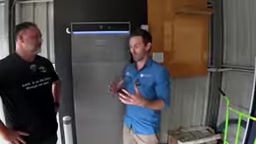
So while the video can show the installation process, early usage data, and even a simulated outage test, it cannot yet show how the system performs in a real storm. With summer approaching and mountain storms becoming more frequent, Mark has committed to a follow-up video in three months, focusing specifically on how critical backup loads like the water pump perform during an actual outage, and how quickly solar can recharge the battery afterward.
This honest acknowledgment of what remains unproven is, arguably, the most valuable part of a product review like this.
Advice for Anyone Considering a Similar Setup
Mark offered a practical decision-making framework: start by being clear on what you actually want the battery to do — store more solar, provide outage backup, support evening usage, charge an EV, or all of the above. Then work through your existing equipment, consumption patterns, and which specific loads need to be covered in a backup scenario with your installer, paying particular attention to whether the system can start and sustain equipment like water pumps.
He also noted that the upfront cost of these systems is significant and may take several years to recoup. But for him and his family, the peace of mind during an outage — especially for a content creator who depends on working at a computer for extended periods — is worth more than the savings on the electricity bill.
It's worth noting that the equipment and installation were provided by Anker in exchange for the video, with no additional cash payment, and the manufacturer applied no pressure on the content. Mark specifically chose Resync Solar — the same company that had previously installed his own system — to carry out the work. This kind of transparent disclosure is commendable in product experience content.
Related articles

Workbuddy for Absolute Beginners: How a Desktop AI Agent Fits Into Real Workflows
A beginner's guide to the Workbuddy desktop AI agent: installation, claiming credits, file management, and building automated workflows—compared with CodeX for fit and cost, helping professionals shift from AI question-askers to AI managers.

OpenAI's New Agent Stack: Computer Use, Decisions API, and Ultra-Fast Workflows
OpenAI Dev Day unveiled a new agent stack: Computer Use outperforms humans, Decisions API delivers ultra-low-latency classification via Luna, Agents API opens the same Computer Use capabilities, and GPT-6.1 Sol costs only one-seventh of Astra. Core updates, benchmark data, and developer insights.

Liang Wenfeng Open-Sources DeepInfo Inference Framework, Takes On U.S. Ban
DeepSeek open-sources its DeepInfo inference framework after its models, featuring GPU/CPU cross-pipelining, small-model prediction with large-model verification, and full Huawei Ascend and NVIDIA chip support—facing the U.S. federal ban head-on. This article analyzes its significance for AI deployment and open-source strategy.