Solar-Powered Mac mini Running Local LLMs: A Practical Guide to Off-Grid AI

Mac mini's unified memory and low power draw enable low-cost, off-grid, round-the-clock local LLM operation.
The article covers an off-grid local AI setup shared by a Bilibili creator: running open-weight models on a Mac mini's large unified memory, with zero usage cost after deployment, no internet needed, and data kept fully local. The small unit draws about 150W continuously while the higher-spec model runs about 480W; efficiency per unit of compute improves with scale. Four solar panels plus a 5 kWh battery support round-the-clock operation. Despite disliking Apple, the author recommends the Mac mini for unified memory value. He stresses task orchestration and multi-AI cross-validation over simple Q&A, and plans to add humanoid robots and Starlink for a fully grid-independent system. Limitations include small model sizes and a lack of reproducible evaluations.
Why Run Local AI Off-Grid
According to a share from the Bilibili creator "DIY Solar Power with Will Prowse," local large models have become remarkably powerful and efficient over the past few weeks, and can now run around the clock on a small off-grid solar system. He emphasizes a widely overlooked fact: these open-weight models can be downloaded for free, and once deployed, continued use incurs no further cost.
More importantly, there's the question of the barrier to entry. The author states plainly that users don't need to be software engineers, and after setup they don't even need an internet connection. This matters enormously for privacy—data no longer flows to big tech companies but stays entirely local. The author notes that some people are already building off-grid, survival-grade AI devices that fit in the palm of your hand.
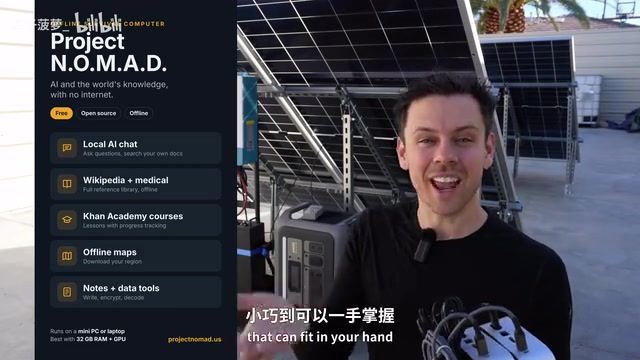
The author admits that just a few months ago he opposed this kind of approach, yet now considers it "absurdly practical"—a shift in attitude that itself illustrates how far local model capabilities have leapt.
The Cheapest Option: A Mac mini Cluster
The author chose the Mac mini as the vehicle for local AI for a straightforward reason: it has large unified memory capacity, and multiple units can be combined to scale up the system. The whole setup process is reduced to the bare minimum—power on, install the software, and the software itself is free.
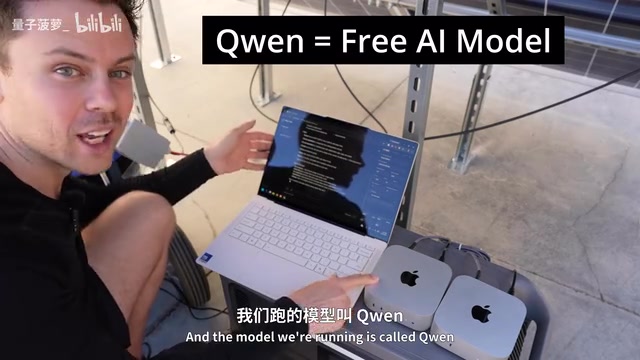
The video demonstrates loading a model called Quinn on the Mac mini, then asking it how to make muffins, to which the model responds properly. The author jokes that you could also use it to design a bunker, illustrating its versatility. These are smaller-scale models, but by adding more unified memory, the intelligence level of the models can be significantly increased.
Larger Mac mini configurations can support models far beyond the entry-level unit—large enough to run models competitive with frontier models. The author calls the current cost-effectiveness of unified memory "ridiculous," and considers it the cheapest and most efficient path to running local AI today.
Unified Memory is a core feature of Apple's M-series chip architecture: the CPU, GPU, and Neural Engine share a single physical memory pool, rather than having a discrete graphics card with its own VRAM as in traditional PCs. This is crucial for local large models—when running a model, the weights must reside entirely in memory that the compute units can directly access. Traditional setups are limited by GPU VRAM (typically 8–24GB), whereas a Mac mini's unified memory can reach 32GB, 64GB, or even 192GB, meaning a single machine can hold larger parameter counts or higher-precision models. The trade-off is lower memory bandwidth than high-end discrete GPUs, so generation speed isn't a strong point—but on the first hurdle in off-grid scenarios, "can it fit at all," the cost per GB of unified memory is currently almost the lowest available.
The "Quinn" mentioned in the article should refer to the Qwen series of open-weight models (a common transliteration error). The distinction between open-weight and fully open source is worth explaining: open-weight means the post-training parameters of a model can be freely downloaded and run locally, but the training data, training code, or full recipe may not be public. For users, the practical significance is that once the model file is on disk, inference happens entirely locally—no API call costs are incurred, and no data is transmitted to any provider. This is precisely the technical precondition behind the article's emphasis on "zero cost after deployment, fully offline," and the source of its privacy advantage.
Power Consumption Is the Core Metric for Off-Grid Solutions
In solar scenarios, energy consumption directly determines system size. The key figures the author provides are: a small Mac mini draws a maximum of about 150 watts during continuous operation, while the configuration capable of running much larger models draws about 480 watts continuously.
This means the bigger the device, the higher the energy efficiency per unit of compute—in his words, efficiency improves as you scale up. For off-grid deployment, this is a counterintuitive but highly favorable conclusion.
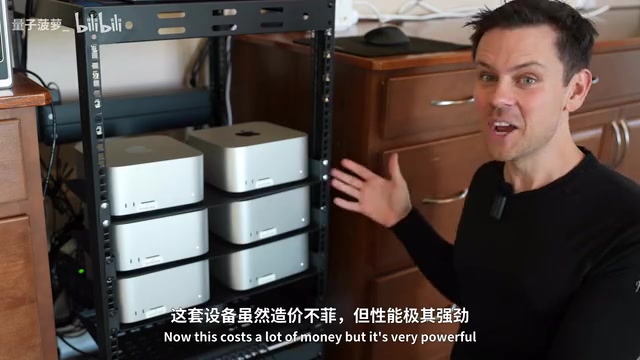
According to the author, with the four solar panels behind him supplying power, this system can run around the clock. To cover nighttime usage, you only need a 5 kWh battery. He mentions he has multiple videos explaining how to set up this system in an hour, and that you can also just buy a plug-and-play off-the-shelf solution without doing it yourself.
Understanding the power figures requires a bit of conversion context. A 5 kWh battery supplying a 480-watt load would theoretically last about 10 hours, but inverter losses and depth-of-discharge limits (lithium batteries are generally not recommended to be drained to 0%) reduce the actual usable capacity, so when running the larger configuration at night, battery capacity often needs a margin. On the other hand, four typical 400-watt solar panels peak at about 1.6 kW under ideal sunlight; after accounting for charge controller and inverter losses, that's enough during the day to both power the load and charge the battery. But on cloudy days or in high-latitude regions in winter, output may drop to 20–30% of peak, at which point the 150-watt smaller model is clearly easier to keep running around the clock. The claim that "the bigger, the more efficient" refers to watts per unit of compute falling, not total power consumption falling.
Why the Author Chose a Product He Doesn't Like
The video contains a rather persuasive confession: the author states outright that he hates Apple, doesn't like the iPhone, has always used Android, yet still admits the Mac mini is the preferred choice for running local AI.
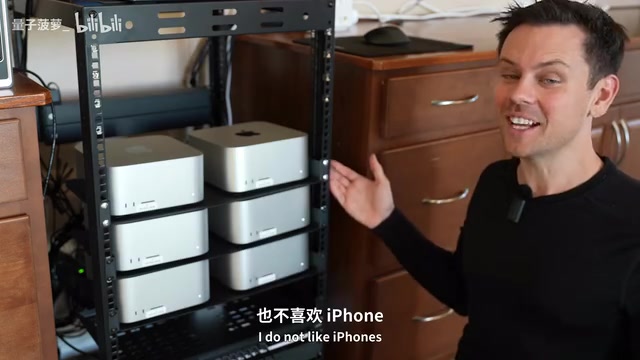
This "set aside brand preference and talk about tool value" framing actually strengthens the credibility of the recommendation. His judgment is based not on ecosystem or experience, but on the cost of unified memory and overall energy efficiency—precisely the two things off-grid AI deployment values most.
He also mentions that you could invest heavily in building your own server rack, but model capabilities are still iterating rapidly, so that path may not be necessary. He himself is continuing to invest, and plans to put the equipment in an underground bunker to prevent theft while staying connected via Starlink, achieving a completely grid-independent AI system.
Don't Just Ask for Muffin Recipes: Task Orchestration Is Where the Value Lies
The author's critique of the current mainstream usage is quite sharp: most people just ask the model simple questions and never really put it to work. His advice is to give it tasks, give it structure, and give it energy.
In his own usage, multiple AI instances form a relationship of division of labor and cross-validation—one AI is responsible for dispatching tasks to the others, and then they check each other's results to ensure output quality. Using his own business scenario as an example, he points out that doing the same work with human labor would require hundreds of employees, whereas AI doesn't get tired, doesn't need insurance, and can operate around the clock.
He also reveals his next step: connecting humanoid robots on top of the local models to form a dispatchable "workforce." In his view, this approach is highly versatile and scalable.
Orchestration in local multi-model scenarios typically refers to a scheduling layer that breaks a complex goal into subtasks, dispatches them to different models or multiple instances of the same model, and then aggregates, compares, and corrects the results. Its value lies in compensating for the capability ceiling of any single small model: cross-validation can expose wrong answers through multi-party comparison, while division of labor lets each instance handle only the parts it's better at. However, the reliability of such workflows depends heavily on prompt design, task-splitting granularity, and the models' own judgment—if all instances share the same knowledge blind spots, mutual checking will struggle to catch problems. This is also why the article notes a "lack of reproducible evaluation data": orchestration effectiveness is currently more empirical than benchmarked.
A Few Sober Judgments
The persuasiveness of this approach rests on three points—high energy efficiency, low cost, and full offline operation—but there are still several things to view rationally. The author himself admits that current model sizes are on the small side and lag behind frontier models; adding memory can compensate, but costs rise accordingly. Second, the multi-AI cross-checking workflow sounds ideal, but actual results depend heavily on task design and model capability, and the author provides no reproducible evaluation data.
Still, his core call deserves serious attention: rather than watching news and opinions about AI on video platforms, run a model yourself and find genuinely useful work for it to do. From this perspective, the combination of solar power and a Mac mini offers a cost-controllable, privacy-friendly entry point.
One-line Summary
With unified memory and low power draw, the Mac mini enables low-cost, off-grid, around-the-clock local LLM operation.
Paragraph Summary
The article introduces an off-grid local AI solution shared by a Bilibili creator: using the Mac mini's large unified memory to run open-weight models, with zero usage cost after deployment, no internet needed, and data kept entirely local. The small model draws about 150 watts continuously, while the higher-spec unit capable of running larger models draws about 480 watts; the bigger the scale, the higher the energy efficiency per unit of compute. Four solar panels plus a 5 kWh battery can support around-the-clock operation. Although the author dislikes the Apple brand, he still recommends the Mac mini for the cost-effectiveness of its unified memory. He stresses that the real value lies not in simple Q&A but in task orchestration and multi-AI cross-validation, which can replace a great deal of human labor, and he plans to connect humanoid robots and Starlink to build a fully grid-independent system. The article also notes limitations such as small model sizes and the lack of reproducible evaluations for multi-AI workflows.
Related articles
 Tech Frontiers
Sherlock: An Open-Source Tool for Tracking Usernames Across Social Networks
Sherlock is an open-source Python tool that tracks social accounts across networks by username. This article covers its core features, why developers love it, typical use cases, and privacy compliance considerations.
 Tech Frontiers
GitHub Daily·Nov 07: Agent-Ready and Context Compression
GitHub Trending Nov 07: meta's agent-ready design system astryx, billion-context's 5x context compression, sherlock nearing 100k stars, plus local-first localthings and bare-metal GPU orchestration nvke.
 Tech Frontiers
Buoyant Open-Sources Kinference: An Inference Control Plane for vLLM on K8s
Buoyant open-sources Kinference, an inference control plane for vLLM on Kubernetes, with declarative routing, KV-cache-aware load balancing, and per-tenant metrics—claiming 95% lower median TTFT in official benchmarks.