Sonnet 5.5 vs GPT 6.1 Sol Benchmark: 30x Cost Difference on 3D Tasks

Same Three.js task, but Sonnet 5.5 cost 30x more than GPT 6.1 Sol with similar output quality.
A developer compared GPT 6.1 Sol and Anthropic's Sonnet 5.5 using the same Three.js 3D keyboard animation prompt. While output quality was similar, the cost gap was enormous: Sol completed the task with 4 agents in 11 minutes for $1.78, while Sonnet 5.5 used 19 agents, ran 78 minutes, generated over 200M token reads, and cost $57.34 — about 30x more. Sonnet's high cost stems from its aggressive multi-agent decomposition strategy, where repeated context cache reads accumulated to a massive absolute volume despite high cache hit rates. The tester concluded he'd choose Sol and manually fine-tune, highlighting that in AI-assisted coding, cost-efficiency often outweighs marginal quality gains.
A Reddit user ran the same Three.js 3D modeling prompt through both the newly released GPT 6.1 Sol and Anthropic's Sonnet 5.5 in a head-to-head comparison. The results are striking: output quality was roughly on par, yet the API-equivalent cost difference was a full 30x. This is a case study every developer paying attention to AI coding costs should take a close look at.
How the Test Was Conducted
The tester gave both models an identical prompt — generate a Three.js animation of a transparent acrylic keyboard "self-assembling key by key," in the style of a typical keyboard advertisement. Both models ran in the same ultracode environment, accessed via the atomic.chat platform (GPT on the 5x subscription tier, Claude on the 20x tier).
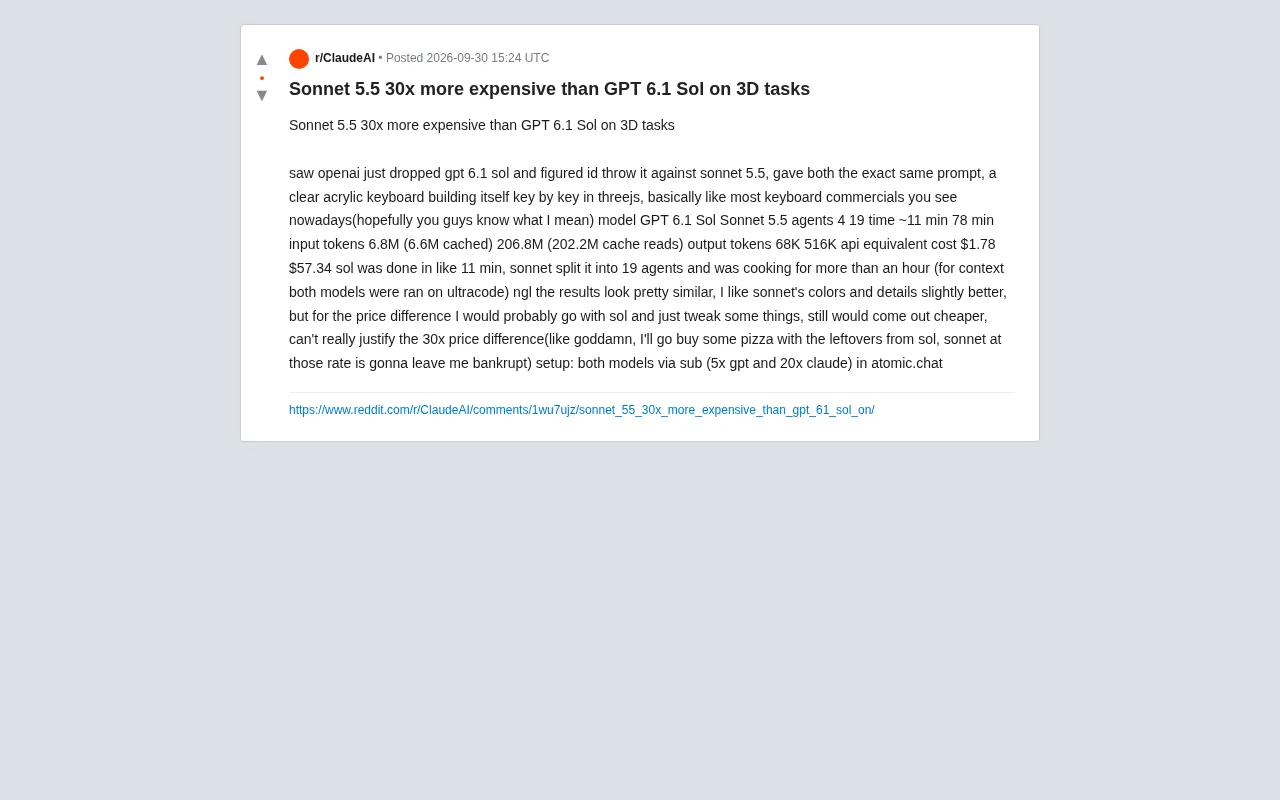
Same task, same runtime environment — these were the conditions that made the comparison relatively fair. The differences came down to each model's own execution strategy.
Three.js is an open-source JavaScript 3D rendering library built on WebGL. It lets developers create complex 3D scenes, animations, and interactive effects in the browser without writing raw WebGL code. It's widely used in product visualization, data visualization, and game prototyping. A "self-assembling key by key" animation involves particle trajectory calculations, material transparency control (acrylic effects require PBR material parameter tuning), and per-frame tweening logic — demanding a high level of AI code generation capability. It tests not just syntactic correctness, but also spatial geometry understanding and visual aesthetic judgment. Because of the large codebase and complex dependencies, this kind of 3D visualization task is a classic scenario for testing multi-round reasoning and self-correction in AI models, exposing differences in execution strategy far more clearly than simple text generation tasks.
The Numbers: A Massive Gap in Efficiency and Cost
Looking at the raw data the tester provided, the performance gap between the two models is stark:
| Metric | GPT 6.1 Sol | Sonnet 5.5 |
|---|---|---|
| Agents called | 4 | 19 |
| Time elapsed | ~11 minutes | 78 minutes |
| Input tokens | 6.8M (6.6M cached) | 206.8M (202.2M cache reads) |
| Output tokens | 68K | 516K |
| API-equivalent cost | $1.78 | $57.34 |
GPT 6.1 Sol completed the task with just 4 agents in 11 minutes. Sonnet 5.5 broke the task into 19 agents and ran for over an hour. The input token gap is especially dramatic — Sonnet's 200M+ token read volume is more than 30x that of Sol, which directly drove up the final cost.
Why Did Sonnet Consume So Many Tokens?
Sonnet 5.5 adopted a more aggressive multi-agent decomposition strategy. With 19 agents repeatedly reading the context cache, the token volume accumulated to a staggering scale. While most of it was cache reads (which are cheaper), the sheer magnitude still pushed the API-equivalent cost to $57. By contrast, Sol's "fewer agents, faster convergence" approach was far more restrained.
Multi-Agent Architecture refers to breaking a complex task into multiple independent AI agents that collaborate, each handling a subtask and passing results to one another. The core cost of this approach is context bloat: each agent typically needs to read the task background, previous agents' outputs, and shared memory at startup. As agent count grows, the cumulative token reads can scale linearly or even super-linearly. Among Sonnet 5.5's 19 agents, most of the time was spent repeatedly reading the same context cache — this is the primary source of its 200M token read volume.
While cache reads are priced significantly lower than newly generated tokens (typically 5–10x cheaper), that doesn't change the basic economics of "volume = cost." When cache reads reach the hundreds of millions of tokens, even discounted unit prices add up to a hefty bill. This explains why Sonnet's cache hit rate exceeded 97%, yet its cost still far outpaced Sol's — a high hit rate doesn't mean low total cost. The key variable is the absolute volume of cache reads.
Output Quality: Similar, But Not Equivalent
The tester's subjective assessment: the two results looked "quite close." He personally preferred Sonnet's color palette and attention to detail, giving it a slight edge. But that advantage looks pretty thin against a 30x cost gap.
In his own words: "At that price difference, I'd go with Sol and tweak a few details myself — still comes out cheaper." He even joked that the money saved with Sol would buy him pizza, while Sonnet's pricing "would bankrupt me."
This actually highlights a real engineering trade-off: when both models can produce output that's "usable and tweakable," cost efficiency often matters more than marginal quality improvements.
Takeaways for Developers
This single test case isn't enough to draw definitive conclusions about either model, but it does raise several points worth thinking about.
More agents doesn't mean better results. Sonnet 5.5's 19-agent decomposition yielded very limited quality gains over Sol's 4-agent approach, while consuming tokens at dozens of times the rate. For cost-sensitive use cases, runaway agent counts can become a serious budget black hole.
Caching has its limits. Even though the vast majority of Sonnet's tokens came from cache reads, the enormous absolute volume still caused costs to spiral. Caching lowers the unit price, but it can't stop runaway volume.
Cost-effectiveness is a real decision factor. When quality converges, "cheap and good enough" often makes more business sense than "slightly better but expensive" — especially for teams generating 3D or visual content at scale.
One important caveat: this is a single user's one-time test on a specific task type (Three.js 3D animation). The sample size is tiny, and performance across different task types could look very different. For a real evaluation, it's worth running multiple comparison rounds against your own actual workloads.
Related articles

Chain of Thought Isn't Just for AI: How Humans Can Use CoT to Improve Thinking Quality
Chain of Thought isn't just a prompt trick for large models. Starting from a Hacker News discussion, this article analyzes why CoT works for human thinking too, breaks down actionable ways to transfer it, and highlights the key differences between human CoT and machine CoT.
Cloudflare Teams Up with OpenAI: Closi…
Cloudflare Teams Up with OpenAI: Closing the Loop from Vulnerability Discovery to Defense with AI
Cloudflare uses OpenAI Daybreak to investigate security vulnerabilities and generate reviewable remediation plans, while developers use Codex to boost coding efficiency and quality.

Orca Multi-Agent Orchestration in Practice: A Guide to Parallel Collaboration with Claude and Codex
Orca is Stable AI's free open-source agent workbench supporting 34 agents like Claude Code and Codex in parallel. Learn its Git worktree isolation, multi-model orchestration, and mobile management.