Sony Quarterly Profit Jumps 44%: PlayStation and Spider-Man Drive Growth

Sony's quarterly net profit jumps 44%, powered by PlayStation and the Spider-Man IP.
Sony reported quarterly net profit of 449.6 billion yen (about $2.84 billion), up 44% year-over-year, standout growth amid a slowing hardware cycle and content industry headwinds. Growth wasn't reliant on one business: PlayStation's install base, store commissions, subscriptions, and first-party games provide a stable profit base, while Spider-Man: Brand New Day keeps unlocking IP value through box office, licensing, and game tie-ins. Sony's edge: holding both film and gaming outlets so one IP cross-promotes across media.
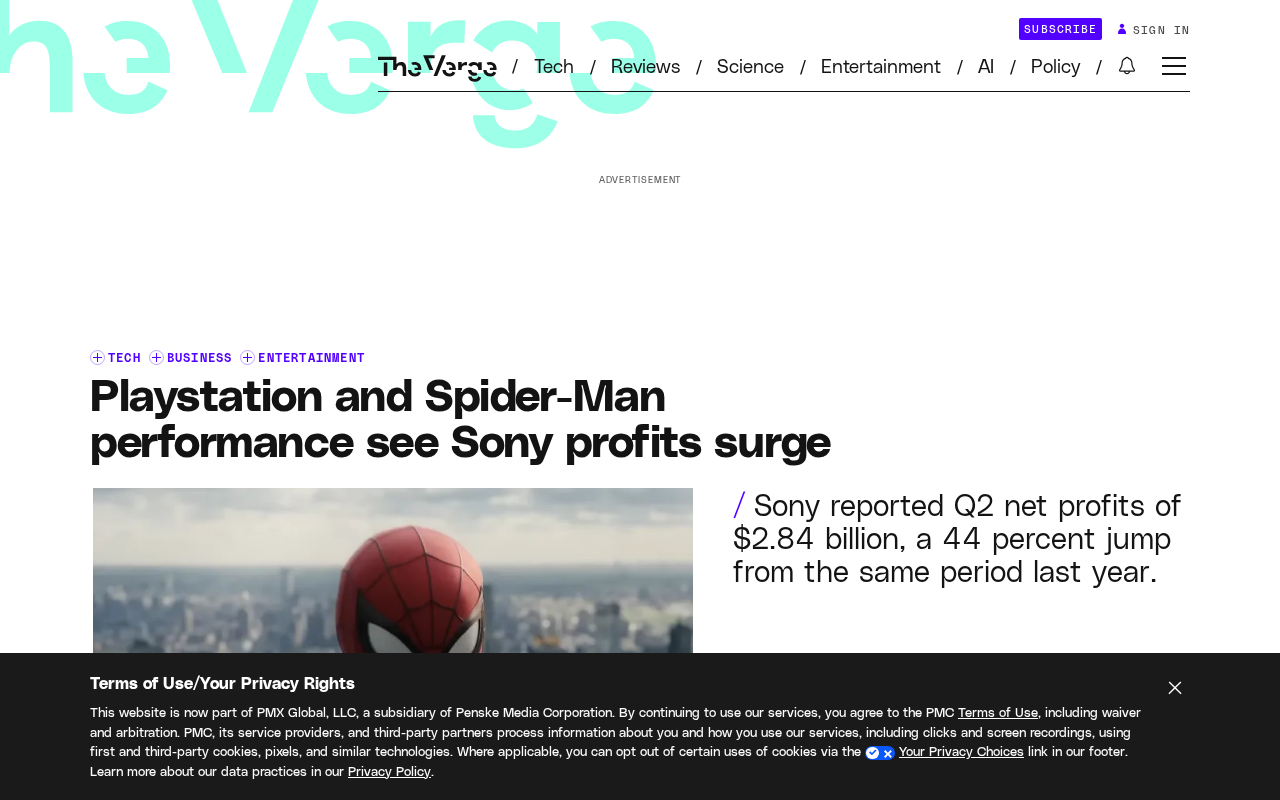
Sony's latest quarterly earnings are out, with net profit surging 44% year-over-year to 449.6 billion yen (approximately $2.84 billion). Two businesses powered this growth: the PlayStation gaming ecosystem and the box office and derivative revenue from Spider-Man: Brand New Day.
The Key Numbers Behind the Profit Surge
According to Sony's quarterly earnings for the period ending in September, net profit rose to 449.6 billion yen (about $2.84 billion), up 44% from the same period last year. Such a growth rate is unusual at a time when hardware cycles typically plateau and the content industry faces broad headwinds.
It's worth noting that this growth didn't come from a single business's incidental contribution, but from the hardware platform and content IP firing on all cylinders simultaneously. PlayStation provided a stable foundation of platform commissions and subscription revenue, while Spider-Man: Brand New Day contributed additional exposure and revenue on the content side. Only when these two curves stack does the profit line climb so steeply.
PlayStation: The Compound Effect of a Platform Ecosystem
PlayStation is the most stable piece of Sony's profit structure. Console install base, digital store commissions, membership subscriptions, and first-party game sales together form a highly sticky revenue pool—once users enter the ecosystem, every subsequent purchase translates into profit at a relatively high margin.
The resilience of this model shows in the fact that even when hardware sales enter a plateau phase of the cycle, software and services revenue can still sustain the profit baseline. In this earnings report, PlayStation was explicitly cited as a primary driver of profit growth, indicating that the quality of platform-side revenue remains healthy.
For the industry, this is also a case study: as the console war shifts from "selling hardware" to "operating users," the competitive focus for platform holders has moved from specs to the consistency of content supply and the value proposition of subscription services.
The "hardware cycle" in the console industry refers to the phased shifts in sales and profit structure over a product's lifecycle: in the early days after a new console launches, hardware is often sold at or near cost—sometimes at a loss—to rapidly build install base, with profit coming mainly from subsequent software, accessories, and subscription services; as install base peaks and hardware sales slow, the revenue center of gravity shifts further toward digital store commissions and membership subscriptions. Platform commissions (typically around 30% of third-party game sales) and subscription services are characterized by high margins and strong predictability, so even when hardware enters a plateau, platform holders' profits can be maintained or even improved. This also explains why console makers increasingly emphasize "user operations"—metrics shift from hardware sales to active user counts, average revenue per user, and subscription retention rates.
The Spider-Man IP: The Leverage of Content Assets
The success of Spider-Man: Brand New Day gives Sony a case study in efficiently monetizing content assets. Spider-Man is one of the most commercially valuable IPs in Sony's portfolio, and its film performance isn't limited to box office alone—it continues to release value through derivative licensing, game tie-ins, home entertainment distribution, and other chains.
The significance of content IP lies in its leverage: a single successful work can be monetized repeatedly across multiple windows and channels, with diminishing marginal costs. When a work becomes a "phenomenon," its impact on earnings often exceeds the normal fluctuation range of any single business line.
What makes Sony unique is that it holds two major content outlets simultaneously—film and gaming. The same IP can create cross-promotion between the silver screen and the console—films bring in new users, games extend the IP's lifecycle—and this synergy is difficult for pure content companies or pure platform companies to replicate.
The "windowing" practice in the film and television industry refers to the staged release of a work across different channels, typically including theatrical exhibition, paid video-on-demand or streaming, home video and digital purchase, and free television, among others. Each window corresponds to different pricing and licensing models, allowing the same film to be monetized multiple times over an extended period. Derivative licensing covers merchandise such as toys, apparel, and theme parks, typically generating ongoing revenue for IP holders in the form of royalty splits. For Sony, the film rights to Spider-Man are held by Sony Pictures, and the game adaptation rights are also in its hands, enabling the film and game to be developed in coordination under the same IP, creating revenue stacking across windows and media.
What This Means for the Industry
Sony's earnings report sends a signal: in today's entertainment industry, neither hardware sales alone nor a single content hit is enough to sustain rising profits. What truly sets companies apart is the ability to combine "platform + IP."
PlayStation provides distribution channels and user relationships; IPs like Spider-Man provide content ammunition. The two form a virtuous cycle. The advantage of this structure is greater risk resilience—when one component underperforms, the other can fill the gap.
From a broader perspective, Sony's growth this quarter also shows that demand for entertainment consumption hasn't shrunk overall—users are willing to pay for high-quality content and a stable platform experience. For industry practitioners, this is more noteworthy than any single quarter's profit figure.
One-line Summary
Sony's quarterly net profit surged 44% year-over-year, driven by both the PlayStation platform ecosystem and the Spider-Man IP.
Paragraph Summary
Sony reported quarterly earnings for the period ending in September, with net profit reaching 449.6 billion yen (about $2.84 billion), up 44% year-over-year—a standout growth rate against the backdrop of a slowing hardware cycle and broad headwinds in the content industry. Growth didn't rely on a single business: PlayStation built a highly sticky revenue pool through install base, digital store commissions, membership subscriptions, and first-party games, providing a stable profit baseline; Spider-Man: Brand New Day continued to unlock IP value through box office, derivative licensing, and game tie-ins. The article argues that Sony's unique advantage lies in holding both film and gaming content outlets, allowing the same IP to cross-promote between the silver screen and consoles, forming a "platform + IP" virtuous cycle with greater risk resilience.
Related articles
 Tech Frontiers
Coldframe: A Honeypot Disguised as a Supermarket Freezer Controller
Coldframe is a honeypot disguised as Danfoss AK-SM 800A and Dixell XWEB freezer controllers, built as a single Python file that detects CVE-2025-41450 attempts and is identified as real devices on Shodan.
 Tech Frontiers
GRFNet: A Lightweight PyTorch Model Designed for Multichannel Time-Series Classification
GRFNet is a lightweight PyTorch model for multichannel time-series classification, originating from EEG decoding research. With only 3,847 parameters, it is based on the ROCKET architecture, combining random convolution kernels with learnable spatial filters, supports arbitrary input lengths, and will soon be evaluated on the PhysioNet dataset.
 Tech Frontiers
CUDA-Accelerated Rocket League Simulator: A Player-Made Hardcore Experiment
A Reddit post shows a "100% Accurate" Rocket League simulator accelerated with CUDA. We analyze its technical context, CUDA's value in game physics simulation, and the significance and limitations of such community projects.