Sony Retro Headphone Review: A Sonic Journey Back to Childhood

Sony's retro headphones evoke Walkman-era childhood memories, revealing that emotional value is becoming a key competitive edge for tech products to break through homogenization.
Starting from the author's personal memories of using a Walkman in childhood, the article explores why Sony's retro headphones strike a broad emotional chord amid spec-obsessed tech products. It argues that retro design is not mere replication but a balance between preserving era-specific visual elements and ensuring a modern experience, creating a rare form of differentiation. The focused listening experience of the Walkman era—"carrying music with you"—contrasts with today's streaming and TWS earbuds, where music is everywhere but ritual is diluted, evoking longing for that state of focus. The article further proposes that amid severe homogenization in AI hardware and consumer electronics, emotional value can be an effective path to competitive breakthrough, and product design should bring warmth back to technology.
An Unexpected Emotional Resonance
As tech products increasingly chase extreme specs and futuristic appeal, a retro headphone from Sony unexpectedly strikes the softest chord in many people's hearts. According to the original author from the RSS source, many summer afternoons of childhood were spent either riding a Huffy bike around town, or, a bit older, taking the bus to hang out near Harvard Square and whiling away time around The Garage. The Sony Walkman was always in a jacket pocket, with a pair of headphones perpetually on the head. This memory of carrying music everywhere forms the emotional bedrock of an entire generation's relationship with personal audio devices.
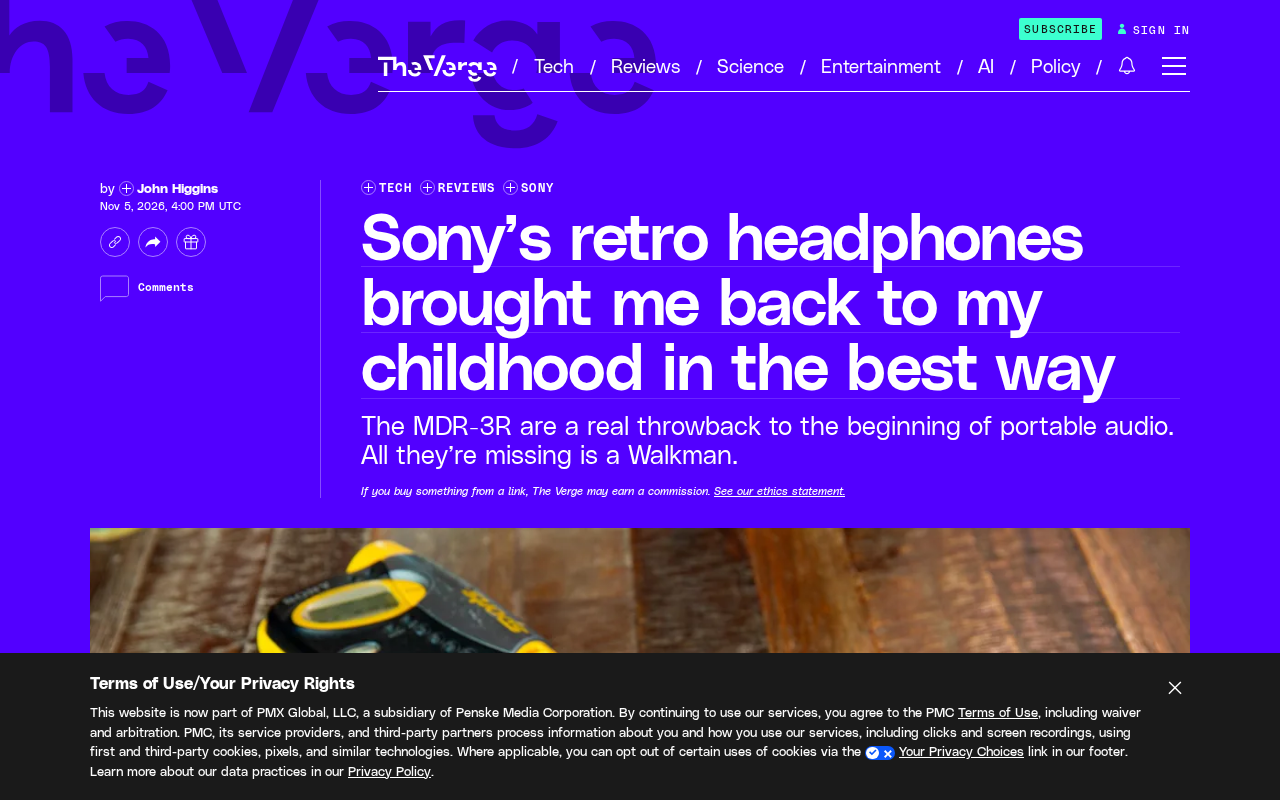
This personal narrative explains precisely why retro design resonates so strongly today. It's not just about the product itself, but about a lifestyle—a time when listening to music was an active choice, a ritual with a sense of ceremony.
The Walkman was a portable cassette player launched by Sony in 1979, and it was the first to truly make music a personal experience you could carry with you. Before the Walkman, listening to music was typically confined to home stereo systems or car radios, but the Walkman privatized music through headphones, shaping the prototype of "immersive personal listening." This product not only transformed the consumer electronics industry but also profoundly influenced the product design logic of the following four decades—from CD players and MD to the iPod, and now to today's TWS earbuds and streaming services, the core idea has always been "music on the go." For users who lived through that era, the Walkman, together with details like jacket pockets, headphone cables, and flipping cassette tapes, forms a complete sensory memory—this is the underlying reason retro design can trigger such strong emotional resonance.
The Contemporary Significance of Retro Design
The original author states outright that Sony's retro headphone takes you back to childhood in the best possible way. Behind this remark lies an industry phenomenon worth pondering: when major brands are all competing over noise cancellation depth, spatial audio, and battery life, a retro appearance becomes a rare point of differentiation. It lets users find not just functionality in a product, but also identity and emotional connection.
From a product design perspective, retro headphones are not simply a reissue of old models. They are more like a carefully orchestrated nostalgic experience—retaining the visual elements that make you instantly recognize "this is that era" while ensuring a basic modern user experience. This balance is not easy to strike; too much retro feels contrived, while too much modernization loses the soul.
Spatial audio refers to technology that uses algorithms to simulate sound coming from different directions in three-dimensional space, allowing listeners to perceive a surround sound field through headphones, commonly used in film, gaming, and music scenarios. Noise cancellation depth refers to an active noise-cancelling headphone's ability to suppress ambient environmental noise, usually measured in decibels. These two parameters are core competitive metrics in the current high-end headphone market, with brands often touting greater noise cancellation depth and more precise spatial audio rendering as selling points. However, as these technical specifications gradually converge, functional differences between products become hard to perceive, and retro appearance becomes a low-cost differentiation strategy—it doesn't rely on technological breakthroughs but evokes emotional memories through visual language, thereby creating recognizability on store shelves and social media.
What the Walkman Era Teaches Us Today
The music consumption habits shaped by the Walkman and portable headphones continue to influence product logic today. The core experience of that era was "carrying music with you," and today's TWS earbuds and streaming have pushed this concept to the extreme—music is everywhere, and devices are nearly invisible. But the cost is that the ritual and focus of listening to music have been significantly diluted.
The nostalgia evoked by retro headphones is essentially a longing for that state of focus. The scenes described by the original author—bicycles, buses, Harvard Square, the Walkman in a jacket pocket—together form a warm, vivid scenario rather than a cold spec sheet. For practitioners focused on AI hardware and smart wearables, this offers an important reminder: emotional value often builds long-term user relationships better than specs.
Emotional Value Is Becoming a Competitive Advantage
In an era of rapid iteration in AI applications and smart hardware, product homogenization is a common challenge. The case of Sony's retro headphone shows that emotional value can be a path to breaking through homogenization. When features and price are hard to differentiate, designs that evoke user memories and emotional resonance often play a decisive role in purchase decisions.
This also explains why the retro trend has been heating up in consumer electronics in recent years. From film cameras to mechanical keyboards to portable music players, users are willing to pay a premium for "experiences with a story." For content creators and product teams, rather than chasing technical specs, it's better to think about how to make products part of users' personal narratives.
Conclusion: Bringing Warmth Back to Tech Products
What makes Sony's retro headphone so moving is not how many advanced features it has, but that it accurately touches a memory cherished by many. In the wave of AI-driven products, this attention to human-centered experience is all the more precious. Technology can race forward, but good product design always needs to look back and see what users truly care about.
Related articles

WorkBuddy in Practice: How Tencent's AI Agent Is Reshaping Office Workflows
An in-depth analysis of Tencent WorkBuddy AI agent: it reads local files, executes multi-step tasks, runs on schedules, and supports remote control—how is it fundamentally different from conversational AI? This article combines practical cases to help you understand its core capabilities and use cases.

Codex App Complete Guide: From Installation to Hands-On Practice — AI Automatically Organizes Files and Builds Reports
Codex App complete guide: install from the app store, configure everyday work mode, and use real coffee shop data to practice file organization, Excel reports, and visual dashboards. Learn Plan Mode and the little pet feature — master Codex's AI automation workflow in one episode.

Getting Started with Langfuse: Building a Financial Analysis Agent and Evaluation Platform
A Langfuse tutorial: explore the core capabilities and boundaries of this open-source AI Engineer platform, and learn how to build an enterprise-grade log tracing, evaluation, and observability platform for a Harness-architecture financial analysis multi-agent system, covering prompt management, token cost analysis, and integration with frameworks like LangChain.