SpacebarX: A Deep Dive into the Keyboard-First, Local-First Outliner Note-Taking Tool

SpacebarX is a keyboard-first, local-first outliner blending notes and tasks with full data sovereignty.
SpacebarX is an outliner note-taking tool built around keyboard-first and local-first principles. It lets users capture ideas, organize structures, and manage tasks without leaving the keyboard. Key features include inline dates with a Today view, context-preserving search, and sync via user-controlled cloud folders. The Pro version adds visual views, encrypted documents, version restore, and BYOK AI integration. Built by indie developer Selvan, it targets power users who value efficiency and data autonomy.
In an era of information overload, note-taking and task management tools are everywhere, yet very few truly satisfy power users. SpacebarX, which recently launched on Product Hunt, puts forward a clear philosophy: keyboard-first + local-first, aiming to redefine the outliner note-taking experience. It earned 120 upvotes and landed at #9 on the product rankings, catching the attention of productivity tool enthusiasts.
What Is a Keyboard-First Outliner?
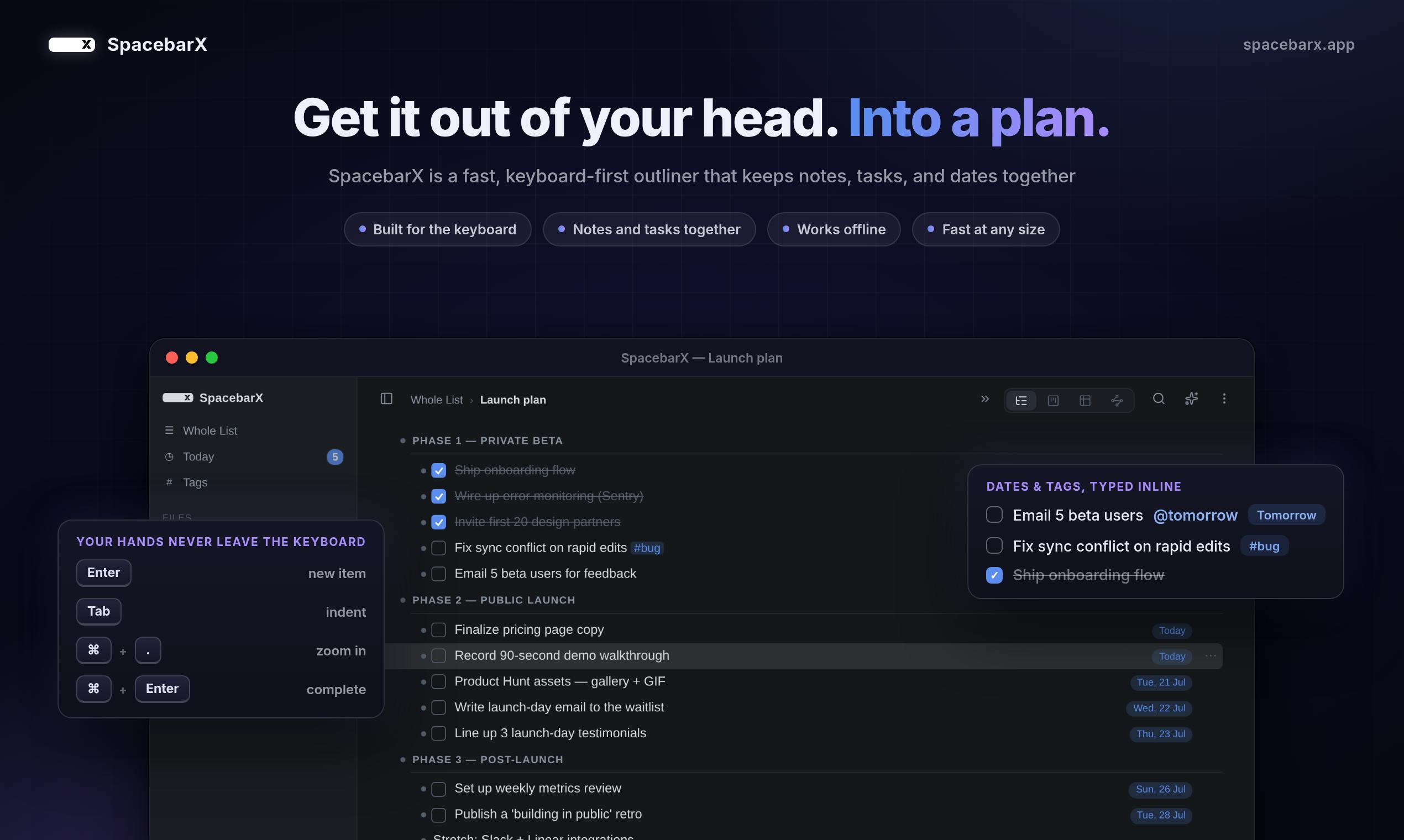
At its core, SpacebarX is an outliner designed for managing notes, tasks, writing, Markdown, code, and projects. The history of outline editors dates back to the 1980s with Dave Winer's ThinkTank and MORE. The fundamental idea is that human thinking is inherently hierarchical — by nesting parent and child nodes, users can naturally organize ideas from the macro to the micro level. Modern examples include WorkFlowy, Dynalist, and Logseq. Unlike free-form note-taking tools, outliners enforce structured information recording, which offers unique advantages in scenarios like brainstorming, project decomposition, and meeting notes. SpacebarX carries on this tradition while adding a keyboard-first interaction layer.
Unlike tools such as Notion and Obsidian, SpacebarX makes "never leaving the keyboard" its core design principle — virtually every operation, including capturing ideas, organizing structure, and adding dates, can be completed entirely via keyboard.
For programmers, writers, and knowledge workers who value high-efficiency input, mouse operations are often the biggest obstacle to maintaining flow. There's solid theoretical backing for this: psychologist Mihaly Csikszentmihalyi's concept of "Flow" shows that flow states require highly focused, uninterrupted attention. The process of moving from keyboard to mouse and back, though only taking 1-2 seconds, causes cognitive context switching. Research shows it takes an average of 23 minutes to fully regain focus after a single interruption. SpacebarX's approach is philosophically aligned with classic editors like Vim and Emacs — Vim, since 1991, has used modal editing to let users perform all text operations without leaving the home row, while Emacs achieves similar goals through key combinations. These tools have steep learning curves, but once mastered, their operational efficiency far surpasses mouse-driven graphical interfaces. SpacebarX aims to bring the "hands-on-keyboard" efficiency experience to everyday note-taking and task management.
Inline Dates and the Today View
One highlight of the tool is its ability to add dates inline. While writing, users can tag any item with a date on the fly, and the system's "Today" view automatically collects all content that needs attention for the day. This design blurs the boundary between notes and tasks — there's no need to switch back and forth between a dedicated to-do list and a notebook; everything flows naturally within the same outline structure.
This feature reflects an important trend in the productivity tool space in recent years: the dissolving boundary between note-taking and task management. In traditional workflows, users had to manually sync information between note apps (like Evernote) and task management apps (like Todoist), which not only added operational overhead but also led to information fragmentation. Roam Research pioneered the concepts of bidirectional linking and inline TODOs in 2020, proving the viability of a unified "everything is a node" data model. Tools like Logseq and Tana further developed this idea, embedding metadata such as dates, tags, and attributes directly into the text flow. SpacebarX's Today view is essentially a dynamic query based on date attributes — it automatically aggregates all items tagged with today's date, enabling seamless switching between the "calendar perspective" and "project perspective" in the GTD (Getting Things Done) methodology.
Local-First Architecture and Data Sovereignty
At a time when data privacy is increasingly valued, SpacebarX emphasizes a local-first storage philosophy: the app works completely offline, and all notes are saved locally by default.
Local-first is a software architecture concept systematically introduced by the Ink & Switch lab in their 2019 paper of the same name. Its core principles include: data is primarily stored on the user's local device, the app runs fully without network access, multi-device sync resolves conflicts through algorithms like CRDT (Conflict-free Replicated Data Types), and users have complete ownership and portability of their data. Compared to traditional SaaS models (where data is stored on vendor servers), local-first architecture eliminates single-point-of-failure risks — even if the service provider shuts down, user data remains intact and accessible. Tools like Obsidian, Logseq, and AnyType have adopted similar approaches.
Even more noteworthy is its sync method — syncing through a cloud folder you control. This means data sovereignty always stays with the user, rather than being locked into a vendor's proprietary servers. SpacebarX syncs through user-controlled cloud folders (such as iCloud, Dropbox, or Google Drive), essentially returning the choice of sync layer to the user and avoiding vendor lock-in. This approach is similar to tools like Obsidian, mitigating the risk of "vendor disappears, data vanishes," and giving technically-minded users greater peace of mind.
Search Without Losing Context
Many note-taking tools display search results in isolation, causing users to lose their sense of where information sits within the broader structure. SpacebarX emphasizes searching across your entire workspace while preserving the context of each note, allowing users to see the hierarchical structure surrounding each result during searches, enabling faster location and understanding of information.
SpacebarX Free vs. Pro Feature Comparison
SpacebarX adopts a "Free forever" base model, with core keyboard operations, local storage, cloud folder sync, and global search all available for free. For individual users, this already covers most daily needs.
The Pro version adds a range of advanced capabilities on top of this:
- Visual views: Diverse presentation modes beyond the pure outline
- Saved searches: Turn frequently used queries into quick-access shortcuts
- Encrypted documents: Further strengthened privacy protection
- Version restore: Recover historical versions to prevent accidental changes
- Calendar and file uploads
- BYOK AI: "Bring Your Own Key," allowing users to connect their own AI service API keys
BYOK AI particularly demonstrates the product's friendliness toward technical users — you can use your own OpenAI, Anthropic, or other API keys to access AI features, giving you control over costs while avoiding concerns about data passing through third-party intermediaries. BYOK (Bring Your Own Key) is a business and architectural pattern that has emerged in the AI tool space since 2023. In the traditional approach, app developers purchase AI API quotas in bulk and charge users subscription fees, meaning user input data passes through the developer's servers — posing privacy leak risks — while users have no control over the specific model version or costs. The BYOK model lets users enter their own API keys obtained directly from AI providers into the tool, with the app making calls directly from the user's end without data passing through the developer's servers. The advantages include: users can freely choose models (such as GPT-4o, Claude Sonnet, etc.), precisely control calling costs (pay per token instead of fixed subscriptions), and enjoy more transparent data flow paths. Developer tools like Cursor, Typing Mind, and BoltAI have widely adopted this model.
Summary: Who Is SpacebarX For?
SpacebarX was built by independent developer Selvan and currently has only 3 comments on Product Hunt — a typical indie tool. But its positioning is quite clear: rather than trying to become an all-encompassing all-in-one workspace, it focuses on a core user base that values keyboard efficiency and data autonomy.
As Notion grows increasingly bloated and cloud lock-in becomes more prevalent, tools that are "lightweight + local + keyboard-driven" are gradually forming a stable niche market. The productivity tool market has undergone a pendulum-like evolution from "big and comprehensive" to "small and focused" over the past five years. Between 2019 and 2022, Notion rapidly rose to prominence with its all-in-one experience combining databases, kanban boards, documents, and wikis, sparking an all-in-one workspace trend. However, as Notion's features continued to expand (AI, project management, forms, etc.), its startup speed and operational smoothness drew increasing criticism. Meanwhile, a wave of tools focused on single scenarios began to emerge: Obsidian for local Markdown notes, Linear for project management, Bear for minimalist writing. This "Unix philosophy" — each tool does one thing well — is making a comeback. Independent developers have a natural advantage in these niche markets, as small teams can iterate faster, stay closer to core user needs, and avoid the growth pressure driven by venture capital.
For users who prefer pure keyboard operation, value data sovereignty, and need seamless integration of notes and tasks, SpacebarX is worth trying. Of course, whether it can continue to deliver on feature depth and long-term maintenance remains to be seen.
Related articles

Chain of Thought Isn't Just for AI: How Humans Can Use CoT to Improve Thinking Quality
Chain of Thought isn't just a prompt trick for large models. Starting from a Hacker News discussion, this article analyzes why CoT works for human thinking too, breaks down actionable ways to transfer it, and highlights the key differences between human CoT and machine CoT.
Cloudflare Teams Up with OpenAI: Closi…
Cloudflare Teams Up with OpenAI: Closing the Loop from Vulnerability Discovery to Defense with AI
Cloudflare uses OpenAI Daybreak to investigate security vulnerabilities and generate reviewable remediation plans, while developers use Codex to boost coding efficiency and quality.

Orca Multi-Agent Orchestration in Practice: A Guide to Parallel Collaboration with Claude and Codex
Orca is Stable AI's free open-source agent workbench supporting 34 agents like Claude Code and Codex in parallel. Learn its Git worktree isolation, multi-model orchestration, and mobile management.