SpaceX Alums' Reliable Robotics Raises $115M, Valued at Over $1B

Reliable Robotics raises $140M Series D extension at over $1B valuation, becoming a unicorn.
Reliable Robotics announced a Series D extension adding $115M in equity and $25M in debt, pushing its valuation past $1B and into unicorn status. Founded by former SpaceX employees, the company's core product is an autonomous flight system retrofittable onto existing aircraft, following an asset-light "change the brain, not the aircraft" approach and prioritizing cargo scenarios to ease certification. The article notes intensifying competition from Xwing, Merlin Labs, Airbus, and Boeing, with long certification cycles and high costs remaining key bottlenecks.
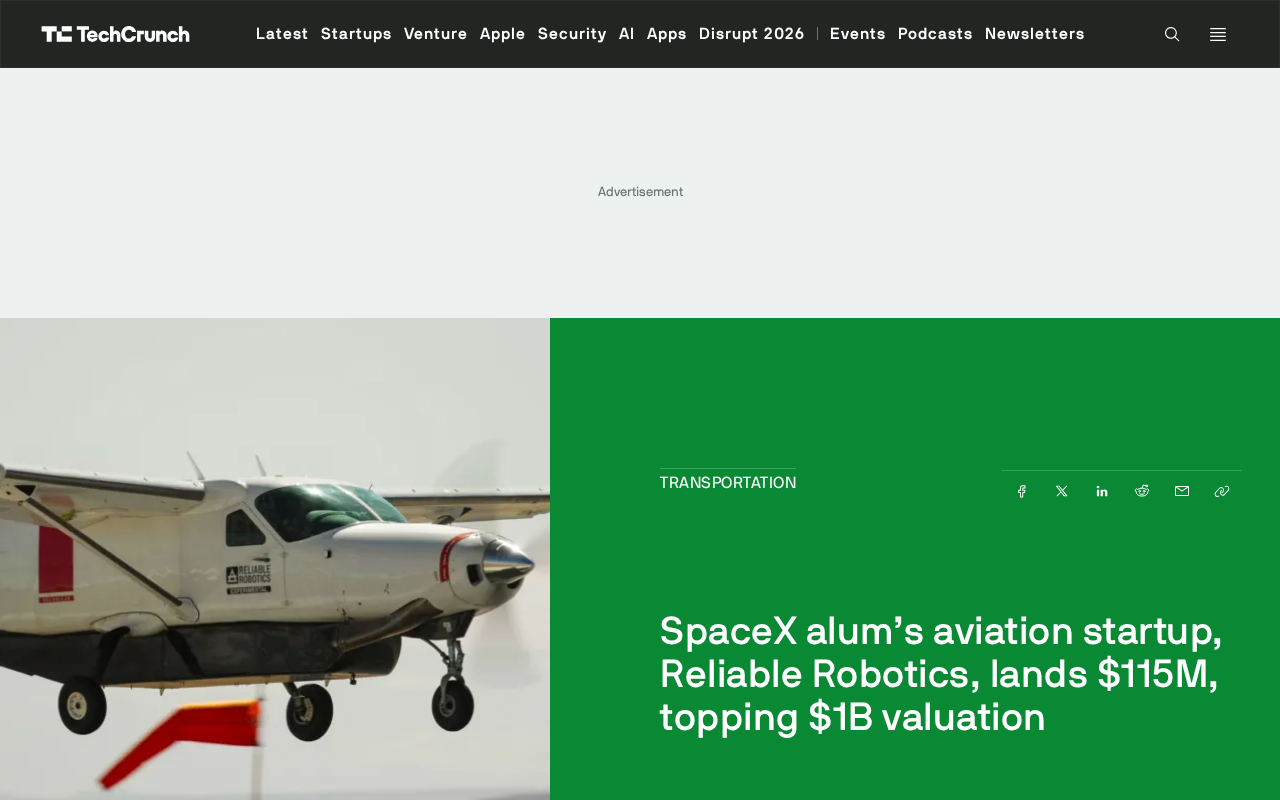
The autonomous cargo drone sector has landed another major funding round. Reliable Robotics, founded by former SpaceX employees, announced that its Series D round has added $115 million in equity financing and $25 million in debt financing, pushing its valuation past $1 billion and into unicorn territory.
Funding Details and Investor Background
According to public information, Reliable Robotics' Series D extension includes $115 million in equity and $25 million in debt. While the original source did not disclose the specific investor list, based on the company's prior funding history, it is backed by several venture capital firms focused on deep tech and aviation.
The funds will be used to advance airworthiness certification and commercialization of its autonomous flight system. For a startup founded in 2017, achieving a valuation of over $1 billion in aviation autonomy—a high-barrier, long-cycle sector—itself signals that capital markets recognize the company's technical approach.
Technical Approach: Gradual Automation Starting with Cargo
Reliable Robotics' core product is an autonomous flight system that can be retrofitted onto existing aircraft, rather than building new aircraft from scratch. This "retrofit existing platforms" strategy reduces the complexity of airworthiness certification and makes the system easier for aviation operators to adopt.
The company initially focused on cargo scenarios, which is closely tied to the regulatory pace of aviation autonomy—cargo flights carry less risk exposure to passenger safety, so regulators are more willing to grant approval first. The founders' SpaceX background also gives the team engineering experience in flight control software and redundant system design.
Airworthiness Certification refers to the formal process by which aviation regulators determine whether an aircraft or its onboard systems meet safety standards. In the United States, this responsibility falls to the Federal Aviation Administration (FAA), and the certification process typically includes design approval, production approval, and continuing airworthiness, among other stages, often taking years or even over a decade. For autonomous systems retrofitted onto existing aircraft, the certification path is more complex: it may follow the Supplemental Type Certificate (STC) route or require separate system-level approval. Certification is costly and requires applicants to submit extensive flight test data, failure mode analyses, and software verification documentation. This is one of the fundamental reasons why commercializing aviation autonomy is far slower than ground-based autonomous driving—any software change involving flight safety must undergo rigorous step-by-step verification rather than the rapid iteration typical of consumer software.
Competitive Landscape in Aviation Autonomy
Reliable Robotics is not alone. Competitors such as Xwing and Merlin Labs are pursuing similar solutions, while major aviation companies like Airbus and Boeing are incubating autonomous flight projects internally. Compared with these rivals, Reliable Robotics' differentiation lies in its asset-light model of "not changing the aircraft, only changing the brain."
However, commercializing aviation autonomy is far more complex than ground-based autonomous driving. Airworthiness certification cycles are long and costly, and require repeated communication with regulators such as the FAA. The $115 million funding round may seem substantial, but by aviation manufacturing standards, it may only support several years of certification work.
Redundancy is a core principle of aviation safety architecture, referring to multiple backup hardware and software channels that ensure the system can continue operating safely when a single component or sensor fails. In autonomous flight systems, common redundancy includes dual flight control computers, multiple power sources, independent barometric and inertial sensors, and heterogeneous software implementation paths. For unmanned cargo aircraft, redundancy design directly determines whether the system can handle unexpected failures without pilot intervention, and it is also a key focus of airworthiness certification review. Engineering teams from SpaceX typically have experience with aerospace-grade redundancy and fault-tolerant design, which constitutes an implicit advantage for Reliable Robotics in technical credibility, since rocket flight control also has extremely low tolerance for single-point failures.
What This Funding Means
Crossing the $1 billion valuation mark is a signal: capital is willing to bet on long-cycle aviation automation. For the industry as a whole, Reliable Robotics' progress will test whether the "gradual retrofit" approach can close the regulatory loop. If its system can obtain cargo airworthiness approval first, it will open up a replicable commercialization template.
But it should also be noted that the original source provides limited information, without disclosing key data such as revenue, order volume, and certification timeline. In aviation, valuations reflect technical potential more than current revenue, and the real test is still ahead.
Unicorn refers to an unlisted startup valued at $1 billion or more, a term coined by venture capitalist Aileen Lee in 2013, originally used to describe software startups with unusually high valuations. In recent years, the threshold has expanded to capital-intensive sectors such as deep tech and aerospace, but in such long-cycle, high-certification-barrier industries, a $1 billion valuation often reflects recognition of the technical approach and future market expectations rather than current revenue or profit. For Reliable Robotics, reaching unicorn status means stronger credibility in talent recruitment, dialogue with regulators, and subsequent fundraising, but it also raises investors' expectations for its commercialization timeline.
One-line Summary
Reliable Robotics raises $140M in Series D extension, surpassing $1B valuation to become a unicorn.
Paragraph Summary
Reliable Robotics announced a Series D extension adding $115 million in equity and $25 million in debt, pushing its valuation past $1 billion and into unicorn status. Founded by former SpaceX employees, the company's core product is an autonomous flight system retrofittable onto existing aircraft, following an asset-light "change the brain, not the aircraft" approach and prioritizing cargo scenarios to ease airworthiness certification. The funds will advance certification and commercialization. The article notes that competition in aviation autonomy is intensifying, with Xwing, Merlin Labs, Airbus, and Boeing all positioning themselves, but long certification cycles and high costs remain key bottlenecks, and valuations reflect technical potential more than current revenue.
Related articles

Chain of Thought Isn't Just for AI: How Humans Can Use CoT to Improve Thinking Quality
Chain of Thought isn't just a prompt trick for large models. Starting from a Hacker News discussion, this article analyzes why CoT works for human thinking too, breaks down actionable ways to transfer it, and highlights the key differences between human CoT and machine CoT.
Cloudflare Teams Up with OpenAI: Closi…
Cloudflare Teams Up with OpenAI: Closing the Loop from Vulnerability Discovery to Defense with AI
Cloudflare uses OpenAI Daybreak to investigate security vulnerabilities and generate reviewable remediation plans, while developers use Codex to boost coding efficiency and quality.

Orca Multi-Agent Orchestration in Practice: A Guide to Parallel Collaboration with Claude and Codex
Orca is Stable AI's free open-source agent workbench supporting 34 agents like Claude Code and Codex in parallel. Learn its Git worktree isolation, multi-model orchestration, and mobile management.