SpaceX Revenue Soars 161%, AI Business Becomes New Engine

SpaceX Q2 revenue $14.6B, up 161% YoY, with AI and connectivity as core growth drivers.
SpaceX's latest quarterly earnings show revenue of $14.6 billion, up 161% year-over-year. Officials attributed growth to the "Super Intelligence" (SI) AI segment and connectivity business. The revenue structure has fundamentally changed: the space division posted a $7 million operating loss, while connectivity generated $2.4 billion in operating profit as the main profit source. The SI segment was placed first in growth contribution, marking SpaceX's transformation from a space transportation and satellite communications company into a comprehensive tech enterprise encompassing AI. However, the earnings summary did not disclose the SI segment's specific business content or profitability, and the base and sustainability of the 161% growth rate remain to be seen.
SpaceX's latest quarterly earnings show revenue of $14.6 billion, up 161% year-over-year, driven primarily by the Super Intelligence (SI) AI segment and connectivity business. The space division posted a slight loss of $7 million, while the connectivity business generated $2.4 billion in operating profit, with AI emerging as SpaceX's new growth engine.
SpaceX's latest quarterly earnings report shows revenue reaching $14.6 billion, up 161% year-over-year. This remarkable growth did not come from the traditional rocket launch business, but was driven jointly by an AI segment called "Super Intelligence" (SI) and the accelerating growth of the Connectivity business.
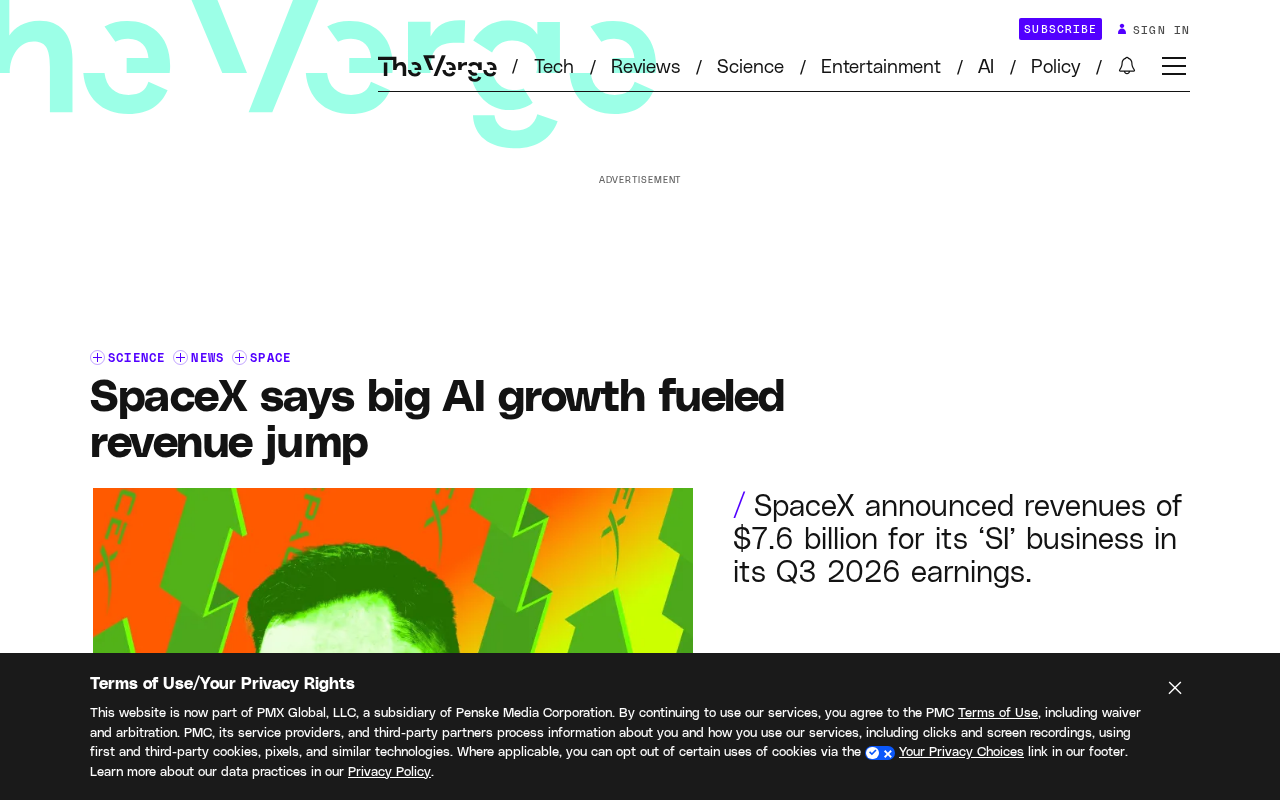
Revenue Structure Transformed: AI and Connectivity Take the Lead
According to SpaceX's published quarterly results, total revenue climbed to $14.6 billion, up 161% from the same period last year. Officials attributed this leap to "accelerated growth in the Super Intelligence (SI) segment and the Connectivity business."
This statement marks a fundamental shift in SpaceX's revenue composition. In the past, external perception of SpaceX centered mainly on rocket launches and Starlink satellite internet service, but now the AI business has joined connectivity as a core driver of growth. A quarterly revenue scale of $14.6 billion is substantial even for global tech giants, and the 161% growth rate indicates that its AI-related business is in an explosive phase.
Space Division Posts Slight Loss, Connectivity Business Remains Solidly Profitable
In contrast to the overall revenue surge, SpaceX's Space division recorded an operating loss of $7 million this quarter. Although small in absolute terms, this figure reflects the profitability pressure on the traditional launch business at the current stage.
On the other side, the Connectivity division performed steadily, achieving $2.4 billion in operating profit. This division is primarily responsible for the Starlink satellite internet service, and its sustained profitability provides important support for the company's overall financial performance. The slight loss in the space segment stands in sharp contrast to the profitability of the connectivity segment, which also explains why the company has shifted its growth narrative toward AI and connectivity.
Operating Income is a core metric for measuring the profitability of a company's main business. It refers to the profit remaining after deducting operating costs and operating expenses such as sales, administrative, and R&D costs from operating revenue. Unlike net income, it does not include non-operating items such as interest and taxes. For a company like SpaceX with clearly differentiated business lines, segment-level disclosure of operating income provides an intuitive picture of each segment's ability to generate cash: the connectivity business's $2.4 billion operating profit means Starlink still has a considerable surplus after covering costs, while the space division's $7 million operating loss indicates that the launch business has not yet achieved profitability at scale under the current launch cadence and cost structure. Investors typically use operating margin (operating income/revenue) to compare the efficiency of different segments, and this is also a key reference for judging the quality of the SI segment.
The "Super Intelligence" Segment: SpaceX's AI Ambitions
The "Super Intelligence" (SI) segment mentioned in the earnings report is the most eye-catching part of this disclosure. Although SpaceX did not elaborate on the specific business content of this segment in the summary, judging from its naming and growth contribution, SI clearly carries the company's strategic positioning in artificial intelligence.
Placing the AI business alongside the space and connectivity businesses means SpaceX is transforming from a space transportation and satellite communications company into a comprehensive technology enterprise that encompasses AI capabilities. Among the 161% revenue growth, the contribution of the SI segment was placed first by officials, indicating that its revenue scale or growth rate is already sufficient to affect overall financial performance. For a company famous for rockets, this transformation deserves continued attention.
"Superintelligence" in AI research generally refers to an artificial intelligence system that comprehensively surpasses human levels across almost all cognitive tasks, a concept at a different level from today's mainstream "narrow AI" and "artificial general intelligence (AGI)." There remains enormous controversy in the industry over whether superintelligence is feasible and when it might arrive, so when a company names a business segment with this term, it often carries strategic declaratory significance rather than a strict technical definition. If SpaceX's SI segment involves massive data processing for the Starlink network, autonomous satellite scheduling, or launch mission optimization, it would be closer to a positioning of "AI infrastructure + industry applications." Understanding the actual business boundaries behind this naming is a prerequisite for assessing the sustainability of its revenue.
Challenges and Points to Watch Behind the Growth
The explosive revenue growth is certainly impressive, but SpaceX's financial structure also reveals some issues that warrant attention. Although the space division's $7 million operating loss is limited in scale, it suggests that the profitability of the traditional launch business is not yet firmly established. The connectivity business's $2.4 billion operating profit is the main source of current profit, while the profitability of the SI segment was not disclosed in the summary.
In addition, the base on which the 161% year-over-year growth rate is built, and whether the SI segment's revenue is sustainable, are key pieces of information that need to be tracked going forward. SpaceX has placed AI at the center of its growth narrative, but the market still needs more details to judge the long-term quality of this new engine.
From a broader perspective, SpaceX's earnings report reflects a trend: even leading companies in the space sector are making AI a core growth pole. When profit margins in the rocket launch business are limited, AI and connectivity services are becoming the new story supporting high valuations.
Year-over-year growth rate interpretation is highly dependent on the base effect: if 161% growth is built on a small base, the absolute increment may be limited; if the base itself is already sizable, it indicates strong growth momentum. The article does not disclose last year's revenue for the same period, so it is difficult to judge directly. In addition, the disclosure scope of segment revenue and profit also affects conclusions—the earnings summary only gives the space division's operating loss and the connectivity division's operating profit, without breaking down the SI segment's revenue and costs, so readers cannot calculate its operating margin. When analyzing such earnings reports, one should distinguish between "revenue growth" and "earnings quality," and pay attention to whether the company provides segment data, customer concentration, and capital expenditure details in subsequent full earnings reports.
One-line Summary
SpaceX quarterly revenue reached $14.6 billion, up 161% year-over-year, with AI and connectivity businesses as the core of growth.
Related articles

Workbuddy for Absolute Beginners: How a Desktop AI Agent Fits Into Real Workflows
A beginner's guide to the Workbuddy desktop AI agent: installation, claiming credits, file management, and building automated workflows—compared with CodeX for fit and cost, helping professionals shift from AI question-askers to AI managers.

OpenAI's New Agent Stack: Computer Use, Decisions API, and Ultra-Fast Workflows
OpenAI Dev Day unveiled a new agent stack: Computer Use outperforms humans, Decisions API delivers ultra-low-latency classification via Luna, Agents API opens the same Computer Use capabilities, and GPT-6.1 Sol costs only one-seventh of Astra. Core updates, benchmark data, and developer insights.

Liang Wenfeng Open-Sources DeepInfo Inference Framework, Takes On U.S. Ban
DeepSeek open-sources its DeepInfo inference framework after its models, featuring GPU/CPU cross-pipelining, small-model prediction with large-model verification, and full Huawei Ascend and NVIDIA chip support—facing the U.S. federal ban head-on. This article analyzes its significance for AI deployment and open-source strategy.