SpaceX's AI Business Exceeds Expectations, Q3 Net Profit Hits $4.4 Billion

SpaceX's Q3 net profit hit $4.4B, with AI named as a growth engine, showcasing the profitability of self-use AI.
SpaceX's Q3 report shows a $4.4 billion net profit and profitability, with AI—rather than rocket launches or Starlink user growth—named as the growth engine. The article argues that SpaceX's AI capabilities are deeply embedded in Starlink communications data and rocket launch and recovery scenarios, making it a typical self-use efficiency tool rather than externally sold model services. This model typically yields higher margins than pure model services because it directly reduces operating costs and boosts product premium. Unlike pure AI companies, SpaceX uses AI to amplify its asset-heavy moat, with a clear cost-recovery path. However, available information does not disclose a specific revenue breakdown for the AI business, so attributing the entire $4.4 billion net profit to AI is not rigorous. If AI capabilities are externalized as products in the future, the valuation logic could be reassessed.
SpaceX's AI Business Is Rewriting Its Profit Story
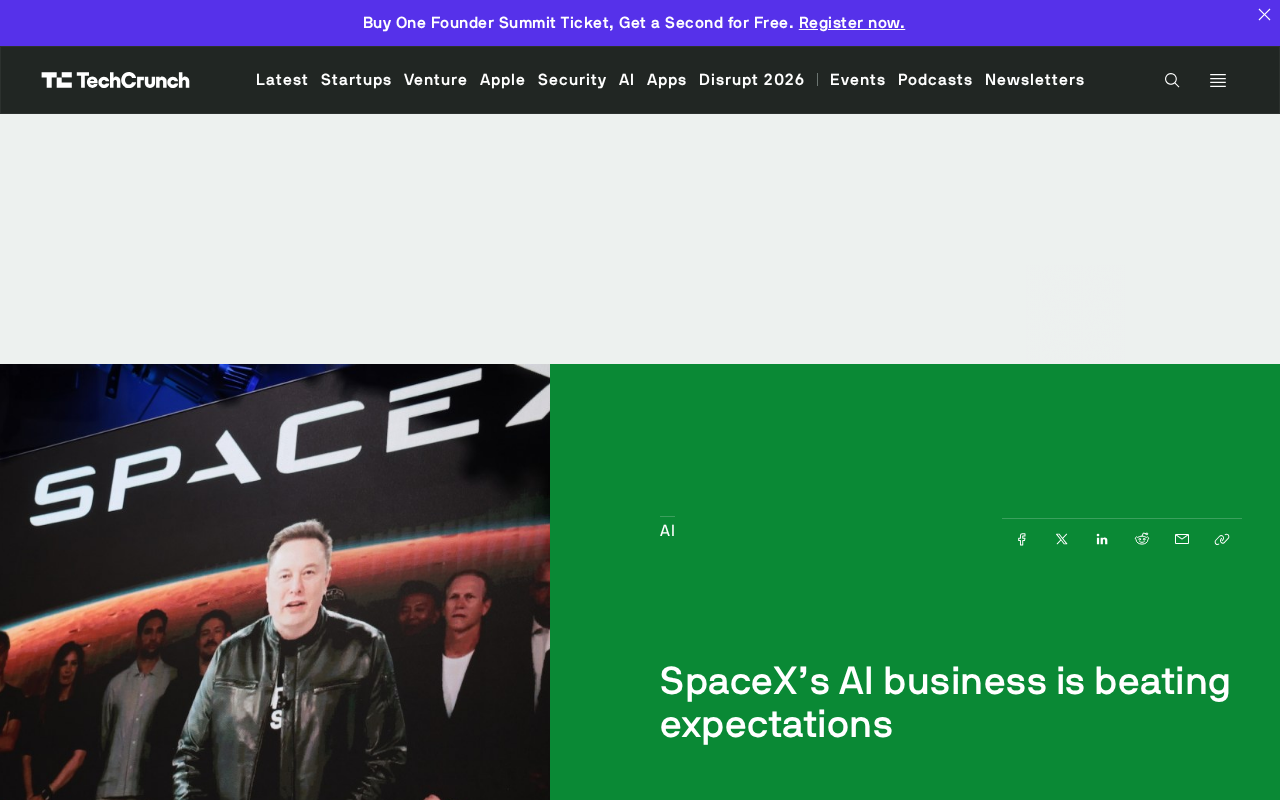
SpaceX has released its third-quarter financial results, reporting a net profit of $4.4 billion and achieving profitability. Surprisingly, the growth engine called out in this report isn't rocket launches or Starlink user growth—it's the AI business.
This news is noteworthy because it upends the conventional perception of SpaceX—a company centered on aerospace manufacturing and satellite internet is turning AI into a tangible source of profit. According to RSS feed reports, SpaceX's AI business performed "better than expected" and directly drove a leap in overall profitability.
How AI Became SpaceX's Profit Engine
From a business structure perspective, SpaceX's AI capabilities don't exist independently—they are deeply embedded in its existing systems. Starlink generates massive volumes of communications and network data every day, and rocket launches and recoveries involve complex real-time decisions. These scenarios are naturally suited to AI optimization.
In other words, SpaceX doesn't sell models externally; it treats AI as an internal efficiency tool and product enhancement layer. This "self-use AI" approach typically yields higher profit margins than pure model services, because it directly reduces operating costs while boosting product premium.
The $4.4 billion net profit in Q3 shows that this logic is beginning to pay off at scale.
Self-use AI refers to enterprises that do not sell AI models as standalone products, but instead embed AI capabilities into their own business processes to optimize operations, reduce costs, and enhance product performance. Unlike model providers such as OpenAI and Anthropic that offer external APIs or subscription services, the returns from self-use AI are reflected in internal efficiency gains—for example, reducing manual intervention, shortening decision cycles, and cutting fuel or bandwidth waste. The advantage of this model is its clear input-output path: every AI R&D expense can be mapped to specific cost savings or product premiums, without depending on external customers' willingness to pay or market promotion. Asset-heavy industries such as aerospace, manufacturing, and logistics are particularly well suited to this approach, because their operations contain many quantifiable optimization opportunities.
Starlink is the low-Earth-orbit satellite internet constellation built by SpaceX, providing broadband access to remote regions worldwide by deploying thousands of satellites in near-Earth orbit. The Starlink system generates massive volumes of network traffic, signal quality, and user behavior data every day, while also requiring dynamic scheduling of satellite beams, management of spectrum resources, and optimization of ground station handovers. These tasks demand extremely high real-time performance and large-scale decision-making, which traditional rule engines struggle to cover, whereas AI can automate optimization in areas such as traffic prediction, interference avoidance, and antenna scheduling. The larger Starlink's user base grows, the more significant the marginal efficiency gains from AI become—which is why it is regarded as one of the core internal AI application scenarios at SpaceX.
How the AI Narrative of an Aerospace Company Differs from Pure AI Companies
Most current market discussions about AI commercialization focus on model providers and cloud service providers. SpaceX offers a different example: how hardware and infrastructure companies can use AI to amplify their own moats.
The barriers to entry in aerospace and satellite internet are extremely high. Here, AI's role is not to create new businesses from scratch, but to make existing assets operate more efficiently. The advantage of this model is that AI investment has a clear cost-recovery path and doesn't depend on external customers' willingness to pay.
For the industry, this may mean that the yardstick for measuring AI value is shifting—not just looking at model capabilities, but also at how much AI reduces costs and improves efficiency in asset-heavy scenarios.
Asset-heavy scenarios refer to business models in which companies rely on large amounts of fixed assets (such as rockets, satellites, launch sites, and ground stations) to operate. Unlike asset-light software or model service companies, asset-heavy enterprises have cost structures dominated by depreciation, maintenance, and operating expenses, so any efficiency improvement can translate directly into profit. The value of AI in asset-heavy scenarios lies not in creating entirely new revenue streams, but in making existing assets operate more efficiently—for example, improving rocket recovery success rates, extending satellite service life, and reducing unit bandwidth costs. Such cost reductions and efficiency gains can be precisely measured, so the payback period for AI investment is shorter and more predictable than for pure model services—but it also depends more heavily on the company's own asset scale and accumulated operational data.
What Warrants a More Measured View
The available information only discloses the net profit figure and the judgment that "AI is the engine," without providing a specific revenue breakdown, profit margin, or growth data for the AI business. Therefore, attributing the entire $4.4 billion net profit to AI is not rigorous. A more reasonable interpretation is that AI played a key efficiency-enhancing role across multiple business lines.
Going forward, it will be worth watching whether SpaceX discloses AI-related metrics separately in its financial reports, and whether these capabilities will be externalized as products. If the AI business moves from an internal tool to an external service, its valuation logic will be reassessed once again.
Related articles

Workbuddy for Absolute Beginners: How a Desktop AI Agent Fits Into Real Workflows
A beginner's guide to the Workbuddy desktop AI agent: installation, claiming credits, file management, and building automated workflows—compared with CodeX for fit and cost, helping professionals shift from AI question-askers to AI managers.

OpenAI's New Agent Stack: Computer Use, Decisions API, and Ultra-Fast Workflows
OpenAI Dev Day unveiled a new agent stack: Computer Use outperforms humans, Decisions API delivers ultra-low-latency classification via Luna, Agents API opens the same Computer Use capabilities, and GPT-6.1 Sol costs only one-seventh of Astra. Core updates, benchmark data, and developer insights.

Liang Wenfeng Open-Sources DeepInfo Inference Framework, Takes On U.S. Ban
DeepSeek open-sources its DeepInfo inference framework after its models, featuring GPU/CPU cross-pipelining, small-model prediction with large-model verification, and full Huawei Ascend and NVIDIA chip support—facing the U.S. federal ban head-on. This article analyzes its significance for AI deployment and open-source strategy.