SparkWinShape Review: Is Windsurf Auto Account-Switching for Unlimited Claude Opus Actually Reliable?

SparkWinShape enables unlimited Windsurf Claude Opus use via auto account-switching, but risks outweigh convenience.
This article examines the Windsurf AI coding tool's quota limitations and analyzes the third-party tool SparkWinShape's seamless account-switching mechanism—achieving continuous high-end model usage through batch account management and automatic switching. However, it highlights significant risks including account security concerns, Terms of Service violations, and device fingerprint-based risk detection, recommending developers prioritize compliant alternatives like official subscription upgrades, direct API access, or local model deployment.
The Quota Dilemma of AI Coding Tools: Why People Want Auto Account-Switching
Windsurf is one of the hottest AI-assisted coding tools right now, attracting a large number of developers with its excellent code generation capabilities. Developed by Codeium, Windsurf is an AI coding IDE that rose rapidly in the second half of 2024. Unlike GitHub Copilot, which primarily exists as an editor plugin, Windsurf is a complete standalone IDE built on VS Code's open-source core but with deeply integrated AI capabilities. Its standout feature is Cascade—an AI agent mode that can understand an entire project codebase and automatically execute multi-step programming tasks, making it particularly strong at handling cross-file modifications, project-level refactoring, and other complex tasks. However, whether you're on a Pro subscription or a trial account, they all share the same pain point—limited API call quotas. This is especially problematic when using high-end models like Claude Opus, where quotas are consumed extremely quickly, and frequently switching accounts manually seriously disrupts development workflow.
To understand why quotas are consumed so fast, you need to understand LLM pricing mechanisms. Tokens are the basic unit that large language models use to process text—an English word is typically split into 1-3 tokens, while Chinese characters usually correspond to 1-2 tokens each. Taking Claude as an example, Anthropic charges based on the number of input and output tokens using a tiered pricing strategy: Claude 3.5 Sonnet costs approximately $3/million input tokens and $15/million output tokens, while Claude Opus as the flagship model costs approximately $15 per million input tokens and $75 per million output tokens—5x the price of Sonnet. Integrated tools like Windsurf typically offer users a certain amount of "credits" or "request counts" through monthly subscriptions, essentially repackaging and reselling the underlying API costs. When users frequently perform code generation, refactoring, debugging, and other operations, each interaction consumes a large number of tokens. This is especially true for long conversations carrying full project context in Cascade mode, where a single request's input tokens can reach tens of thousands or even hundreds of thousands—this is the fundamental reason why high-end model quotas are consumed so quickly.
Recently, a third-party plugin tool called "SparkWinShape" (星火WinShape) has generated considerable discussion. It claims to achieve fully automatic, seamless account switching for Windsurf, allowing developers to continuously use full-quota AI models without interrupting their workflow. Below, we'll break down this tool's functional mechanisms and real-world usage experience in detail, while also objectively analyzing the associated risks.
SparkWinShape Core Feature Breakdown
Batch Account Management
SparkWinShape provides a complete account management system supporting three import methods:
- Manual Addition: Enter accounts and passwords one by one
- Batch Import: Import large numbers of account credentials at once via file
- Batch Paste: Paste account credentials directly in a specified format
Once imported, accounts can be organized into groups, flexibly allocated by different purposes (daily development, testing and debugging, etc.). The tool also includes a "Brain Mode" that, when enabled, can perform batch registration operations—though users who've purchased ready-made accounts generally won't need this feature.
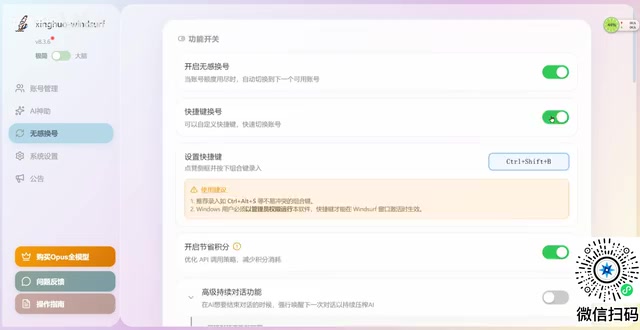
Windsurf Seamless Account-Switching Mechanism Explained
This is the tool's most core capability. "Seamless switching" means that when the current account's quota is about to be exhausted, the system automatically switches to the next available account—without requiring a Windsurf restart—and developers barely notice the switch happening.
From a technical implementation perspective, this involves intercepting and replacing the Windsurf client's authentication flow. As an IDE based on VS Code architecture, Windsurf's user authentication typically relies on OAuth tokens or Session Cookies to maintain login state. OAuth (Open Authorization) is an open-standard authorization protocol that allows users to authorize third-party applications to access their resources without exposing passwords. In Windsurf's case, after a user logs in, the server issues an Access Token and a Refresh Token—the former for short-term API call authentication, the latter for obtaining new tokens after the access token expires. Session Cookies are another common authentication method where the server creates a session after user login and stores the session ID as a Cookie on the client side. For a third-party tool to achieve seamless switching, it needs to replace authentication credentials in memory or local storage without restarting the IDE process, and re-establish session connections with the backend service. Such operations are typically accomplished through hooking system APIs, modifying local configuration files, or injecting intermediate proxy layers—technically complex work that also means the third-party tool has read/write access to the user's complete authentication information.
Specific switching strategies include:
- Auto-switch threshold settings: Users can set a percentage threshold (e.g., 3%) that automatically triggers switching when remaining quota falls below it
- Switch frequency control: Multiple frequency options like normal and fast are available; "normal" is sufficient for daily use
- Hotkey manual switching: Besides automatic mode, hotkey-triggered manual switching is supported at any time
- Priority sorting by expiration: The system automatically prioritizes accounts nearing expiration, consuming their remaining quota first
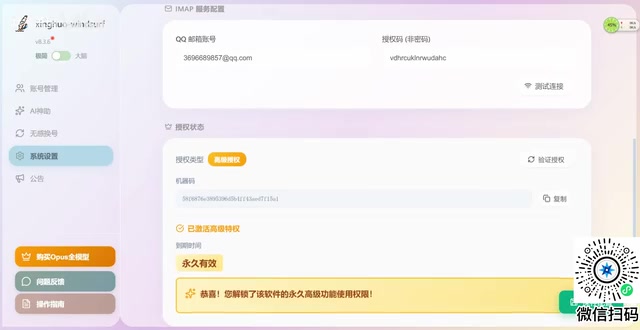
No-VPN Switching & Fully Automatic Operation
The tool also provides two quite practical auxiliary features:
- No-VPN Account Switching: When enabled, account switching can be completed without network proxy tools, lowering the barrier to entry
- Fully Automatic AI Unattended Mode: When enabled, the system runs completely autonomously without human intervention, suitable for long-running automated development tasks
Additionally, the "Advanced Continuous Conversation" feature allows dialogue context to be maintained after account switches, preventing the AI from "losing memory" and dropping previous code discussion records. This feature likely works by caching conversation history locally and re-injecting the context into prompts after a new account session is established, allowing the model to "inherit" previous discussion content. Note that this context injection consumes additional input tokens—the re-injected conversation history after each switch may contain thousands of tokens, which itself accelerates quota consumption on the new account.
Complete Windsurf Seamless Account-Switching Workflow
Step 1: Software Configuration
After installing SparkWinShape, complete the basic configuration:
- Import purchased Windsurf accounts
- Enable the "No-VPN Switching" option
- Enable "Fully Automatic AI Unattended" mode
- Set the auto-switch threshold (recommended 3%-5%)
- Confirm subscription status (e.g., Pro plan)
Step 2: Sync & Launch
After opening Windsurf, the plugin loads automatically. The current version is 8.3.7, and account information typically syncs automatically to the plugin. If sync fails, you can manually click the "Sync to Plugin" button to complete the connection.
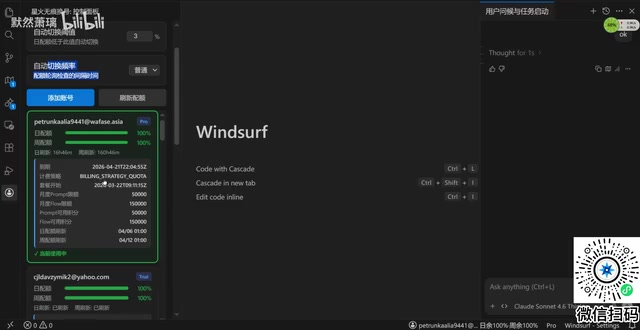
From actual demonstrations, the switched account's quota immediately refreshes to 94%-100%, with Pro accounts showing full quota status. Users can freely choose between using the Sonnet model or Claude Opus model, with all models callable normally.
Step 3: Enter Fully Automatic Operation
Once configured, the system enters fully automatic operation. When quota drops below the threshold, the system automatically completes the switch and quota refresh—the entire process is completely transparent to the developer.
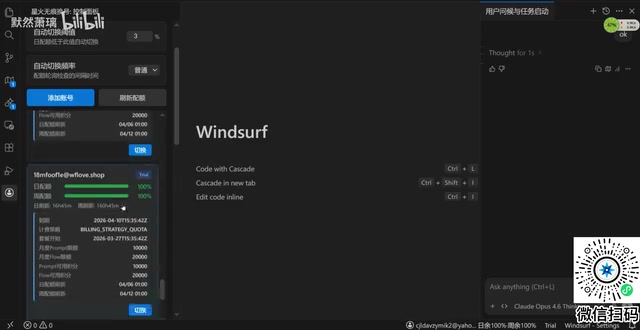
As shown in the screenshots, all accounts' quotas have been successfully refreshed with no manual operation required. Users can also click the "Refresh Quota" button at any time to manually trigger a refresh.
Risk and Compliance Analysis
While SparkWinShape does functionally solve the Windsurf quota limitation pain point, the potential risks must be viewed objectively.
Account Security Risks
- Entrusting large numbers of accounts to a third-party tool creates the possibility of credential leakage
- Batch registration and automatic switching behavior may trigger Windsurf's risk control mechanisms, resulting in account bans
- Purchased third-party accounts have unclear origins and may involve stolen accounts or other violations
It's worth noting that modern SaaS platform risk control systems go far beyond simply checking IP addresses. Service providers like Windsurf typically employ Device Fingerprinting to identify and track devices. Device fingerprinting technology generates a nearly unique device identifier by collecting multi-dimensional device characteristic information—including CPU model, GPU rendering characteristics (Canvas Fingerprint), installed font lists, timezone settings, language preferences, screen resolution, OS version, WebGL renderer information, and more. Even if users clear all cookies or use different browser configurations, device fingerprints can still identify the same physical device with high accuracy. Combined with login behavior patterns (such as login frequency, time intervals, geographic location jumps, etc.) to build user profiles, when the same device fingerprint is associated with multiple different accounts in a short time period, and these accounts exhibit similar usage patterns, such anomalous patterns are easily identified by machine learning models. Once risk controls are triggered, mild consequences include secondary verification requirements, while severe ones involve directly banning device-level identifiers, causing all associated accounts on that device to become invalid simultaneously.
Risk of Violating Terms of Service
Multi-account rotation almost certainly violates Windsurf's Terms of Service (ToS). Most SaaS services' ToS explicitly prohibit account sharing, transfer, and automated access behavior. Violating terms may not only result in account bans—in extreme cases, service providers even reserve the right to pursue legal action. Once detected, not only will current accounts be banned, but the user's other associated services may be affected as well.
Legal and Ethical Considerations
Using technical means to circumvent payment limitations is essentially an act of evading the business model. If such practices become widespread, they will likely force service providers to tighten restriction policies, ultimately harming the interests of the entire developer community. From an industry development perspective, the sustainable development of AI coding tools depends on reasonable business models. The AI coding tool market is currently in a period of intense competition—Windsurf, Cursor, GitHub Copilot, and other products are all using subsidy strategies to compete for users, with many subscription prices actually below the true cost of underlying model APIs. Once the positive cycle between user payments and service quality is broken, service providers may be forced to raise prices, reduce free quotas, or even implement stricter identity verification mechanisms—all measures that ultimately increase usage costs and friction for all users.
Recommended Compliant Alternatives
For developers who genuinely have high-frequency AI coding needs, the following approaches are more reliable:
-
Upgrade Windsurf's Official Subscription: Pro and other premium plans offer more generous quotas—the most direct and safest solution
-
Multi-Tool Combination: Pair Windsurf with Cursor, GitHub Copilot, and other tools to distribute quota pressure across multiple tools. Different tools also have different strengths—Cursor excels at multi-file editing and project-level refactoring, GitHub Copilot provides smooth code completion experiences, and Windsurf's Cascade mode stands out in automating multi-step tasks. Smart combinations can balance efficiency and quota usage
-
Direct Claude API Connection: Purchase Claude API quota directly and call it within your IDE through open-source plugins like Continue or Cline, with pay-as-you-go flexibility. The advantage of this approach is completely transparent pricing (e.g., Claude 3.5 Sonnet at approximately $3/million input tokens), no artificially imposed quota caps, and API Keys managed by the user for better security. Anthropic also provides tiered Rate Limits, allowing users to request increased call frequency limits based on usage. The downside is the lack of project-level context management and advanced orchestration features like Cascade that Windsurf provides, requiring users to configure their own prompt engineering and context window strategies
-
Local Model Deployment: For non-critical tasks, deploy local LLMs using tools like Ollama or LM Studio with absolutely no quota limitations. As of 2025, the open-source code model ecosystem has become quite rich: Meta's Code Llama series offers choices ranging from 7B to 70B parameters; DeepSeekAd Coder V2 performs excellently on code generation benchmarks, approaching GPT-4 levels on some metrics; Alibaba's Qwen2.5-Coder also shows strong performance in both Chinese and English code scenarios. Quantization technology (such as 4-bit quantization in GGUF format) enables these models to run on consumer hardware—for example, a single RTX 4090 with 16GB VRAM can smoothly run a 14B parameter quantized model, providing usable experiences for daily code completion and simple function generation scenarios. Tools like Ollama and LM Studio further lower the deployment barrier—users only need a few commands to launch model services locally, connecting with various IDE plugins through OpenAI API-compatible interfaces. However, it's important to note that significant gaps remain between open-source models and top closed-source models like Claude Opus and GPT-4 in complex architecture design, cross-file refactoring, and long-context understanding, and running larger parameter models (70B level) requires GPUs with at least 48GB of VRAM—a non-trivial hardware requirement
Conclusion: Weighing Convenience Against Risk
The emergence of Windsurf account-switching tools like SparkWinShape reflects widespread developer frustration with AI coding tool quota limitations. From a technical implementation standpoint, its seamless switching, automatic quota refresh, and no-proxy switching features are indeed well-designed, with a reasonably streamlined operational flow.
But convenience should not be a reason to ignore risks. Before considering such tools, developers should thoroughly assess risks in account security, compliance, and other areas, and seriously consider whether more sustainable alternatives exist. After all, a stable and reliable development environment holds far more long-term value than short-term "unlimited quota."
Key Takeaways
- SparkWinShape plugin achieves seamless switching when Windsurf quotas are exhausted through a multi-account auto-rotation mechanism, supporting configurable threshold-triggered switching
- The tool provides batch account management, no-proxy switching, and fully automatic unattended operation, lowering the barrier to entry
- Supports continuous use of high-end models like Claude Opus 4.6, with account quotas auto-refreshable to full status
- Such tools carry account security risks and the danger of violating Terms of Service, potentially resulting in bans; modern risk control systems can precisely identify anomalous operations through device fingerprinting and behavioral analysis
- Developers are advised to prioritize compliant alternatives such as upgrading official subscriptions, direct API connections, or local model deployment, which are more sustainable in the long run
Related articles
 Product Reviews
The Programmer's Desk Setup Guide: Building a Workspace That Feels Like Home
Discover how programmers build productive, comfortable workspaces. From multi-monitor setups to ergonomic design, explore the desk philosophy that drives focus and flow.
 Product Reviews
Qoder vs Cursor Real-World Comparison: Which $20/Month AI IDE Is Better?
Hands-on comparison of Qoder vs Cursor AI IDEs: Agent autonomy, human interaction count, and architecture decisions. Qoder needed only 2 interactions vs Cursor's 8.
 Product Reviews
Cursor Cloud Agent Demo: Eliminating Bottlenecks Across the Entire Software Development Lifecycle
Deep analysis of Cursor's Cloud Agent demo showing how cloud VMs, automated test artifacts, and a full-chain control plane systematically eliminate human bottlenecks across the software development lifecycle.