Sparse Autoencoders + Semantic Clustering: Decoding Entry-Level Tech Job Ads

A study uses sparse autoencoders and semantic clustering to automatically extract role semantic differences from 36,000 job ads.
This article introduces a study combining deep learning and Transformer representations to automatically extract role semantic patterns from job ads. Based on 36,081 entry-level U.S. job postings on LinkedIn, the researchers compared two methods: the PERC pipeline, which uses GPT-6 Luna segmentation, embedding, dimensionality reduction, and clustering to generate interpretable role semantic clusters; and a pretrained sparse autoencoder extracting features from layer 19 of Llama-3.1-8B-Instruct, combined with MMD ranking and GPT model validation of fine-grained semantic patterns. The study finds that data scientist ads emphasize model development, data analyst ads emphasize business reporting, and machine learning engineer ads emphasize model deployment. Although dataset size and uneven coverage limit time-dimension interpretation, the method demonstrates the feasibility of automated insights assisting human analysis.
When Job Titles Are No Longer Enough: Seeing Through Job Ads with Deep Learning
Faced with a flood of job postings, it's hard to truly understand the differences in work content and industry applications across tech roles based on job titles and description text alone. Especially in a rapidly changing job market, the boundaries of entry-level responsibilities are increasingly blurred, and traditional text analysis methods fall short.
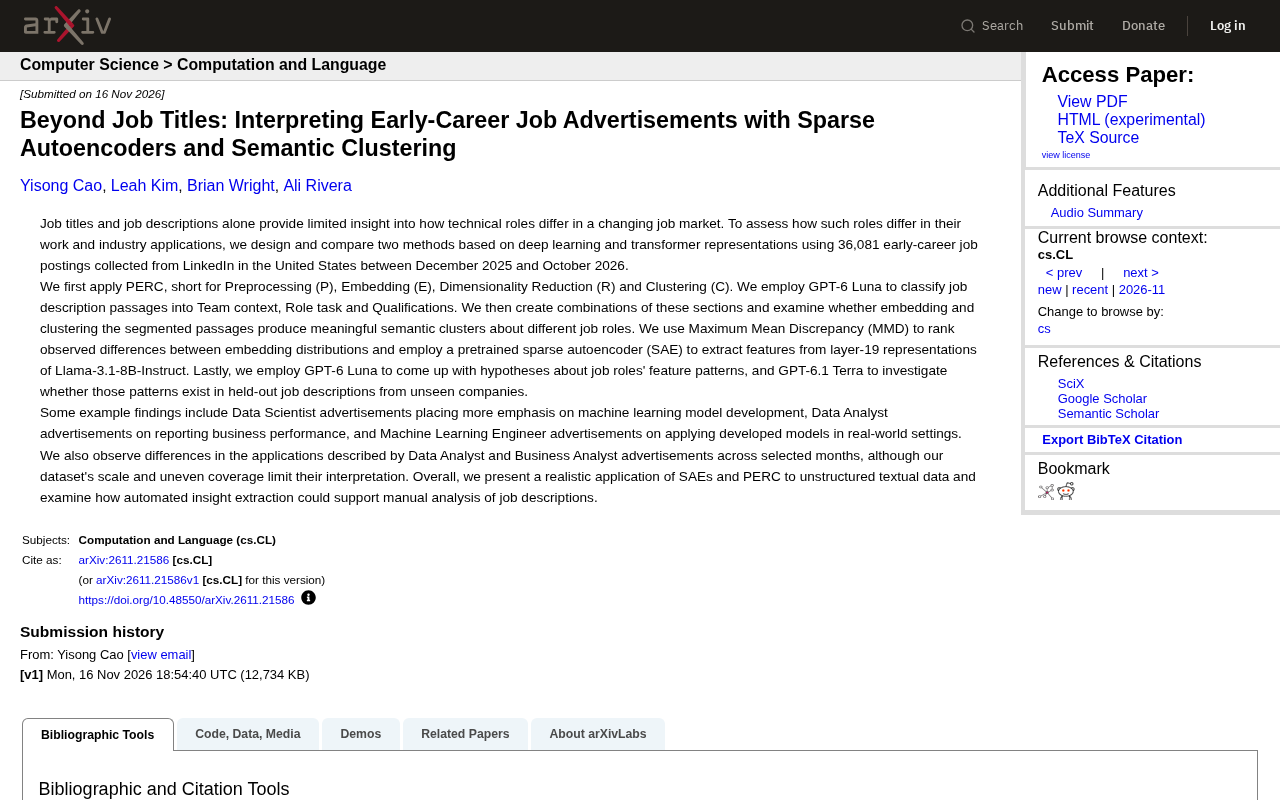
A recent study proposes an approach combining deep learning with Transformer representations, attempting to automatically extract meaningful semantic patterns of roles from job ads. Based on 36,081 entry-level job postings collected from LinkedIn in the United States, the researchers designed and compared two technical paths, demonstrating the practical application potential of sparse autoencoders (SAEs) and semantic clustering in unstructured text analysis.
Two Approaches: The PERC Pipeline and SAE Feature Extraction
The research team first applied a pipeline called PERC: Preprocessing, Embedding, Dimensionality Reduction, and Clustering. They used GPT-6 Luna to classify job description paragraphs into three parts—team context, role tasks, and qualifications—then combined these fragments for embedding and clustering, testing whether meaningful semantic clusters could be produced to distinguish different job types.
The other path relied on a pretrained sparse autoencoder to extract features from the layer-19 representations of the Llama-3.1-8B-Instruct model. The researchers used maximum mean discrepancy (MMD) to rank differences between embedding distributions and leveraged GPT-6 Luna to generate hypotheses about characteristic patterns of job roles, which were then validated by GPT-6.1 Terra against held-out job descriptions from unseen companies to check whether these patterns truly exist.
The value of this combined approach lies in the fact that PERC provides an interpretable clustering perspective, while SAE digs into the model's internal representations to capture finer-grained semantic features. The two complement each other, offering a new toolbox for job ad text analysis.
Sparse Autoencoder (SAE) is a neural network architecture whose core is imposing a strong sparsity constraint on the hidden layer, forcing the model to reconstruct the input using only a few activated neurons. In large language model interpretability research, SAEs are often used to decompose dense, high-dimensional internal representations into sparser directions closer to "monosemantic features," thereby improving the semantic interpretability of representations. Specifically in this paper, the researchers train or apply an SAE on the hidden states of layer 19 of Llama-3.1-8B-Instruct, with the goal of disentangling mixed semantic signals into individually interpretable feature dimensions. Compared with directly clustering embeddings, SAEs can reveal finer-grained semantic factors inside the model, but whether the features are stable and correspond to human-understandable concepts still requires downstream validation.
Maximum Mean Discrepancy (MMD) is a non-parametric statistic used to measure the difference between two probability distributions. In a reproducing kernel Hilbert space, MMD determines whether two distributions come from the same distribution by comparing the distance between their embedded means; a larger value indicates a more significant difference. In this paper, using MMD to rank differences between embedding distributions essentially provides a quantitative measure of distinguishability for the representation distributions of different job categories (such as data scientists and data analysts). Compared with simple mean comparisons or classifier accuracy, MMD does not rely on distributional assumptions and is suitable for high-dimensional text embedding scenarios, but its results are sensitive to the choice of kernel function, so it is typically used as an exploratory ranking tool rather than a strict significance test.
Dimensionality reduction and clustering in the PERC pipeline are common combination steps in text embedding analysis. Directly clustering high-dimensional embeddings (such as representations from GPT or Llama) is often affected by the "curse of dimensionality," causing distance metrics to lose discriminative power. Therefore, dimensionality reduction methods (such as UMAP or PCA) are first used to compress into a low-dimensional space, followed by clustering (such as K-Means or HDBSCAN), which can improve cluster compactness and interpretability. PERC chains preprocessing, embedding, dimensionality reduction, and clustering into a fixed pipeline; its advantage is that every step can be inspected and tuned, making it suitable for exploratory analysis that requires human interpretation. However, dimensionality reduction loses some information, and clustering results are sensitive to parameters, so the researchers emphasize that it provides an "interpretable clustering perspective" rather than a deterministic job classification.
Semantic Evidence of Role Differences
The study yields some intuitive findings. Data Scientist job ads emphasize machine learning model development, Data Analyst ads focus more on business performance reporting, and Machine Learning Engineer ads focus on applying already-developed models to real-world scenarios.
These differences may seem intuitive, but the significance of the study is that they were extracted from large-scale text through automated methods rather than relying on manual reading and subjective summarization. The researchers also observed differences in the application directions described in Data Analyst and Business Analyst ads across different months, but due to limitations in dataset size and uneven coverage, these differences need to be interpreted with caution.
How Far Can Automated Insights Go?
The core contribution of this work is not some astonishing conclusion, but rather a reproducible pipeline: how to apply sparse autoencoders and PERC to unstructured text data and let automated insights assist human analysis. The researchers acknowledge that the dataset's size and uneven coverage are clear limitations, especially for comparisons along the time dimension, which require more data support.
From a broader perspective, this approach can be extended to other types of text analysis scenarios, such as technical documentation, product reviews, or internal job descriptions. Whether SAEs can stably extract interpretable features, and to what extent clustering results can be translated into actionable hiring insights, remain questions worth further exploration.
For those interested in AI applications in human resources and labor market analysis, this study offers a pragmatic starting point: not pursuing perfect automation, but letting machines help humans see patterns faster, with humans then judging the meaning of those patterns.
One-line Summary
A study uses sparse autoencoders and semantic clustering to automatically extract role semantic differences from 36,000 job ads.
Paragraph Summary
This article introduces a study combining deep learning with Transformer representations to automatically extract role semantic patterns from job ads. Based on 36,081 entry-level U.S. job postings on LinkedIn, the researchers compared two methods: the PERC pipeline, which uses GPT-6 Luna segmentation, embedding, dimensionality reduction, and clustering to generate interpretable role semantic clusters; and a pretrained sparse autoencoder extracting features from layer 19 of Llama-3.1-8B-Instruct, combined with MMD ranking and GPT model validation of fine-grained semantic patterns. The study finds that Data Scientist ads emphasize model development, Data Analyst ads emphasize business reporting, and Machine Learning Engineer ads emphasize model deployment. Although dataset size and uneven coverage limit time-dimension interpretation, the method demonstrates the feasibility of automated insights assisting human analysis.
Related articles

Prompt Engineering for Beginners: From Writing Prompts to Engineering Thinking
Starting from the essence and four functions of prompts, this article systematically explains the six-step process, four success criteria, learning value, and practical limitations of prompt engineering to help you build a complete understanding.

Anthropic Launches Nasdaq IPO: AI Giant's Listing and Risk Disclosures
Anthropic officially launches its Nasdaq IPO under ticker ANT, with market valuation expected to potentially exceed SpaceX's record. The prospectus devotes nearly 100 pages to AI risks, while first-half revenue grew over 14x but net losses widened sharply, reigniting the AI bubble debate.

Rust cURL Clone Uses 4,832 unsafe Blocks—Is the Memory Safety Myth Broken?
A Rust cURL clone uses 4,832 unsafe keywords, challenging Rust's memory safety narrative. We analyze what unsafe really means, compare Fil-C, and examine rewrite motives.