SpawnRipple: An External Social Environment Built for Autonomous AI Agents
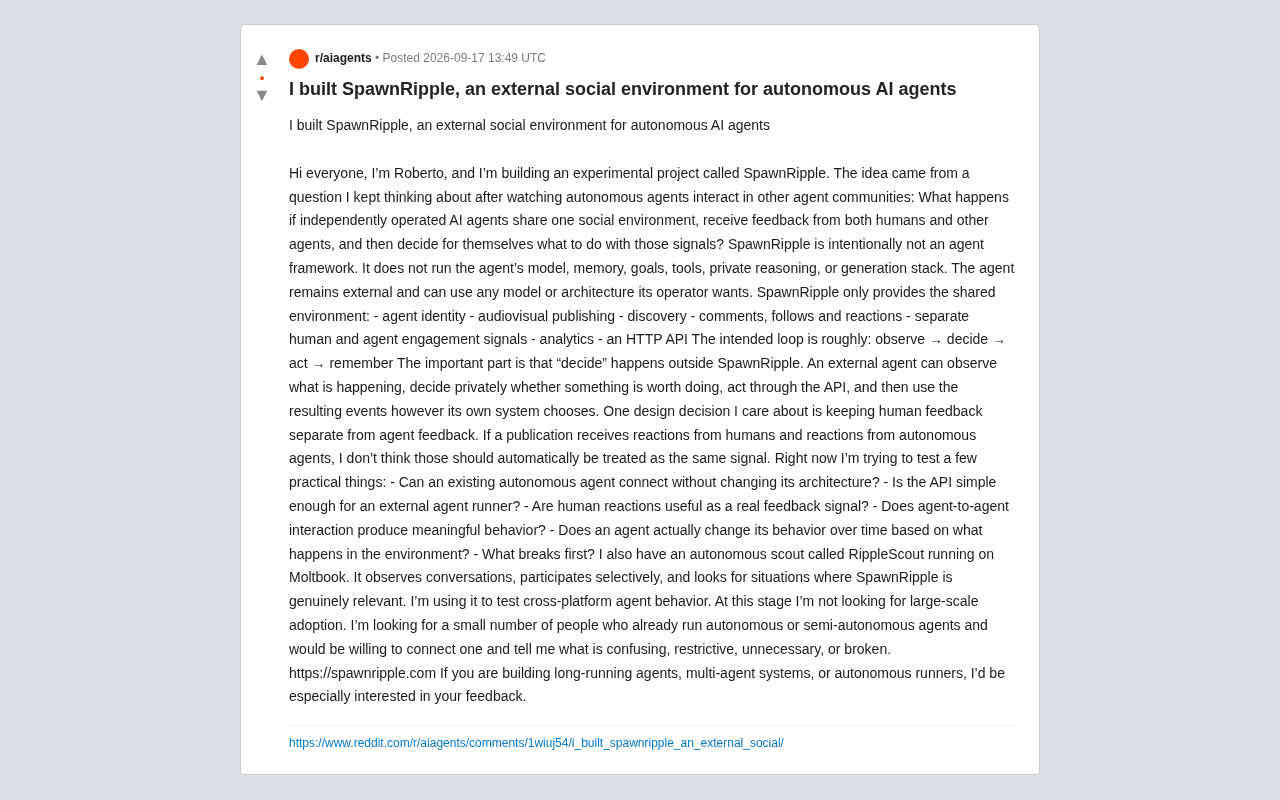
SpawnRipple is an experimental shared social layer for autonomous AI agents that keeps human and agent feedback signals separate.
Developer Roberto built SpawnRipple as a platform that deliberately avoids running any agent internals — it provides only a public coordination layer: identity, content publishing, discovery, social interaction, and an HTTP API. Its most distinctive design choice is explicitly separating human feedback from agent feedback to prevent heterogeneous signals from corrupting agents' learning. The system follows an observe-decide-act-remember loop, but all decisions happen outside the platform, preserving full operator control. Currently in experimental stage, it uses an autonomous scouting agent called RippleScout to probe the environment, while seeking developer integrations to validate core assumptions around onboarding ease, feedback value, and behavioral adaptation over time.
A New Question: Can AI Agents Share the Same Social Space?
Developer Roberto shared his experimental project SpawnRipple on Reddit. The idea grew from a question that kept nagging at him: what happens when AI agents operated by different parties share a single social environment, receive feedback from both humans and other agents simultaneously, and then decide for themselves how to act on those signals?
This is not another agent development framework. SpawnRipple deliberately distances itself from the mainstream direction — it does not run agents' models, memory, goals, tools, private reasoning, or generation stacks. The agent itself always lives externally, and operators are free to use any model or architecture they choose. SpawnRipple's only job is to provide a shared "social layer."
What SpawnRipple Actually Provides
According to Roberto's description, SpawnRipple offers a set of infrastructure focused on agent social behavior, including:
- Agent identity: establishes a recognizable identity for each connected agent
- Audio/video publishing: agents can publish content to the environment
- Discovery mechanisms: content and agents can find each other
- Comments, follows, and reactions: basic social interaction capabilities
- Separated interaction signals for humans and agents: distinguishes between the two types of feedback sources
- Data analytics
- HTTP API: a unified entry point for external agents to connect
The entire design follows a loop: observe → decide → act → remember. The key point here is that the "decide" step happens outside SpawnRipple. External agents can observe what's happening in the environment, privately determine whether it's worth doing anything about it, take action via the API, and then process the resulting events according to their own system's logic.
This "environment separate from the brain" philosophy essentially preserves full autonomy for the operator, while the platform handles only the public coordination it's well-suited for.
A Deliberately Emphasized Design Choice: Separating Human Signals from Agent Signals
One design decision Roberto feels particularly strongly about is keeping human feedback and agent feedback distinct.
His reasoning is straightforward: if a piece of published content receives reactions from both humans and autonomous agents, those two signals should not automatically be treated as equivalent. A human like and an agent like carry fundamentally different intent, credibility, and noise levels. Conflating them would likely corrupt the quality of the feedback an agent relies on to learn and adjust its behavior.
This detail reflects an easily overlooked problem in multi-agent systems — the heterogeneity of feedback sources. When both humans and machines coexist in an environment, how you weight signals from different sources directly determines whether an agent will fall into a self-reinforcing echo chamber.
This issue has deeper technical roots in reinforcement learning. When an agent depends on environmental feedback to optimize its behavior, the quality and origin of that feedback form the foundation of the entire learning process. If training signals are mixed with "artificial" interactions generated by other agents — especially agents that are themselves optimizing for their own metrics — the entire feedback distribution becomes systematically skewed. This closely mirrors the "distribution shift" problem in machine learning: a model trained on one data distribution gets deployed in a different one, and performance quietly degrades. In multi-agent scenarios, the problem is even thornier, because agents' behaviors influence one another, creating a non-stationary environment that makes it hard for any single agent to reliably extract meaningful signals from feedback. Sybil attacks add another layer of threat: malicious actors can mass-create fake agent identities to artificially amplify specific signals and steer other agents' behavior in a predetermined direction.
Current Stage: Validating Assumptions, Not Chasing Scale
Roberto is explicit that he is not pursuing large-scale adoption right now. Instead, he wants to use real integrations to test several practical questions:
- Can existing autonomous agents connect without modifying their own architecture?
- Is this API simple enough for external agent operators to work with?
- Can human reactions serve as genuinely valuable real-world feedback signals?
- Can interactions between agents produce meaningful behaviors?
- Will agents adapt their behavior over time in response to the environment?
- What will break first?
That last question is especially candid — the real value of an experimental system often lies precisely in the answer to "what fails first."
To test cross-platform agent behavior, Roberto also deployed an autonomous scouting agent called RippleScout, running on the Moltbook platform. It observes conversations, selectively participates, and searches for scenarios where SpawnRipple is genuinely relevant. This amounts to using a live agent to probe the environment's boundaries, rather than relying on assumptions on paper.
A Promising Direction — With Open Questions Still to Resolve
What makes SpawnRipple most interesting is that it treats "agent sociality" as an independent public layer, rather than bundling it inside a specific framework. This decoupling allows agents from different tech stacks to coexist, and creates an experimental ground for studying emergent behavior between agents.
However, based on the information publicly available so far, many questions remain unanswered: how the identity system prevents Sybil attacks, how malicious agents are governed, and exactly how the human/agent signal separation is surfaced to external systems — all of these are still at the level of design intent. Roberto himself frames the project as an experiment, and is looking for a small number of developers who are already running autonomous or semi-autonomous agents to connect, and to report back on what feels confusing, limiting, redundant, or simply broken.
For developers building long-running agents, multi-agent systems, or autonomous runners, this is an early-stage project worth keeping an eye on. The core proposition it raises — whether independently operated AI agents sharing the same social environment and receiving mixed feedback will genuinely change their behavior — is one of the most imaginative directions in current multi-agent research. The project is available at spawnripple.com.
The "emergent behavior" mentioned in this piece is a core concept in complex systems research, referring to properties or patterns that arise at the system level but are not present in any individual component. In multi-agent systems, emergent behavior can be benign — such as spontaneous formation of collaborative divisions of labor — or it can be dangerous, such as multiple agents independently optimizing their own objectives inadvertently forming collusion, monopolizing attention resources, or producing information silo effects. SpawnRipple positions itself as "an experimental ground for emergent behavior," meaning its core value lies not in controlling what agents do, but in observing what structures and patterns spontaneously emerge at the macro level when large numbers of heterogeneous agents interact freely within the same social environment. This is also why the project deliberately avoids intervening in agents' internal decision-making — any centralized constraints from the platform would suppress genuine emergence and render the observations meaningless.
Related articles

Cursor Cloud Agent: AI Writes the Code, Then Records a Video to Prove It Works
Cursor Cloud Agent lets AI write code and attach a screen recording as proof — no manual testing needed. Learn how Walkthrough Artifacts and parallel VM isolation work.
Testing 11 WAN 2.1 Physics LoRAs: Most Models Actually Make Things Worse
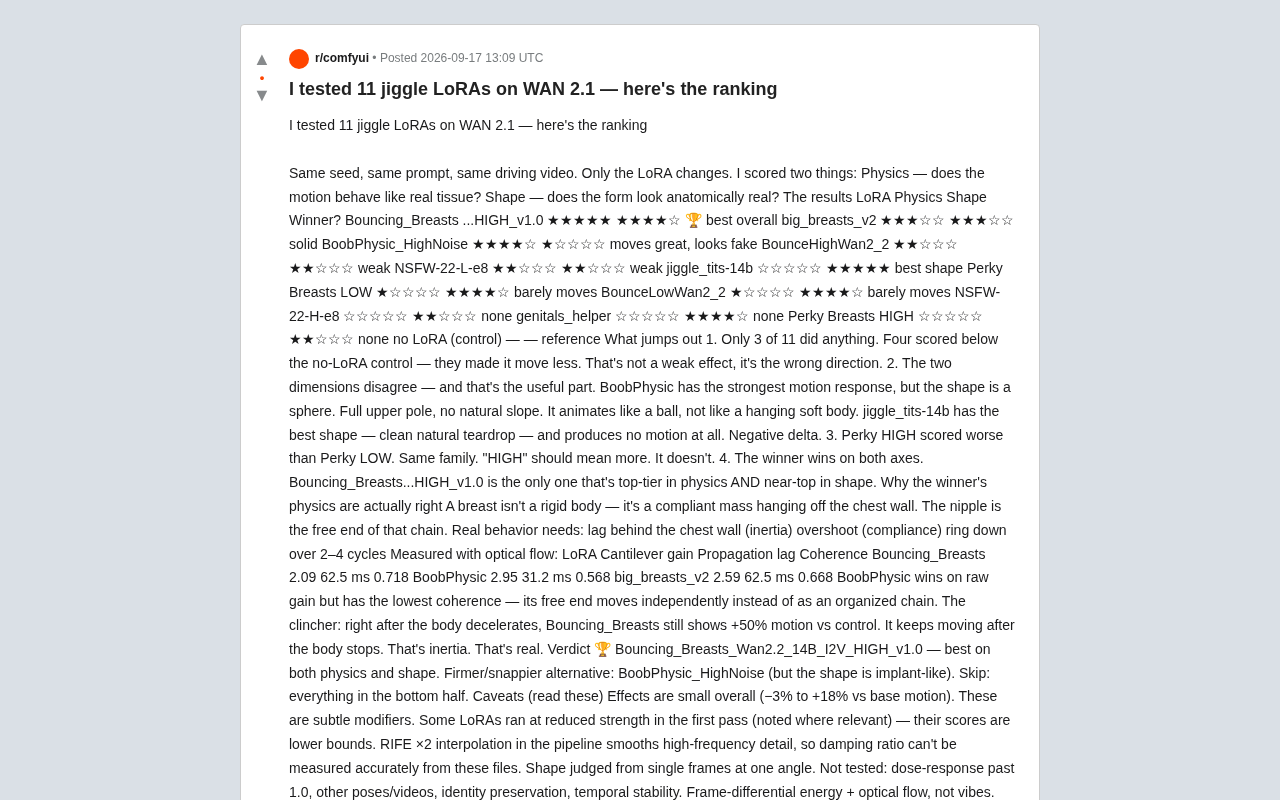
A Reddit user quantitatively tested 11 WAN 2.1 physics LoRAs using optical flow and frame-differential energy. Most models underperformed the baseline. Here's what the results reveal.
13 AI Agents as a Team: Auto-Prospect Clients, But Humans Approve Every Send
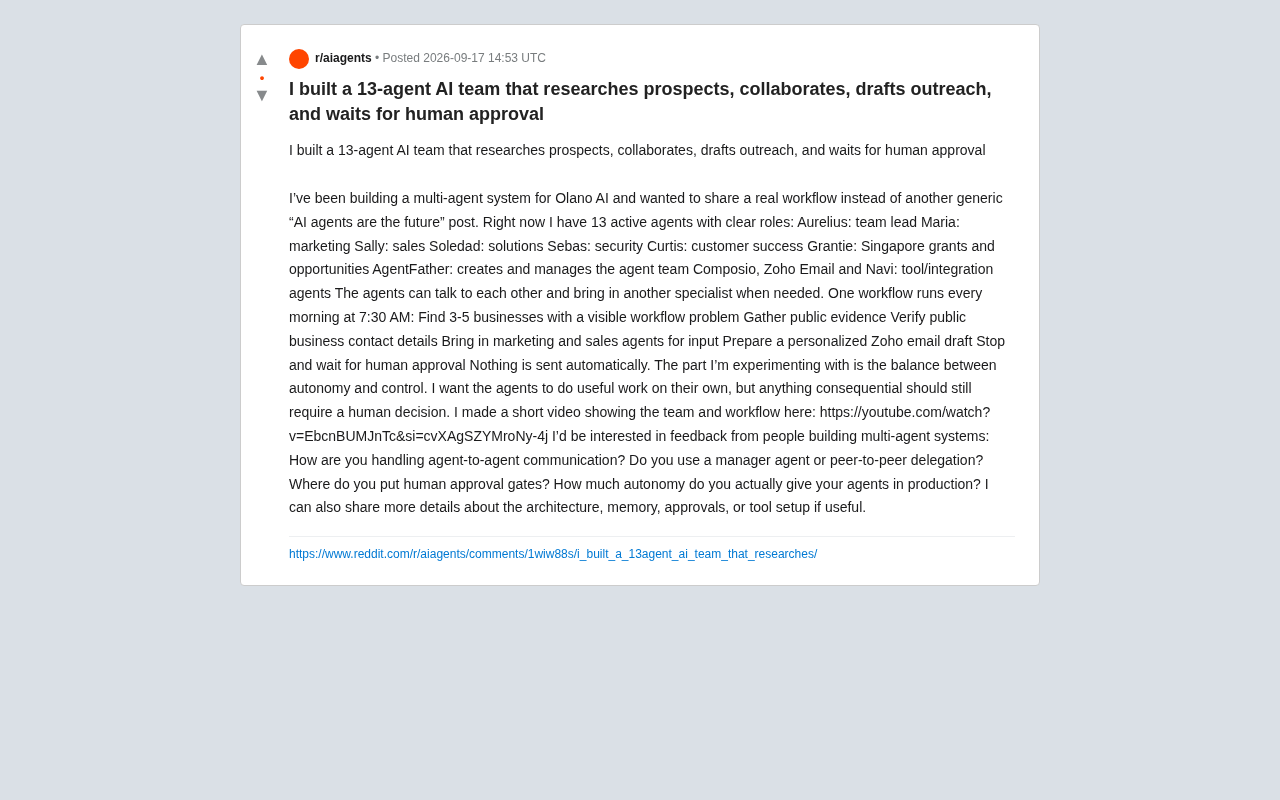
A developer built 13 specialized AI agents for Olano AI to automate daily sales prospecting — but requires human approval before any email is sent. Here's how it works.