spdlog: In-Depth Analysis and Practical Guide to the High-Performance C++ Logging Library

A comprehensive guide to spdlog, the fast and feature-rich C++ logging library with 29K+ GitHub stars.
This article provides an in-depth analysis of spdlog, a high-performance C++ logging library with over 29,000 GitHub stars. It covers core features including header-only integration, {fmt}-based formatting, async logging via ring buffers, and the flexible Sink architecture for multi-target log output. The guide also compares spdlog against Boost.Log and glog, highlighting its ideal use cases in high-frequency trading, embedded systems, and cross-platform development.
Introduction: Why Logging Libraries Matter
In modern C++ application development, logging systems are often underestimated as foundational infrastructure. Whether it's troubleshooting production issues, tracing performance bottlenecks, or auditing business processes, an efficient and reliable logging library is indispensable. However, logging itself can become a performance burden—frequent I/O operations, string formatting, and thread synchronization can all slow down program execution.
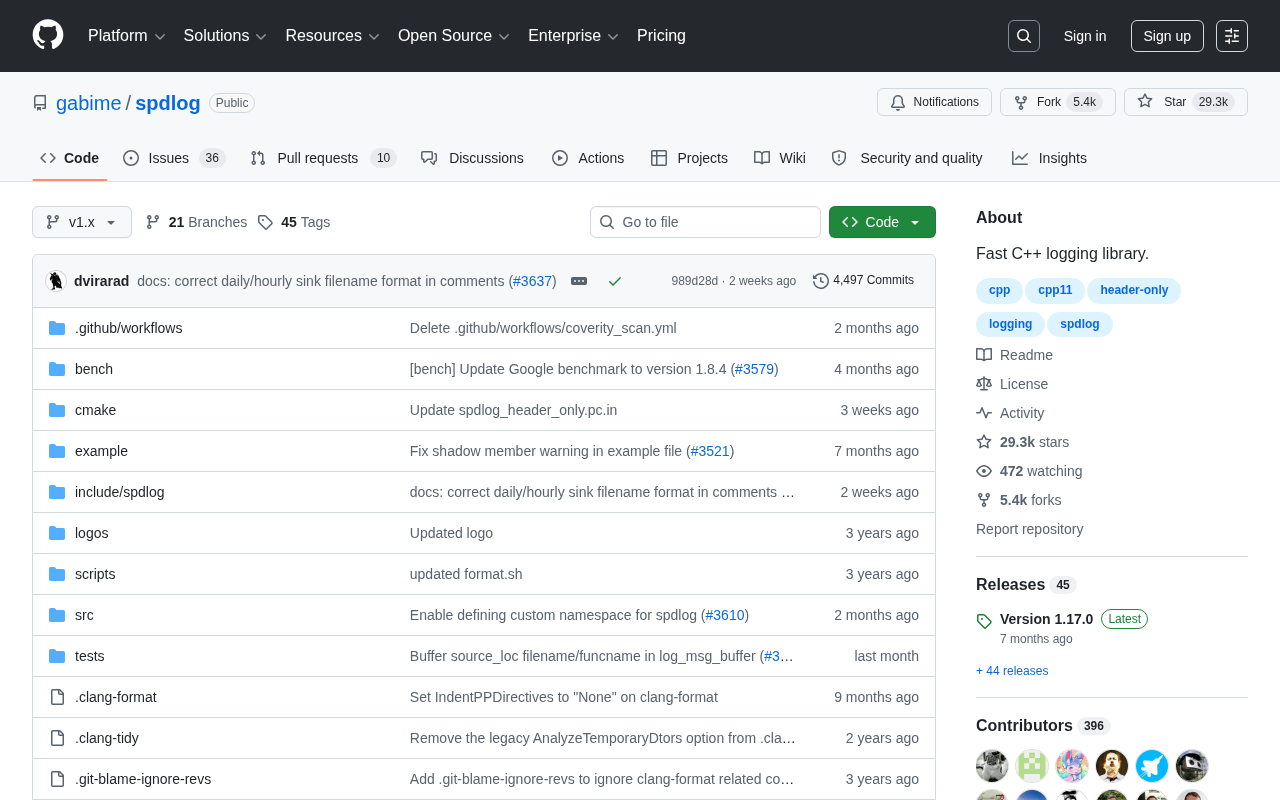
spdlog is an open-source project born to solve this very contradiction. As a star-level C++ logging library on GitHub with over 29,342 stars and 5,365 forks, it is built around the core design philosophy of "speed" and has gained widespread popularity in the C++ community, with momentum continuing to grow.
Core Features of spdlog
Extreme Performance
spdlog's design philosophy is "Fast C++ logging library," and performance is its greatest competitive advantage. Through multiple engineering optimizations, it minimizes the overhead of log recording:
-
Header-only mode: Can be used as a pure header-only library without separate compilation and linking, making it easy to quickly integrate into any C++ project. Header-only is a classic distribution pattern for C++ libraries where all implementation code is contained within header files—users only need to
#includeto use it, with no need to precompile static or dynamic libraries. The advantage of this pattern lies in greatly simplifying build system configuration—no need to handle link order, ABI compatibility, or binary compatibility between different compiler versions. The trade-off is potentially increased compilation time, as each translation unit (.cpp file) will recompile the library code. To address this, spdlog also offers a compiled mode (precompiled as a static library), allowing developers in large projects to reduce incremental compilation time, achieving an optimal balance between development efficiency and integration convenience. -
fmt-based formatting: spdlog has the renowned {fmt} formatting library built in, providing type-safe, high-performance string formatting capabilities that avoid the type hazards and performance overhead of traditional printf-family functions. {fmt} is a modern C++ formatting library developed by Victor Zverovich, whose core design has been adopted as C++20's
std::format. Compared to traditionalprintf-family functions, {fmt} provides compile-time type checking—if the format string doesn't match the parameter types, the error is caught at compile time rather than runtime. In terms of performance, {fmt} is typically 20-30% faster thanprintf, thanks to avoiding locale processing overhead and more efficient number-to-string conversion algorithms. It uses Python-style curly brace placeholder syntax (e.g.,spdlog::info("User {} logged in from {}", username, ip_address)), which is both intuitive and completely eliminates the undefined behavior caused by%d/%sparameter type mismatches inprintf. -
Asynchronous logging support: Through a dedicated background thread handling log writes, I/O operations are decoupled from business logic, significantly reducing main thread blocking time.
Rich Output Targets (Sinks)
spdlog introduces the "Sink" concept to abstract log output destinations, allowing developers to flexibly configure log output to different endpoints:
- Console (with color output support for convenient development debugging)
- Regular files
- Log files with automatic rotation by size or time
- System logs (syslog / Windows Event Log)
- Custom output targets
The Sink concept originates from the "data flow" metaphor—log messages flow like water, ultimately draining into different "sinks." This design follows the object-oriented Open-Closed Principle: the framework is open for extension (users can implement custom Sinks) and closed for modification (no need to alter core code). In spdlog, each Sink is an object implementing the sink interface, containing methods like log(), flush(), and set_pattern(). Common enterprise-level extensions include: sending logs to Kafka/RabbitMQ message queues, writing to databases, or pushing via network to centralized logging platforms (such as the ELK Stack—a combination of Elasticsearch, Logstash, and Kibana).
This Sink design enables a single log message to be simultaneously dispatched to multiple destinations, meeting the complex log collection requirements of production environments.
Deep Dive into Technical Architecture
Layered Design of Logger and Sink
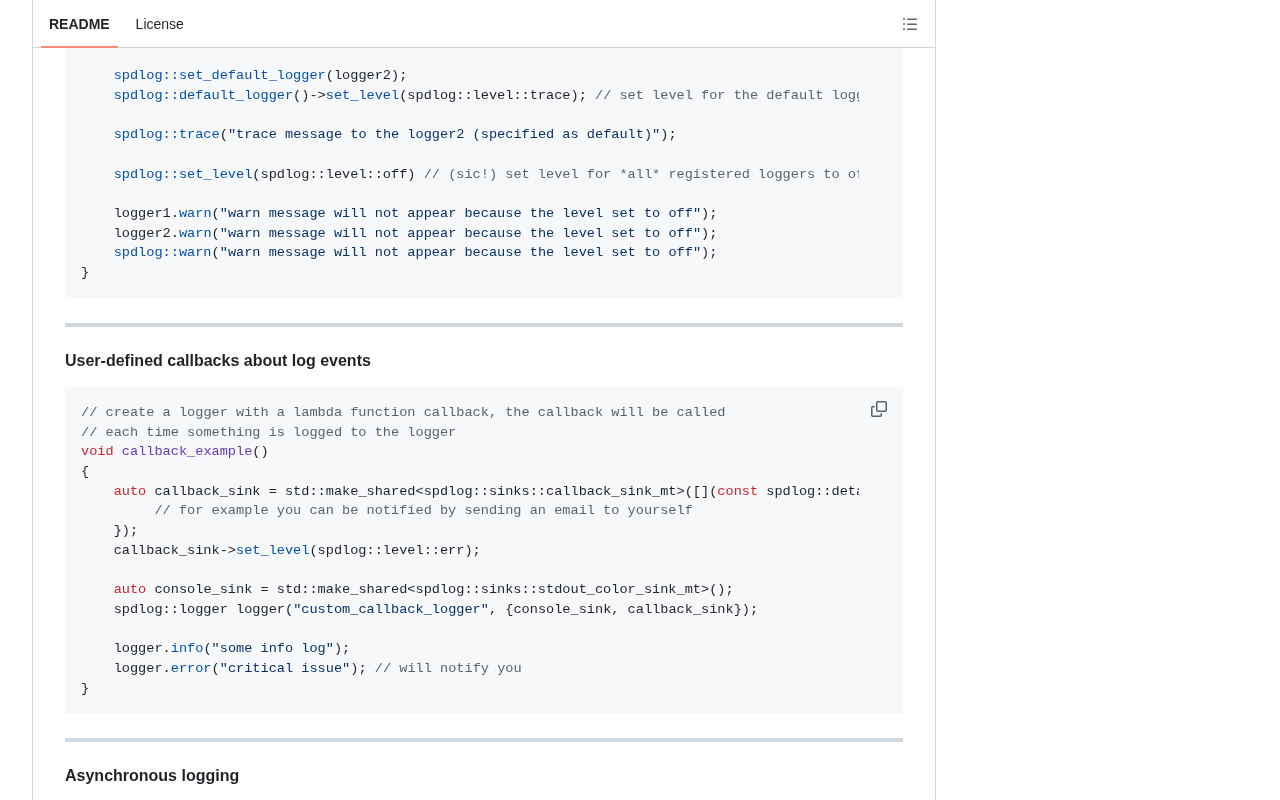
spdlog employs a clear layered architecture: Logger is responsible for receiving log messages and performing level filtering, while Sink handles the actual formatting and output. A single Logger can be associated with multiple Sinks, enabling log multiplexing.
This decoupled design brings tremendous flexibility. For example, you can have ERROR-level logs simultaneously written to both the console and an error file, while DEBUG-level logs are only output to the console in development environments and completely disabled in production. The hierarchical structure of log levels (trace < debug < info < warn < error < critical) allows developers to control the verbosity of log output through a single configuration change, which is particularly important across different stages from development to production.
Implementation Principles of Async Mode
spdlog's asynchronous logging is implemented based on a lock-free (or low-lock) ring buffer. When an application thread calls the logging interface, the message is quickly pushed into the queue and returns immediately, while the actual formatting and I/O operations are completed by a dedicated worker thread in the background.
A Ring Buffer (Circular Buffer) is a fixed-size FIFO data structure that achieves efficient enqueue and dequeue operations through circular movement of head and tail pointers, avoiding the overhead of dynamic memory allocation. In concurrent scenarios, lock-free ring buffers use atomic operations (such as CAS, Compare-And-Swap) to achieve thread safety, avoiding context switches and priority inversion problems caused by mutexes. spdlog's async mode uses a mutex-based queue by default for reliability, but its architectural design allows substitution with a lock-free implementation for lower latency. Queue sizes are typically set as powers of 2 (e.g., 8192 slots) to efficiently calculate index positions through bitwise operations (modulo operations become bitwise AND operations).
The core advantages of this "producer-consumer" pattern are:
-
Reduced main thread latency: Business threads barely need to wait for disk I/O completion. In the producer-consumer pattern, business threads as producers only need to quickly write log messages into the buffer (typically requiring only nanosecond-level memory copy operations), while background consumer threads handle time-consuming disk I/O operations (typically requiring microsecond to millisecond levels, especially when fsync system calls are involved). The enormous difference in execution speed between the two is precisely where the value of asynchronization lies.
-
Smoothing traffic spikes: Sudden bursts of large volumes of logs can be buffered by the ring buffer, avoiding latency jitter caused by instantaneous I/O pressure. For example, when the system processes an abnormal request it might instantly generate hundreds of log entries, and the ring buffer can spread this burst load across subsequent time windows for gradual disk writes.
-
Configurable overflow strategies: When the queue is full, you can choose to block and wait or discard old messages—developers can flexibly balance reliability and performance based on business scenarios. Additionally, spdlog provides
flush_onstrategies (e.g., immediately flushing the buffer when encountering error-level logs) and automatic flushing during destruction, ensuring that critical logs are not lost in the buffer when the program exits abnormally.
Practical Application Scenarios and Value
Best-Fit Scenarios
spdlog is particularly well-suited for the following types of C++ projects:
-
High-performance server programs: Such as game backends, quantitative trading systems, and real-time data processing pipelines—these scenarios are extremely sensitive to logging overhead and cannot tolerate logging becoming a performance bottleneck. Taking quantitative trading systems as an example, these systems typically need to make trading decisions at the microsecond or even nanosecond level, and any additional latency could result in lost trading opportunities—in high-frequency trading, 1 microsecond of latency could mean thousands of dollars in losses. The logging framework must meet stringent requirements such as single log record latency below 100 nanoseconds (in async mode), no garbage collection pauses, and no context switches triggered by system calls. spdlog's async mode can achieve throughput of millions of log entries per second in benchmark tests, with p99 latency controlled at sub-microsecond levels, making it a strong candidate for such extreme performance scenarios.
-
Embedded and resource-constrained environments: The header-only nature and small runtime overhead make it easy to deploy on constrained platforms. In embedded scenarios where memory and storage resources are often very limited, spdlog's compiled artifact size is controllable and doesn't depend on complex runtime libraries (such as Boost), enabling smooth deployment on ARM-architecture embedded Linux devices, industrial controllers, and similar platforms.
-
Cross-platform application development: Comprehensive support for Linux, Windows, macOS, and major compilers (GCC, Clang, MSVC), with excellent compatibility. spdlog encapsulates differences in file systems, console encoding, and time functions across different platforms, so developers don't need to write additional adaptation code for cross-platform compatibility.
spdlog Compared to Other Logging Solutions
Compared to the absent logging functionality in the C++ standard library, and relatively complex solutions like Boost.Log, spdlog achieves an excellent balance between ease of use and performance. While Boost.Log is feature-complete (supporting advanced features like attribute sets, filter expressions, and log record relationships), its template metaprogramming-style API and massive Boost dependency chain result in high initial configuration and compilation time costs. spdlog's API design is clean and intuitive—initialization and logging can be accomplished in just a few lines of code, with an extremely low learning curve.
Compared to glog (Google's logging library), spdlog offers a more modern C++ interface style (based on variadic templates rather than macro definitions), more flexible formatting capabilities ({fmt} vs. stream-style << operators), and a more active community with faster iteration pace. glog's advantage lies in its deep integration with the Google ecosystem (such as gRPC and Abseil), but for standalone use cases, spdlog is typically the more lightweight choice.
Conclusion
With its high performance, easy integration, and rich feature set, spdlog has become one of the top choices for logging libraries in the C++ ecosystem. Nearly 30,000 GitHub stars and continuously active community contributions fully demonstrate its reliability in real production environments.
For developers currently choosing a logging solution for C++ projects, spdlog deserves priority evaluation. Whether for rapid prototyping or long-term infrastructure building for large-scale production systems, it can handle the task with ease. As C++ standards continue to evolve and the {fmt} library is incorporated into the C++20 standard, logging libraries built on modern C++ principles like spdlog will only strengthen their position in the ecosystem. C++20's standardization of {fmt}'s core functionality as std::format marks a significant advancement in C++'s text processing capabilities. As compiler support for C++20 matures (GCC 13+, Clang 15+, and MSVC 19.29+ all support it), spdlog's formatting syntax is fully compatible with the standard, meaning developers learning spdlog's formatting usage can seamlessly migrate to the standard library. This reduces the risk of tech stack fragmentation and provides solid assurance for the long-term maintainability of projects.
Related articles

Kiro Crew: An Open-Source Agentic Development Workspace with Persistent Memory
Kiro Crew is an open-source agentic development workspace that solves AI coding assistants' cold start problem through persistent memory, multi-agent collaboration, and purpose-built Apps.

Getting Started with Machine Learning: How to Overcome Math Anxiety and Find a Pragmatic Learning Path
Scared off by math when starting ML? This article addresses beginners' math anxiety, clarifies how much linear algebra, calculus, and statistics you actually need, and provides a pragmatic top-down learning path with recommended resources.

Dynamic Workflows: A New Paradigm for AI-Driven Quantitative Strategies
Explore how dynamic workflows are transforming quantitative strategy development. From agent orchestration to adaptive strategy iteration, discover the potential and challenges of AI-driven workflows.