Speak2Prompt: An Open-Source Tool for Converting Speech to AI Prompts, Breaking Down Language Barriers in Programming

Open-source tool Speak2Prompt converts Vietnamese speech into structured English AI prompts in real time.
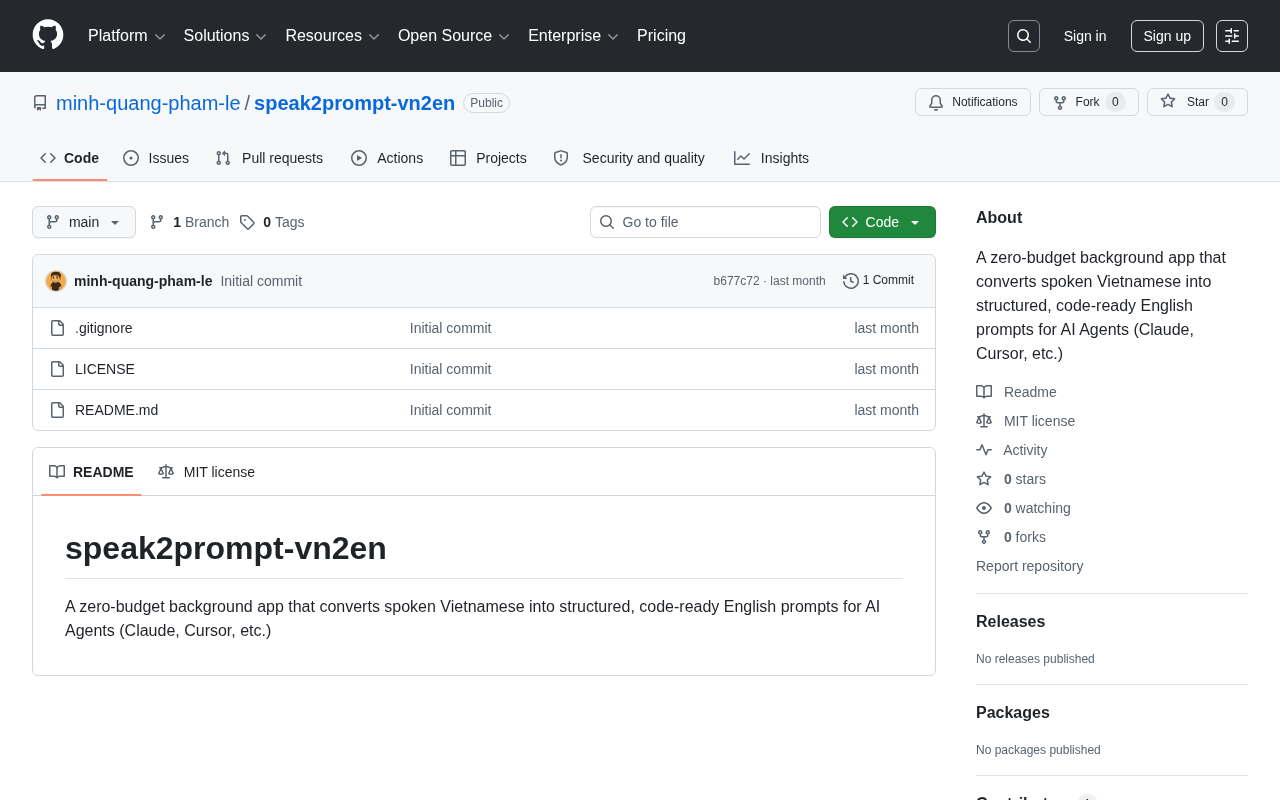
Speak2Prompt-vn2en is a zero-budget open-source tool that converts spoken Vietnamese into structured English prompts for AI coding assistants like Claude and Cursor. Through a three-step pipeline of speech recognition, semantic translation, and prompt structuring, it helps non-English-speaking developers eliminate language barriers in AI collaboration while reducing cognitive load. Its architecture is extensible to Chinese, Japanese, and other languages, revealing emerging trends in prompt engineering localization and voice interaction in developer tools.
Project Overview: Speak Your Native Language, Let AI Understand English Instructions
As AI coding assistants like Claude and Cursor become increasingly prevalent, non-English-speaking developers face a practical challenge: how to think efficiently in their native language while producing high-quality English prompts.
An open-source project on GitHub called speak2prompt-vn2en is attempting to solve this pain point. Created by developer minh-quang-pham-le, the project positions itself as a "zero-budget background application" that converts spoken Vietnamese into structured English prompts ready for direct use with AI Agents.
Although the project is still in its early stages, its design philosophy and the problem it addresses deserve attention from every non-English-speaking developer.
Core Design Philosophy: Not Just Translation, But Semantic Restructuring
Three-Step Conversion from Speech to Structured Prompts
Traditional speech-to-text tools only accomplish the first step — converting speech into text. But for AI programming scenarios, text alone is far from sufficient. What developers need are structured, code-ready prompts — output that not only completes language translation but also performs semantic reorganization to conform to the optimal input format for AI Agents.
Speak2Prompt's workflow consists of three stages:
- Speech Recognition: Captures spoken Vietnamese input
- Semantic Translation: Converts Vietnamese to English while understanding the developer's programming intent
- Prompt Structuring: Formats the translation into standardized prompts suitable for AI tools like Claude and Cursor
The Evolution of Speech Recognition and Feasibility of Zero-Budget Solutions
Automatic Speech Recognition (ASR) technology has undergone a fundamental transformation from traditional Hidden Markov Models (HMM) to deep learning end-to-end models. The most representative achievement in the open-source space is OpenAI's Whisper model, which supports nearly 100 languages including Vietnamese and is completely free for local deployment — this is the technical foundation of the "zero-budget" approach. Whisper uses a Transformer-based encoder-decoder architecture, trained on 680,000 hours of multilingual audio data, capable of simultaneously performing speech recognition, language detection, and translation tasks. For projects like Speak2Prompt, Whisper's multi-task capability is particularly crucial: it can not only convert Vietnamese speech to Vietnamese text but also directly output English translations, thereby merging the speech recognition and translation steps into one and significantly reducing system complexity and latency.
Prompt Engineering Best Practices Behind Prompt Structuring
Prompt Engineering has evolved from simple natural language questioning into a systematic technical discipline. Structured prompts typically contain several key elements: Role definition, Context description, specific Task, output Format requirements, and Constraints. For example, Claude officially recommends using XML tags to organize prompt structure, while Cursor favors defining project-level prompt specifications in .cursorrules files. Converting colloquial natural language into this structured format is essentially a process of semantic parsing and intent recognition — the system needs to extract programming intent, technology stack preferences, coding style requirements, and other implicit information from the user's spoken expression, then map them to standardized prompt templates. The quality of this step directly determines the code quality of the final AI output.
The Design Philosophy of Zero-Budget and Background Operation
The project emphasizes "zero-budget," meaning it relies on free APIs or local models for speech recognition and translation, significantly lowering the barrier to entry.
Zero-budget solutions became feasible in 2024-2025 thanks to the explosive growth of the open-source AI ecosystem. At the speech recognition level, various quantized versions of Whisper (such as whisper.cpp and faster-whisper) can run in real-time on consumer-grade CPUs. At the translation and semantic restructuring level, Meta's NLLB (No Language Left Behind) model supports translation across 200+ languages and is fully open-source, while tools like Ollama allow developers to run large language models such as Llama and Mistral locally for prompt structuring. Additionally, cloud services like Google Cloud Speech-to-Text and Azure Cognitive Services offer a certain free monthly quota. The maturity of these technical components means that building a complete speech-to-prompt pipeline no longer requires any API fees — just an ordinary development machine.
Designed to run as a background application, developers can generate prompts via voice input at any time during coding without switching windows or interrupting their workflow. This seamless interaction experience is exactly the ideal state that developer tools strive for.
Use Cases: How Big Is the Language Barrier in AI Programming?
The Quality Advantage of English Prompts
Nearly all mainstream AI coding assistants use English as the optimal interaction language. While these models also support other languages, English prompts typically produce more precise, higher-quality code output. For developers in non-English-speaking countries like Vietnam, China, and Japan, this creates an invisible efficiency barrier.
The root cause of this quality gap lies in the training data distribution of large language models. The training corpora of mainstream LLMs (such as Claude, GPT-4, and Codex) are overwhelmingly dominated by English data. Taking public datasets like Common Crawl as an example, English content typically accounts for 40%-60% of the total, while languages like Vietnamese and Chinese often make up less than 5%. This uneven distribution of training data directly leads to the model's significantly superior semantic understanding, code generation, and logical reasoning capabilities in English contexts compared to other languages. Furthermore, high-quality corpora in the programming domain — technical documentation, Stack Overflow Q&A, GitHub code comments — are almost exclusively dominated by English, further reinforcing the model's response quality to English programming instructions. This means that even though models "support" multilingual input, outputs from English prompts still have clear advantages in accuracy, completeness, and code standardization.
Thinking in your native language while outputting in English — this "thought-to-expression" conversion process itself consumes cognitive resources. Cognitive Load Theory from cognitive psychology provides scientific evidence for understanding this efficiency loss. When developers need to frequently switch between native language thinking and English expression, the brain's Working Memory must simultaneously process the logical complexity of the problem itself and the additional burden of language conversion — this is called "Extraneous Cognitive Load." Research shows that when bilinguals perform language switching, activity in the prefrontal cortex significantly increases, and the executive control network needs to continuously suppress interference from the non-target language. For programming — an activity that already heavily consumes cognitive resources — stacking the burden of language switching significantly reduces development efficiency and code quality.
By automating this process, Speak2Prompt allows developers to focus on thinking about the problem itself rather than struggling with language conversion — essentially offloading extraneous cognitive load entirely to the machine, so that all of the developer's cognitive resources can be devoted to problem-solving.
Expansion Possibilities from Vietnamese to Multiple Languages
Although the project currently focuses on Vietnamese-to-English conversion, its architectural approach is entirely applicable to other languages:
- Chinese → English Prompts: Highly significant for the Chinese developer community
- Japanese/Korean → English Prompts: Covering the East Asian developer market
- Universal Multilingual Framework: Building a pluggable language module system
Technical Insights: New Directions for Developer Tools
The Localization Trend in Prompt Engineering
This project reveals an overlooked trend: the growing demand for prompt engineering localization. As AI tools become globally widespread, enabling non-English-speaking developers to collaborate efficiently with AI will become a crucial link in the toolchain.
Voice Interaction Enters the Developer Tools Space
Voice input is already highly mature in consumer products, but remains a blue ocean in the developer tools space. Speak2Prompt represents a new interaction paradigm: developers can dictate requirements while looking at code, with AI automatically converting their speech into precise English instructions in the background.
However, voice interaction entering the developer tools space also faces unique technical challenges. First is the professional terminology recognition problem: developers' speech is interspersed with large amounts of programming terms, framework names, and abbreviations (such as "React hooks," "API endpoint," "JWT"). These words typically appear in their original English form within non-English contexts, creating a code-mixing phenomenon that places high demands on the robustness of speech recognition models. Second is noise environment adaptation: developers may work in open-plan offices, coffee shops, and other noisy environments, requiring models with good noise suppression capabilities. Additionally, voice input in programming contexts involves disambiguation issues — for example, "log" could refer to logging, logarithmic functions, or login functionality — requiring the system to make accurate intent inference based on the current code context. These challenges also explain why voice interaction is already mature in consumer products but still in the exploratory stage in developer tools.
This mode is particularly suitable for the following scenarios:
- Quickly suggesting modifications during code reviews
- Describing problem symptoms during debugging
- Recording design decisions during architecture discussions
Practical Value for Chinese Developers
For the Chinese developer community, similar tools have enormous demand potential. Imagine this usage scenario:
You say in Chinese, "Help me write an API endpoint for handling user login, requiring JWT authentication and rate limiting," and the tool automatically generates a structured English prompt that you can paste directly into Cursor for high-quality code output.
This not only saves translation time but, more importantly, preserves the continuity of thought.
Conclusion: Speech-to-Prompt May Become Standard for Developers
Although Speak2Prompt-vn2en is still an early-stage project, the problem it targets — eliminating the language barrier in AI coding assistants — has universal significance.
In today's era of rapidly iterating AI tools, whoever can communicate more efficiently with AI gains a greater productivity advantage. The conversion from speech to structured prompts may well become a standard tool for non-English-speaking developers. For capable developers, building a Chinese version of a speech-to-prompt tool based on similar principles could be a worthwhile open-source direction to explore.
Key Takeaways
- Speak2Prompt is a zero-budget open-source tool that converts Vietnamese speech into structured English AI prompts, supporting AI Agents like Claude and Cursor
- The project addresses the language barrier faced by non-English-speaking developers when using AI coding assistants
- The tool is designed to run in the background, allowing developers to generate prompts via voice without interrupting their coding workflow
- Its architectural approach can be extended to Chinese, Japanese, and other languages, with broad scalability potential
- It reveals new trends in prompt engineering localization and voice interaction in the developer tools space
Related articles
 Product Reviews
The Programmer's Desk Setup Guide: Building a Workspace That Feels Like Home
Discover how programmers build productive, comfortable workspaces. From multi-monitor setups to ergonomic design, explore the desk philosophy that drives focus and flow.
 Product Reviews
Qoder vs Cursor Real-World Comparison: Which $20/Month AI IDE Is Better?
Hands-on comparison of Qoder vs Cursor AI IDEs: Agent autonomy, human interaction count, and architecture decisions. Qoder needed only 2 interactions vs Cursor's 8.
 Product Reviews
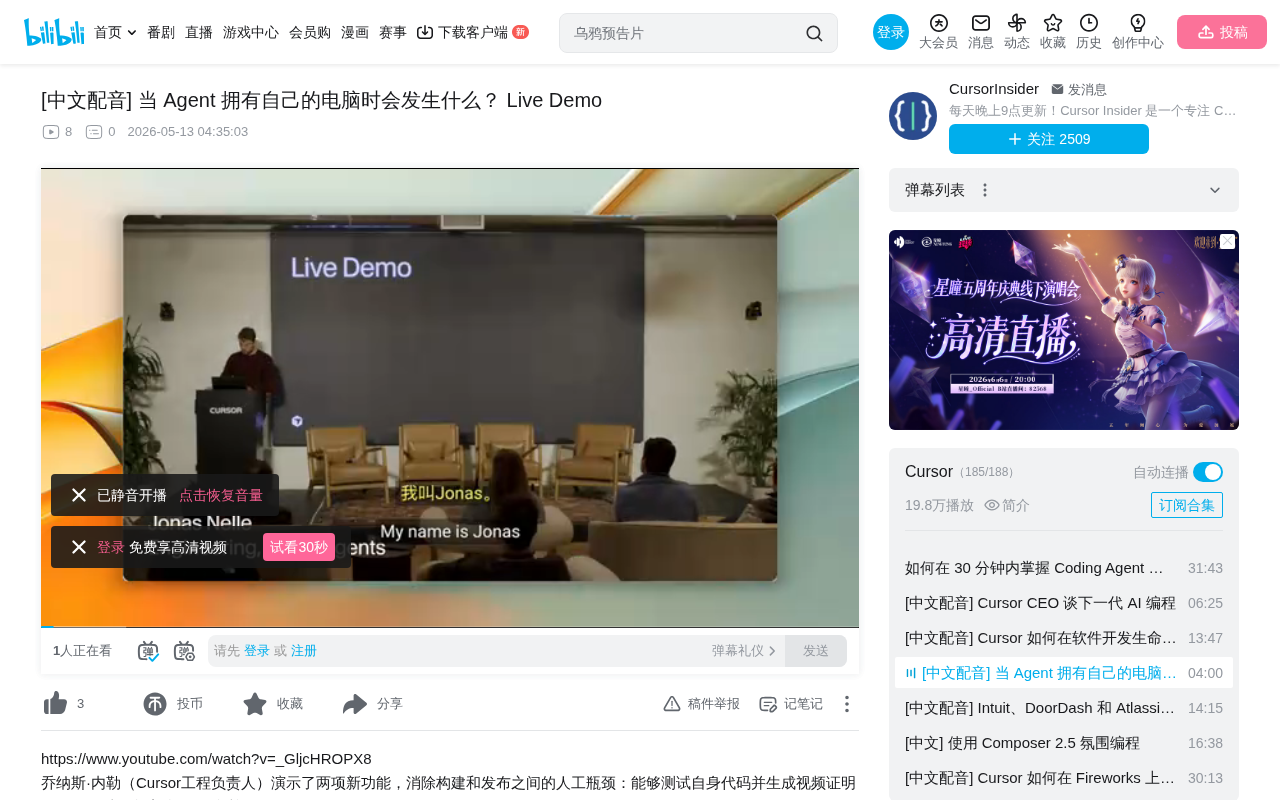
Cursor Cloud Agent Demo: Eliminating Bottlenecks Across the Entire Software Development Lifecycle
Deep analysis of Cursor's Cloud Agent demo showing how cloud VMs, automated test artifacts, and a full-chain control plane systematically eliminate human bottlenecks across the software development lifecycle.