SpeakoFlow: Open-Source Local Voice Assistant — A Privacy-First System-Wide Voice Input Tool for Desktop

SpeakoFlow is a privacy-first open-source voice assistant with system-wide input and screen understanding.
SpeakoFlow is an open-source desktop voice assistant that prioritizes privacy by running speech-to-text entirely locally. It offers system-wide voice input across any application, a "Hey Flow" wake word that understands screen content for context-aware responses, dictation cleanup, real-time translation, and personalized learning. Released under the MIT license and supporting Windows, macOS, and Linux, it represents the growing trend of bringing AI capabilities back from the cloud to local devices.
In an era where the AI voice assistant landscape is dominated by cloud-based giants, an open-source project called SpeakoFlow is carving out a different path — bringing voice interaction back to local devices and putting privacy firmly in users' hands. This product, which launched on Product Hunt with an MIT open-source license and a local-first design philosophy, is gaining significant traction in the developer community.
System-Wide Voice Input: Control Your Entire Desktop with Your Voice
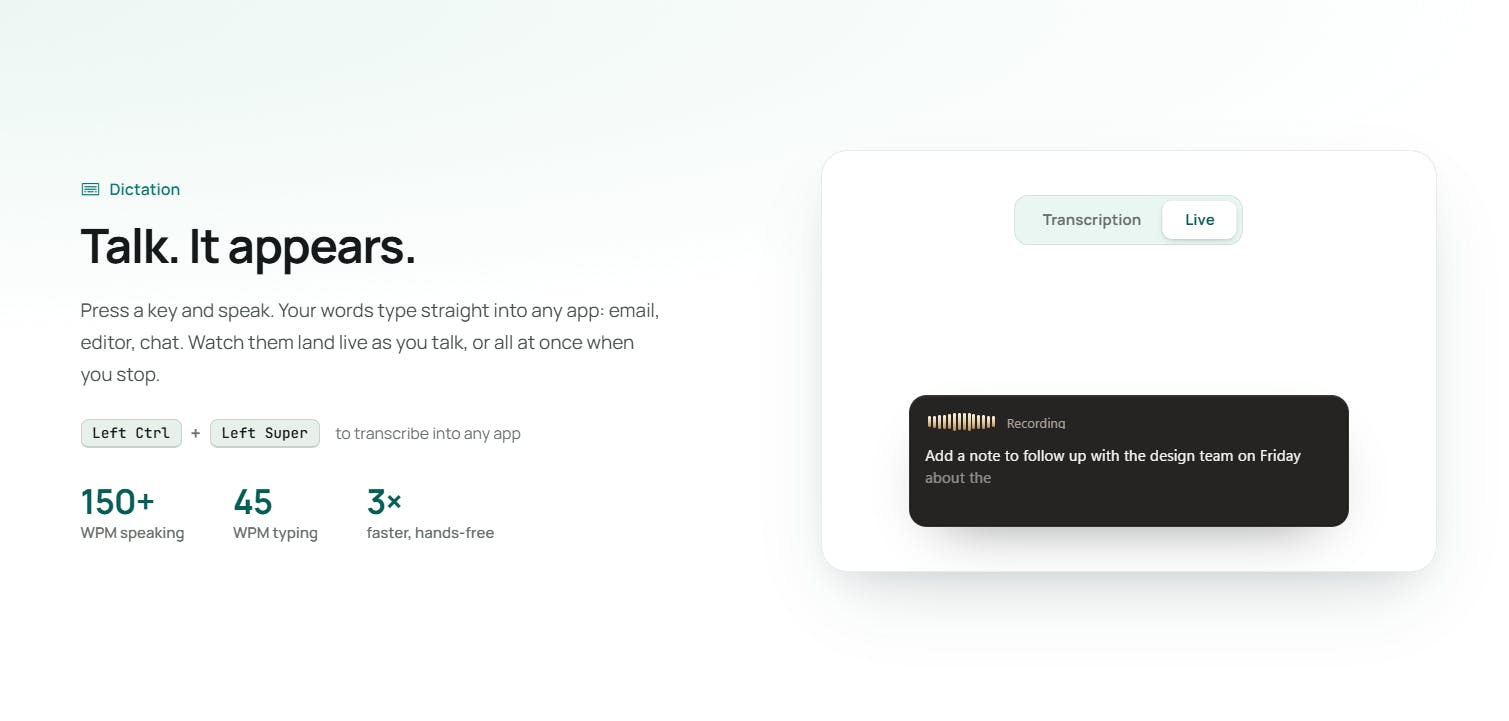
SpeakoFlow's core concept can be summed up in one sentence: extend your voice across your entire desktop. It isn't confined to any specific application — instead, it lets you input text via voice in any software, whether it's an email client, code editor, chat tool, or terminal command line.
This "system-wide voice input" design breaks the boundaries of traditional voice assistants. The voice assistants we're accustomed to are typically encapsulated within a standalone dialog box or dedicated app, but SpeakoFlow turns speech recognition into an input layer that permeates the entire operating system. You speak, and text appears wherever your cursor happens to be.
From a technical implementation perspective, system-wide voice input requires deep integration at the operating system's input method layer. It typically works by hooking into the system's input focus events or leveraging OS-provided accessibility APIs — such as Windows UI Automation or macOS Accessibility API — to inject recognition results into the text input field of the currently active window. The technical challenge lies in maintaining compatibility across different application input frameworks, including native apps, Electron-based cross-platform applications, web browsers, and other environments, each of which responds to text injection differently.
For knowledge workers, programmers, and content creators who spend extended periods typing, this system-wide voice input approach represents a massive productivity boost.
"Hey Flow" Wake Word: A Smart Assistant That Understands Your Screen
Beyond basic speech-to-text functionality, SpeakoFlow includes a more ambitious feature: the wake word "Hey Flow".
When you speak this wake word, the assistant doesn't just passively transcribe — it incorporates what's currently displayed on your screen to generate complete responses. Specific use cases include:
- When you receive an email, say "Hey Flow" and it can draft a reply based on the email content shown on screen
- Ask the assistant questions about whatever you're currently looking at and receive spoken answers
This means SpeakoFlow possesses screen understanding capability — it no longer processes voice commands in isolation but incorporates "what you're looking at" as context for decision-making. This multimodal interaction approach represents a crucial direction in current AI assistant evolution.
Screen understanding technology typically involves multiple components: real-time screen capture, OCR text recognition, UI element detection, and Visual Language Model (VLM) inference. Current mainstream implementation paths include combining screenshots with multimodal large models (such as GPT-4V or open-source LLaVA series) for content comprehension, or obtaining structured interface information through the operating system's Accessibility Tree. SpeakoFlow's screen understanding feature likely combines both approaches, fusing visual context with voice commands to achieve context-aware intelligent responses. Notably, this is also a core capability that tech giants like Apple Intelligence, Microsoft Copilot, and Google Project Astra are heavily investing in — SpeakoFlow offering similar functionality in open-source form provides clear differentiation value.
Privacy First: Voice Data Processed Entirely Locally
Among all its features, SpeakoFlow's most critical differentiator is privacy and local processing.
The team explicitly states that all features can run on local machines, with speech-to-text always completed locally. Compared to commercial voice assistants that upload every utterance to cloud servers for processing, local execution means:
- Voice data never leaves your device
- Fundamentally reduces the risk of privacy breaches
- Works without requiring a network connection
Local speech recognition technology has made breakthrough advances in recent years, making this design philosophy practically viable. OpenAI's open-source Whisper model and its community derivatives (such as whisper.cpp and faster-whisper) have made running high-quality speech recognition on consumer hardware a reality. After INT8/INT4 quantization and optimization through inference frameworks like ONNX, these models can complete transcription at near real-time speeds without dedicated GPUs, supporting nearly 100 languages. Additionally, projects like Mozilla's DeepSpeech, Vosk, and Sherpa-ONNX provide diverse technical options for local speech recognition. The key advantages of local processing are zero network latency and complete data isolation, though the tradeoff is consuming device computational resources — typically requiring 4-8GB of memory for model loading, with larger models potentially needing more.
For users handling sensitive information — such as legal, medical, and financial professionals, or teams with strict corporate confidentiality requirements — local voice processing capability is a decisive advantage. Against the backdrop of increasingly stringent data compliance regulations like GDPR and HIPAA, local processing also holds significant value from a compliance perspective.
Advanced Features: Dictation Cleanup, Real-Time Translation, and Personalized Learning
SpeakoFlow doesn't stop at being merely "functional" — it also offers several advanced features that enhance the user experience:
- Dictation cleanup: Automatically tidies up dictated text, removing filler words, repetitions, and verbal tics for smoother, more polished output
- Real-time translation: Translates as you speak, breaking down language barriers
- Learning your workflow: Over time, the assistant gradually adapts to your habits and style
Behind the dictation cleanup feature lies text normalization and denoising techniques from natural language processing. Human spoken expression naturally contains significant redundancy — filler words like "um," "you know," "I mean," along with sentence repetitions and self-corrections. By applying language models for post-processing of transcribed text, spoken expressions can be transformed into formal written text while preserving core semantics. This feature is particularly critical for scenarios where voice input is used for drafting formal documents.
Together, these features make SpeakoFlow more than just a voice input tool — it's more like a personal work companion that continuously evolves.
MIT Open-Source License, Supporting Windows, macOS, and Linux
SpeakoFlow is released under the MIT open-source license, is completely free, and supports all three major operating systems: Windows, macOS, and Linux. This positioning significantly lowers the barrier to entry:
- Developers can review the source code, deploy it themselves, or build upon it
- Regular users can use it with confidence, without worrying about subscription fees or vendor lock-in
- A community-driven development model ensures project transparency and sustainability
The MIT license is one of the most permissive open-source licenses, allowing anyone to freely use, copy, modify, merge, publish, distribute, sublicense, and/or sell copies of the software — the only requirement being that copyright and license notices are included in all copies. Compared to the GPL license, which requires derivative works to also be open-sourced (its "copyleft" nature), the MIT license permits closed-source commercial use, enabling enterprises to build commercial products on top of SpeakoFlow without having to open-source their own code. This license choice typically attracts a broader range of developers and enterprises — historical experience shows that projects with permissive licenses like React, Node.js, and TensorFlow tend to build more active ecosystems.
On Product Hunt, it's categorized under Open Source, Artificial Intelligence, GitHub, and Audio tags, built by Abhishek Barali. Its combination of "local-first + system-wide voice + screen understanding" represents a noteworthy product design philosophy.
From Cloud Back to Local: A New Trend in AI Applications
SpeakoFlow's emergence reflects a warming trend in the AI application space: moving from the cloud back to local devices. As on-device AI model capabilities continue to improve, an increasing number of functions no longer require powerful cloud computing. For users, this means better privacy protection, lower latency, and reduced costs.
The hardware foundation of this trend lies in the rapid proliferation of NPUs (Neural Processing Units) in consumer-grade chips. Apple's Neural Engine (the latest M4 chip delivers 38 TOPS), Qualcomm's Hexagon NPU, Intel's Meteor Lake NPU, and AMD's XDNA architecture are all providing dedicated hardware acceleration for local AI inference. On the software side, continuous optimization of inference frameworks like ONNX Runtime, llama.cpp, and MLX enables language models with 7B-13B parameters to run smoothly on laptops with 16GB of memory. Microsoft's Phi series, Meta's Llama series, and numerous emerging open-source small models are filling the gap in on-device AI model capabilities.
Of course, local execution also means certain hardware requirements, and the level that complex large model capabilities (such as deep screen understanding and high-quality dialogue generation) can achieve in a purely local environment remains to be validated in practice. On-device models still show notable gaps compared to cloud-based large models (such as GPT-4, Claude, and other models with hundreds of billions or even trillions of parameters) in complex reasoning, long-context understanding, and knowledge breadth — which is why many local-first applications offer optional cloud-enhanced modes as supplements.
Regardless, SpeakoFlow presents a clear direction — making voice the primary interaction method for desktop operation while protecting privacy. For users who pursue efficiency and value data sovereignty, this is an open-source voice assistant solution worth trying.
Related articles

Python 3.15 New Feature: Is the sentinel Type Better Than None?
Python 3.15 adds the sentinel type, using named unique sentinel objects to replace None and bare object(), resolving confusion among missing values, explicit emptiness, and invalid input while avoiding type hint failures.

Deep Learning's Three Architectures and the Universal Approximation Theorem: A Complete Guide to MLPs, CNNs, and Transformers
Explaining the inductive bias differences among MLP, CNN, and Transformer, the existence meaning of the Universal Approximation Theorem (UAT), and the role of Taylor expansion in approximation analysis, while clearing up common misconceptions.

GitLab Emergency Patch Release: Analysis of Critical Security Fixes
GitLab releases critical patch 19.5.1, sparking 355 points of discussion on Hacker News. This article analyzes the background, upgrade steps for self-hosted instances, and verification points to help DevOps teams respond quickly to security updates.