SpecAgent: Turning Strong Models into Reviewers Cuts Tool-Agent Inference Costs in Half

SpecAgent lets weak models draft trajectories and strong models verify once, matching strong-model quality at half the cost.
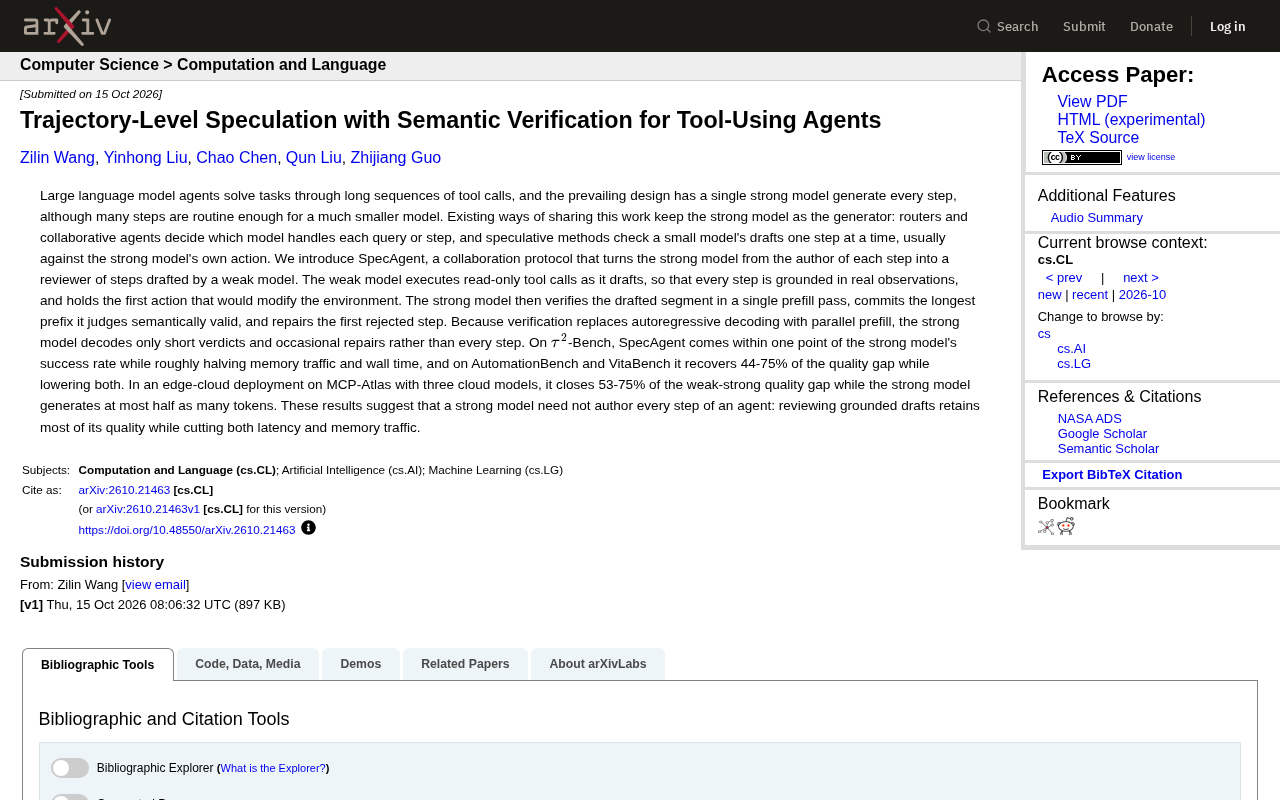
SpecAgent proposes a counterintuitive model collaboration protocol, repositioning the strong model from "generator of every action" to "reviewer of the entire draft." It lets the weak model execute read-only tool calls and draft the trajectory, stopping at the first action that changes the environment state; then the strong model determines the longest semantically valid prefix in a single prefill forward pass, commits it directly, and repairs only the first rejected step. Since verification is parallel prefill rather than serial token-by-token decode, the strong model's computation drops sharply, elevating speculative decoding from single-step, string-level to trajectory, semantic-level. On τ²-Bench, AutomationBench, VitaBench, and MCP-Atlas, SpecAgent approaches strong-model success rates while roughly halving memory traffic and wall time, and in edge-cloud scenarios bridges 53%-75% of the quality gap, cutting strong-model tokens by up to half.
In tool-using agents driven by large language models, a long-standing default architectural choice is that every step's decision is generated by the strongest model. Whether it's routing or collaborative decision-making, the strong model always plays the "author" role, responsible for producing each action. However, in real tasks, a large number of steps are actually quite routine—checking the weather, reading files, searching for information—operations that are not difficult for a small model. The real bottleneck is not capability, but architecture: do we really need the strong model to write out the entire decision sequence word by word?
SpecAgent, coming from academia, proposes a somewhat counterintuitive collaboration protocol: turn the strong model from "the author of every step" into "the reviewer of the draft."
Limitations of Existing Approaches: The Strong Model Always Pays for Every Step
Current model collaboration strategies fall roughly into two categories. One is routing schemes, which decide which model handles a query or step based on its difficulty; the other is collaborative agents, where models of different scales divide the work to complete a task.
These two categories share one thing in common: the strong model is still the generator. Although speculative decoding introduces the idea of a small model drafting and a large model verifying, the verification granularity stays at the single-step level, and it usually judges against the action the strong model itself would have taken.
The cost of this design is obvious. Every step requires the strong model to participate in decoding, even if that step is just reading a local file or initiating a search. When the task trajectory stretches to dozens or even hundreds of steps, inference latency and memory traffic stack up linearly. For edge-cloud collaborative deployment scenarios, this means high cloud invocation costs and non-negligible communication overhead.
Speculative Decoding is an inference acceleration technique first proposed by Leviathan et al. in 2022. Its core idea is to let a lightweight "draft model" quickly autoregressively generate several candidate tokens, and then have the target large model verify in a single forward pass whether these candidate tokens are accepted in parallel, thereby transforming the large model's originally serial token-by-token decoding into parallel batch verification. The reason it accelerates is that the verification stage is parallel prefill rather than token-by-token decode, and parallel efficiency on GPUs is far higher than serial generation. SpecAgent borrows this idea but makes key modifications: first, it raises the granularity of the "draft" from tokens to complete tool-call actions; second, it raises the "accept/reject" obtained from verification from the string level to semantic-level judgment of trajectory validity; third, it adds a "repair" step, providing an alternative action for the first rejected step. Therefore, SpecAgent can be seen as a migration of speculative decoding to the higher abstraction level of agent trajectories.
SpecAgent's Core Idea: Draft—Verify—Repair
SpecAgent's protocol design can be broken down into three key stages.
Weak model drafts, and must "ground" it. During the drafting stage, the weak model directly executes read-only tool calls, grounding each step in real observations rather than imagination. It keeps drafting until it encounters the first action that would modify the environment state, then stops there.
Strong model verifies in a single forward pass. After the entire drafted trajectory is handed to the strong model, the latter no longer decodes autoregressively step by step, but completes verification in one prefill forward pass. It determines the longest semantically valid prefix of the draft, directly commits that prefix, and repairs only the first rejected step.
Verification replaces decoding. This is the fundamental source of efficiency gains. The strong model's output shrinks from "the complete action for every step" to "a brief verdict plus occasional repairs." Since verification is parallel prefill rather than serial token-by-token decoding, the strong model's actual computation drops substantially.
You may not have noticed that the verification here is a semantic-level judgment, not simple string matching or action comparison. The strong model judges whether the draft trajectory as a whole is semantically valid, raising verification granularity from single-step to trajectory level.
The Difference Between Prefill and Decode: Transformer inference is divided into two stages. The Prefill stage processes the entire input prompt at once, and the attention computation for all tokens can be completed in parallel, mainly limited by compute (compute-bound); the Decode stage generates output tokens one by one, and each generated token requires another forward pass, mainly limited by memory bandwidth (memory-bound). For a request with N input tokens that needs to generate M output tokens, the cost of decode is roughly proportional to M and cannot be parallelized. The essence of SpecAgent is precisely to convert the strong model's responsibility from "generating the complete action sequence of M tokens" (decode-dominated) to "reading an already-written draft and giving a verdict" (prefill-dominated). Since prefill is parallel and decode is serial, even if the input grows longer, total latency and memory traffic are still significantly lower than step-by-step generation. This is the fundamental reason why "verification replaces decoding" can bring about roughly halved wall-clock time and memory traffic.
Experimental Results: Approaching Strong-Model Quality at Nearly Half the Cost
SpecAgent validated its effectiveness on multiple benchmarks, and different test platforms gave mutually corroborating conclusions.
On τ²-Bench, SpecAgent's success rate differs from the strong model by less than one percentage point, while memory traffic and wall time are both roughly halved. This is a quite convincing result: quality is almost lossless, yet cost is cut in half.
On AutomationBench and VitaBench, SpecAgent recovered 44% to 75% of the quality gap between the two models, while reducing latency and memory overhead. This means it cannot always fully match the strong model, but in most cases it can significantly narrow the gap while always running at lower cost.
In the edge-cloud deployment scenario of MCP-Atlas, the tests involved three cloud models. SpecAgent bridged 53% to 75% of the quality gap between the weak and strong models, while the number of tokens generated by the strong model was at most half of the original.
Results from multiple independent benchmarks point to the same consensus: the strong model's review capability is more "cost-effective" than its generation capability. Having the strong model examine a draft that has already been grounded and executed is far more efficient than having it generate step by step from scratch.
τ²-Bench, AutomationBench, VitaBench, and MCP-Atlas are all benchmarks used in recent years to evaluate tool-agent capabilities. τ²-Bench, proposed by Sierra, focuses on tool calling and policy adherence in multi-turn conversations in domains such as customer service, emphasizing the agent's ability to complete tasks under real business rule constraints. AutomationBench focuses on automation process tasks, examining the agent's stability in long-chain operations. VitaBench pays more attention to multi-step reasoning and tool composition in complex real-world scenarios. MCP-Atlas is related to the Model Context Protocol (MCP) ecosystem and is used to evaluate the collaborative performance of multiple cloud models in tool-calling scenarios, often used to simulate edge-cloud collaborative deployment. The common feature of these benchmarks is long task trajectories, many steps, and dense tool calls—exactly the scenarios where trajectory-level verification schemes like SpecAgent yield the greatest benefits, so the conclusions they provide have complementary reference value.
Why This Direction Is Worth Watching
The value of SpecAgent is not just an engineering optimization. It touches on a more fundamental question: in agent architectures, what exactly is the core value of a strong model?
If the strong model's real advantage lies in judgment and review—identifying which step in a draft is semantically invalid and where repair is needed—then binding it to step-by-step generation tasks is a misallocation of scarce compute. SpecAgent's experimental results support this judgment: as a reviewer, the strong model retains most of its quality contribution, while the cost structure is completely rewritten.
For scenarios that need to deploy tool agents on edge devices, this idea is especially attractive. The weak model handles most of the drafting work, read-only tool calls are completed locally, and the strong model only performs a single forward verification in the cloud. Bandwidth consumption and cloud compute usage both decline accordingly, while maintaining task completion quality close to the strong model.
Of course, this scheme also has its applicable boundaries. It relies on the weak model being able to draft a semantically largely reasonable trajectory; otherwise the strong model needs to repair frequently, and the gains diminish. The criterion for determining the "longest valid prefix" during verification may also vary by task type. But based on current performance across multiple benchmarks, SpecAgent provides a new direction worth exploring in depth for the cost-quality trade-off of tool agents.
Edge-cloud collaborative deployment refers to an architecture that divides computational tasks between terminal devices (edge) and remote data centers (cloud). In tool-agent scenarios, edge devices usually have limited compute, memory, and bandwidth, while cloud large-model invocation faces constraints in three aspects: latency, cost, and privacy. SpecAgent's collaboration mode naturally fits this architecture: the weak model is deployed on the edge side, responsible for high-frequency, lightweight read-only tool calls and trajectory drafting; the strong model only performs a single forward verification of the draft in the cloud, greatly reducing the amount of data that needs to be uploaded and cloud compute usage. Compared with invoking the cloud strong model at every step, this "local drafting, cloud review" mode can simultaneously reduce bandwidth consumption, cloud invocation costs, and end-to-end latency, while maintaining task completion quality close to the strong model, providing a feasible path for deploying agents in compute-constrained environments.
Related articles

Chain of Thought Isn't Just for AI: How Humans Can Use CoT to Improve Thinking Quality
Chain of Thought isn't just a prompt trick for large models. Starting from a Hacker News discussion, this article analyzes why CoT works for human thinking too, breaks down actionable ways to transfer it, and highlights the key differences between human CoT and machine CoT.
Cloudflare Teams Up with OpenAI: Closi…
Cloudflare Teams Up with OpenAI: Closing the Loop from Vulnerability Discovery to Defense with AI
Cloudflare uses OpenAI Daybreak to investigate security vulnerabilities and generate reviewable remediation plans, while developers use Codex to boost coding efficiency and quality.

Orca Multi-Agent Orchestration in Practice: A Guide to Parallel Collaboration with Claude and Codex
Orca is Stable AI's free open-source agent workbench supporting 34 agents like Claude Code and Codex in parallel. Learn its Git worktree isolation, multi-model orchestration, and mobile management.