SpecMRL: Spectral-Space Restructuring for More Efficient Nested Representations

SpecMRL uses a parameter-derived spectral basis to restructure the feature space, making MRL prefix readout more efficient and outperforming MRL on MTEB.
The article introduces SpecMRL, an improvement on Matryoshka Representation Learning (MRL). MRL supports flexible representation sizes by jointly optimizing nested prefixes but lacks explicit constraints to ensure the leading portion provides a suitable compact encoding. SpecMRL's core is a parameter-derived spectral basis organized by feature importance, placing prefix readout in the learned spectral space to better prioritize informative directions; it does not change the outer training objective, only restructuring the feature space. On MTEB, SpecMRL outperforms MRL at all evaluated reduced dimensions, with larger gains under more aggressive compression, and surpasses full-dimensional MRL using only half the embedding dimensions. The article notes these conclusions come from a single source—the paper abstract—and await independent reproduction and ablation validation.
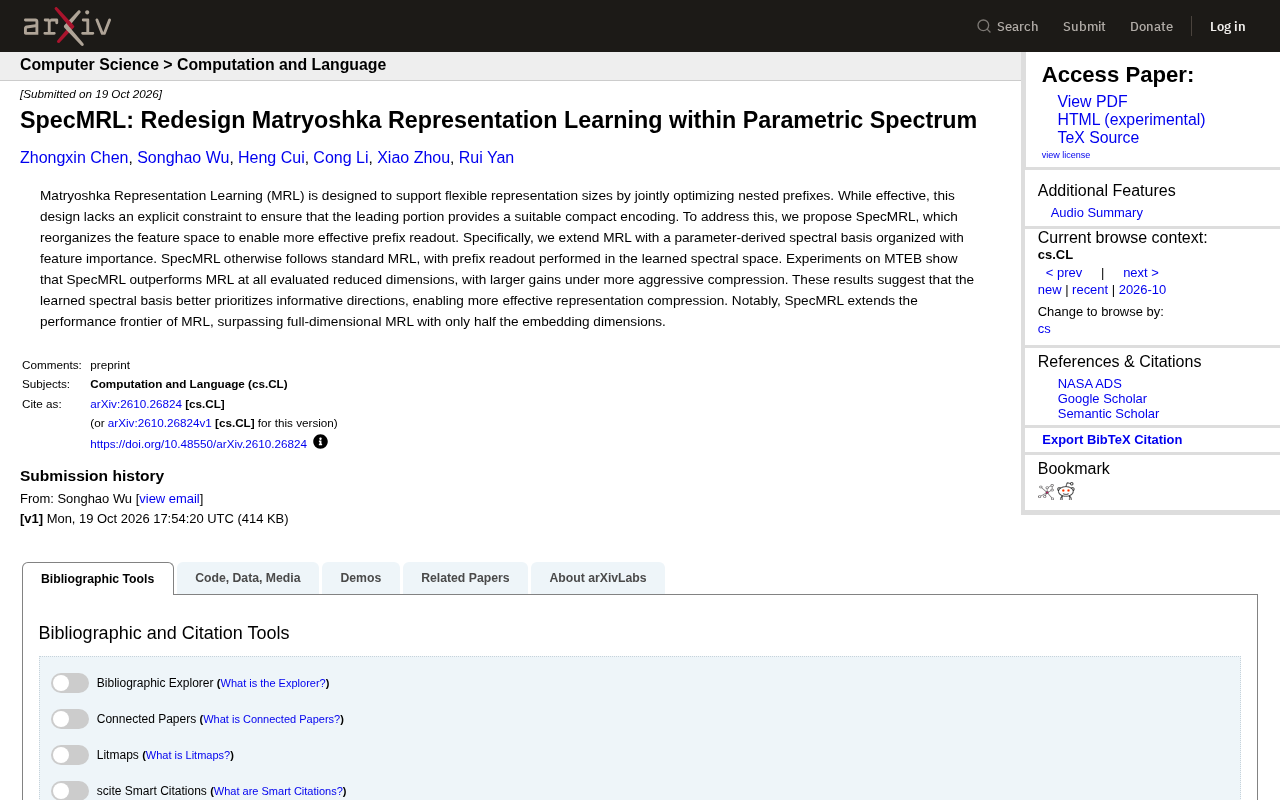
In representation learning, Matryoshka Representation Learning (MRL) supports flexible representation sizes by jointly optimizing nested prefixes. However, MRL lacks explicit constraints to ensure that the leading portion provides a suitable compact encoding. To address this, researchers propose SpecMRL, which restructures the feature space via a parameter-derived spectral basis to enable more effective prefix readout. Experiments on MTEB show that SpecMRL outperforms MRL across all evaluated reduced dimensions, with larger gains under more aggressive compression.
Core Idea: Spectral Basis and Feature Importance
The core innovation of SpecMRL is the introduction of a spectral basis derived from parameters and organized by feature importance. This spectral basis extends standard MRL, but the prefix readout is performed in the learned spectral space. According to the paper, this design better prioritizes informative directions, thereby improving the effectiveness of representation compression.
Compared with standard MRL, SpecMRL does not change the outer training objective; instead, it restructures the feature space to enhance the readability of prefixes. This makes the leading portion naturally carry more important information, alleviating the problem of MRL's lack of explicit constraints.
Spectral basis refers to a set of orthogonal basis vectors obtained through eigendecomposition (e.g., eigenvalue decomposition of a covariance matrix or parameter matrix), where each basis vector corresponds to an eigenvalue, and the magnitude of the eigenvalue reflects the amount of information or importance in that direction. In representation learning, projecting features onto this basis is equivalent to ordering dimensions by information content: the first few basis vectors carry the main variance, and subsequent dimensions contribute progressively less. This aligns with the idea of principal component analysis (PCA), but SpecMRL's basis is derived from model parameters and can be learned end-to-end, rather than decomposing a fixed representation post hoc.
Prefix readout is the core mechanism of MRL: during training, the first d dimensions (for multiple values of d) of the same representation vector are each connected to a classification or retrieval head and jointly optimized, so that any prefix can be used independently. The problem with MRL is that it only requires each prefix to be individually usable, without any mechanism to guarantee that the first few dimensions happen to be the most important directions; SpecMRL places the readout operation in an importance-ordered spectral space, so that prefix truncation naturally corresponds to the most informative directions.
Experimental Results: Outperforming MRL Across the Board
On the MTEB benchmark, SpecMRL outperforms MRL across all evaluated reduced dimensions, and the more aggressive the compression, the more pronounced the gains. Interestingly, SpecMRL surpasses full-dimensional MRL using only half the embedding dimensions, extending the performance frontier of MRL.
These results validate that the learned spectral basis can more effectively prioritize informative directions, enabling more efficient representation compression. For scenarios requiring flexible deployment (such as edge devices or low-latency retrieval), this improvement means better performance at the same dimensionality, or acceptable accuracy at lower dimensionality.
MTEB (Massive Text Embedding Benchmark) is currently the most commonly used comprehensive evaluation benchmark in the text embedding field, covering retrieval, classification, clustering, semantic similarity, reranking, and other task types across dozens of datasets. Scores on each task are typically averaged by task type and then aggregated, so "outperforming MRL across all evaluated reduced dimensions" means the advantage holds across task types, rather than appearing incidentally on a single task.
Embedding dimensionality and the performance frontier should be understood in the context of MRL's setup: MRL-trained vectors support truncation to any prefix length at inference time, allowing a trade-off among storage cost, retrieval latency, and accuracy. The so-called "performance frontier" refers to the upper-envelope curve of achievable accuracy at different dimensionalities; SpecMRL's claim of surpassing full-dimensional MRL with only half the dimensions amounts to shifting this curve upward and compressing it leftward, which is significant for edge deployment and low-latency retrieval.
Significance and Outlook
SpecMRL offers a simple yet effective improvement direction for the MRL family: by restructuring the feature space via a spectral basis, it achieves significant gains without changing the original training pipeline. Future work may further explore how to construct the spectral basis, combinations with other compression techniques, and generalization to more modalities.
According to a single source (the paper abstract), SpecMRL's advantages on MTEB are consistent, but no independent reproduction or third-party analysis has yet been seen. We look forward to future work providing more empirical details and ablation studies to fully assess its robustness and generality.
One-line Summary
SpecMRL restructures the feature space with a parameter-derived spectral basis, making MRL prefix readout more efficient and outperforming MRL across the board on MTEB.
Paragraph Summary
This article introduces SpecMRL, an improved method over Matryoshka Representation Learning (MRL). MRL supports flexible representation sizes by jointly optimizing nested prefixes, but lacks explicit constraints to ensure the leading portion provides a suitable compact encoding. SpecMRL's core is the introduction of a parameter-derived spectral basis organized by feature importance, placing prefix readout in the learned spectral space to better prioritize informative directions; it does not change the outer training objective, only restructuring the feature space. On the MTEB benchmark, SpecMRL outperforms MRL across all evaluated reduced dimensions, with larger gains under more aggressive compression, and surpasses full-dimensional MRL using only half the embedding dimensions. The article also notes that these conclusions currently come from a single source—the paper abstract—and await independent reproduction and ablation validation.
Related articles

Chain of Thought Isn't Just for AI: How Humans Can Use CoT to Improve Thinking Quality
Chain of Thought isn't just a prompt trick for large models. Starting from a Hacker News discussion, this article analyzes why CoT works for human thinking too, breaks down actionable ways to transfer it, and highlights the key differences between human CoT and machine CoT.
Cloudflare Teams Up with OpenAI: Closi…
Cloudflare Teams Up with OpenAI: Closing the Loop from Vulnerability Discovery to Defense with AI
Cloudflare uses OpenAI Daybreak to investigate security vulnerabilities and generate reviewable remediation plans, while developers use Codex to boost coding efficiency and quality.

Orca Multi-Agent Orchestration in Practice: A Guide to Parallel Collaboration with Claude and Codex
Orca is Stable AI's free open-source agent workbench supporting 34 agents like Claude Code and Codex in parallel. Learn its Git worktree isolation, multi-model orchestration, and mobile management.