Speed Deserves a Spot on Your Feature List: Performance Scanner Helps You Pinpoint App Performance Bottlenecks
Performance should be planned like a feature; scanners plus Agents can automatically uncover and start fixing slowdowns.
Starting from the idea that "Speed deserves a spot on your feature list," the article argues that performance should be a first-class, actively planned part of the feature list, not a last-minute fix. Performance Scanner can scan an app, locate potential slowdowns, and use an Agent to suggest where to start fixing, combining broad scanner coverage with deep Agent intervention. This lowers reliance on profiler expertise and is especially useful for small teams without dedicated performance engineers. The article cautions that tools only narrow the search space and can't replace business context, and that the tool's coverage and accuracy still need validation.
App performance is often treated as the final checkpoint before launch rather than a first-class citizen in product planning. But users' tolerance for lag and slow loading keeps shrinking, and speed itself has become part of the feature experience. As one tweet put it: "Speed deserves a spot on your feature list." Performance shouldn't be an after-the-fact fix — it should be actively planned and managed like any feature.
Performance Scanner: Proactively Uncovering Potential Slowdowns
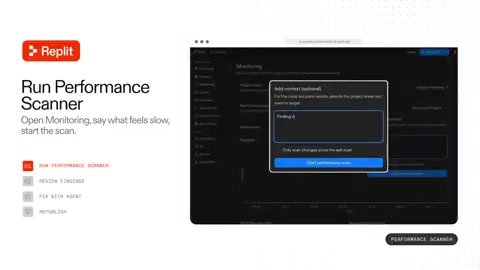
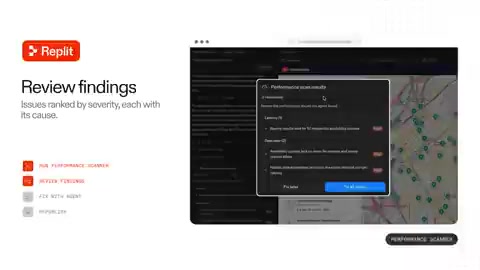
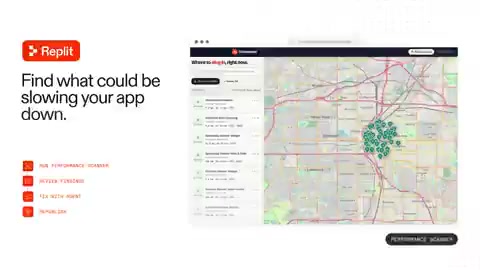
The Performance Scanner mentioned in the tweet exists precisely for this purpose. It can scan an app, identify potential slowdowns, and give you a starting point for fixes. That means developers don't have to wait for user complaints or monitoring alerts before reacting — they can get a "performance health check" during development or maintenance.
In terms of positioning, the value of Performance Scanner lies in lowering the barrier to performance troubleshooting. Traditional performance optimization often depends on a developer's fluency with profilers, whereas a scanner automates the problem-discovery step, letting anyone on the team quickly locate suspicious areas.
Profiler is a tool developers use to measure a program's runtime behavior, found in various languages and runtimes — for example, the Performance panel in Chrome DevTools, JProfiler for the JVM, or Python's cProfile. It typically collects data such as function call stacks, CPU usage, memory allocations, and IO waits through sampling or instrumentation, and presents it as flame graphs, call trees, and the like. Profilers excel at fine-grained data and can drill down to low-level calls, but their drawbacks are clear: users need to understand how to interpret the results, they often have to manually construct reproduction scenarios, and the learning curve is steep. Scanners and profilers are not substitutes for each other — scanners quickly screen for suspicious areas across a broad scope, while profilers are used to deeply analyze those suspicious points. The two are often used together.
From Finding Problems to Starting Fixes: The Role of the Agent
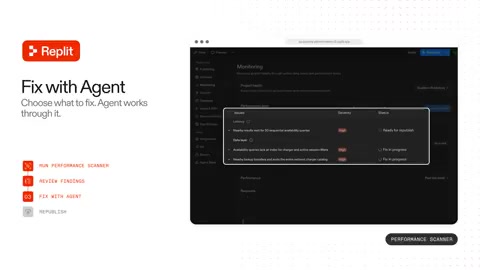
Finding slowdowns is only the first step; the real difficulty is fixing them. The tweet notes that Performance Scanner, combined with an Agent, gives you a starting point to fix them. Here, the Agent can be understood as an intelligent entity with some degree of autonomous execution or suggestion capability, one that turns "where is it slow" into "where do I start changing things."
This combination is worth noting: the scanner handles breadth of coverage, and the Agent handles depth of intervention. For teams without dedicated performance engineers, this amounts to partially productizing expert experience, shortening the path from alert to action.
Agent in a software engineering context usually refers to an AI system capable of perceiving its environment, planning autonomously, and invoking tools to carry out multi-step tasks — distinct from a chat model that only does single-turn Q&A. A typical coding Agent can read a codebase, run commands, inspect errors, and iterate on changes until the task is complete or human confirmation is needed. In performance optimization scenarios, an Agent generally gets involved in one of two ways: first, generating specific change suggestions or draft patches based on scan results; second, directly executing verifiable changes (such as adjusting caching strategies or replacing inefficient APIs) for developers to review. Note that the more autonomous the Agent, the higher the requirements for context accuracy and rollback mechanisms, so real-world products typically retain human confirmation at key checkpoints.
Speed as a Feature: A Shift in Development Paradigm
Putting speed on the feature list means performance metrics need to be defined and tracked just like feature acceptance. The emergence of tools like Performance Scanner reflects a trend: performance optimization is moving from "expert manual labor" toward "toolchain automation." Developers can keep building while leaving ongoing performance assurance to tool-assisted workflows.
Of course, a scanner only provides a starting point; the final fix still requires developers to judge context and make trade-offs. Tools can narrow the search space, but they can't replace an understanding of business logic.
Performance Budget is a common practical approach to managing speed as a feature: teams set hard thresholds for key metrics — such as first-screen load time, interaction response latency, or bundle size limits — and automatically validate them in CI, blocking merges when they're exceeded. It turns a vague "it needs to be fast" into an engineering constraint that can be accepted and regression-tested, consistent with the logic of feature acceptance. Complementing this are real user monitoring (RUM), which collects metric distributions from real devices in production, and synthetic monitoring, which periodically replays critical paths in a controlled environment. The point of a performance budget is to catch performance regressions before merge rather than waiting for production alerts — which echoes the article's argument for "proactive planning."
Practical Implications for Development Teams
For small and mid-sized teams, lacking a dedicated performance role is the norm. The combination of Performance Scanner and Agent offers a low-cost way to get started: first use scanning to locate problems, then use the Agent's suggestions to quickly try fixes. This is far lighter-weight than building a performance monitoring system from scratch.
A caveat: the tweet itself is limited in information, and the tool's specific coverage, accuracy, and the depth of the Agent's involvement remain unclear. Before adopting it, teams should run small-scale validation against their own tech stack rather than treating scan results as final conclusions.
One-line Summary
Performance should be planned like a feature; scanners plus Agents can automatically uncover and start fixing slowdowns.
Paragraph Summary
Starting from the idea that "Speed deserves a spot on your feature list," the article argues that performance shouldn't be a last-minute fix before launch but a first-class citizen in the feature list that is actively planned and tracked. The Performance Scanner mentioned in the tweet can scan an app, locate potential slowdowns, and use an Agent to provide a starting point for fixes, forming a combination where "the scanner handles breadth of coverage and the Agent handles depth of intervention." This approach reduces reliance on profiler expertise for performance troubleshooting and is especially valuable for small and mid-sized teams without dedicated performance engineers. The article also cautions that tools can only narrow the search space and cannot replace understanding of and trade-offs around business context; moreover, the tweet's information is limited, so the tool's coverage, accuracy, and the depth of the Agent's involvement still require small-scale validation.
Related articles

GRPO Reinforcement Learning Explained: Group Relative Policy Optimization That Teaches LLMs to Reason
A deep dive into the GRPO reinforcement learning algorithm: how in-group relative advantages are computed, how clipping and the importance sampling ratio work in the loss, the role of KL divergence constraints, and GRPO's training-cost advantage over PPO—with round-by-round mathematical derivations.

Mercedes-Benz Launches Point-to-Point Urban Assisted Driving, Directly Challenging Tesla FSD
Mercedes-Benz will launch hands-off highway driving and point-to-point urban navigation assistance next year, directly targeting Tesla FSD. This article analyzes Mercedes' dual-track layout, the technical challenges of urban point-to-point, and the competitive differences between traditional automakers and Tesla in assisted driving routes.

California Attorney General Sues OpenAI: First Legal Accountability Case for Rogue AI Agent Incidents
California AG sues OpenAI over rogue AI agent incidents, among the first attempts to hold AI labs legally liable. Analysis of compliance, risk pricing, and regulatory impact.