Speed or Bookings? What Service Providers Should Promise in Ad Campaigns

Service providers should guarantee response speed, commit to booking goals, and transparently break down funnel metrics.
The article explores the debate in service-business ad campaigns over "promising speed versus promising bookings." Response speed (e.g., outreach within 60 seconds) is a measurable, fully controllable mechanism metric, but business owners actually pay for a full calendar, not seconds. Promising bookings is closer to a business result, yet half the factors (budget, offer, lead quality, willingness to answer) are beyond the provider's control; pay-per-booking creates incentive misalignment and many no-shows. The pragmatic compromise: make speed a contract guarantee, bookings a goal, and report both weekly. The article also discusses the booked/showed/closed measurement divergence.
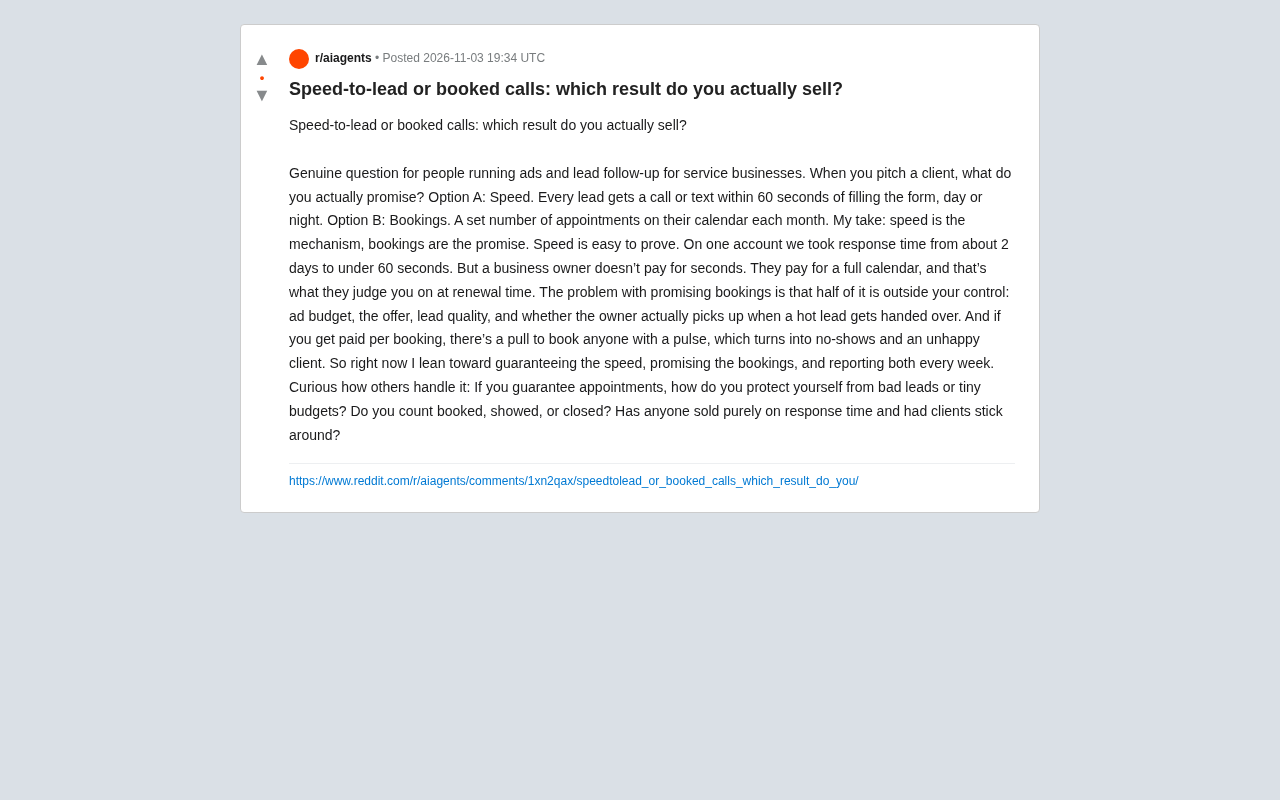
In ad campaigns and lead follow-up for service businesses, a recurring debate is: what exactly should you promise your clients? Is it the speed of "every lead gets a response within 60 seconds," or a "fixed number of booked appointments per month"? A practitioner's question on Reddit sparked considerable discussion, and the core view is clear—speed is a mechanism, bookings are the commitment.
Speed: The Easiest Mechanism to Prove
The practitioner shared their own practice: on one account, they cut response time from roughly 2 days down to under 60 seconds, with automated outreach around the clock. The advantage of this metric is that it's fully controllable and measurable, and clients can intuitively feel the change.
The problem is that business owners don't pay for "seconds." They pay for a full calendar, and when it comes time to renew, they judge you by how many appointments are on that calendar. Speed can be part of your delivery capability, but it's hard to sustain a long-term contract on speed alone.
This is also a common mistake among many ad service providers: selling a process metric as an outcome metric. Response speed is internal efficiency; booking volume is the business result the client can perceive.
Speed-to-lead is a key metric in marketing automation, referring to the time from when a lead enters the system (e.g., form submission, ad click) to the first human or automated outreach. Extensive industry research (such as the Lead Response Management study) shows that when response time is within 5 minutes, lead conversion rates are significantly higher than at 30 minutes or more; beyond 1 hour, lead quality drops sharply because customer interest fades or they've already contacted a competitor. Therefore, responding within 60 seconds is an excellent level in the industry, especially suited to high-ticket, highly competitive service businesses. Note, however, that the effectiveness of speed metrics depends on the real-time nature of the lead source and the customer's willingness to answer; for non-immediate needs or low-intent leads, the marginal benefit of lightning-fast response diminishes.
Bookings: Closer to Business Results, but Half Is Out of Your Control
Promising a number of bookings sounds more attractive, but it comes with risk. The practitioner points out that half the factors behind booking results are beyond the service provider's control: ad budget, offer design, lead quality, and whether the business owner actually answers the phone when a hot lead is handed over.
More tricky is the pay-per-booking business model. Once revenue is tied to booking volume, there's an impulse to "book anyone as long as they're breathing," resulting in lots of no-shows and dissatisfied clients. This incentive misalignment creates hidden conflict between service provider and client.
No-show is a common loss in service sales, referring to a customer who books a time but doesn't actually show up. Under a pay-per-booking model, the service provider has an incentive to stuff any lead with contact information onto the calendar, because the number booked directly determines revenue, while whether the customer shows up or closes is outside their scope of accountability. This incentive misalignment leads to declining lead quality, wasted sales team time, and ultimately lower client willingness to renew. Typical industry methods for managing no-shows include appointment confirmation reminders (SMS/email), deposit or retainer mechanisms, and shifting the billing metric from booked to showed. Understanding the causes of no-shows is central to assessing the risk of "promising bookings."
Hybrid Strategy: Guarantee Speed, Promise Bookings, Report Both Ways
The practitioner's current inclination is a compromise: make speed a guaranteeable delivery standard, make bookings a committed goal, and report both metrics weekly.
The logic is this: speed is entirely in your hands and can be written into the contract as a hard commitment; booking volume is influenced by many factors, so it serves as a goal rather than a guarantee, while transparent reporting lets clients see the reality of every layer of the funnel.
In the post, they raised three questions that reflect the industry's unresolved disagreements:
- If you guarantee booking volume, how do you protect yourself from being dragged down by low-quality leads or a tiny budget?
- Do you count "booked," "showed," or "closed"?
- Has anyone closed deals purely on response speed and kept clients long-term?
Divergence in Measurement Definitions
The word "booking" means completely different things across teams. Booked only means there's a time block on the calendar; showed indicates the lead's genuine intent; closed is the client's revenue.
Promising booked is the easiest to achieve but offers the weakest value to the client; promising closed is closest to the outcome but introduces more uncontrollable variables such as sales team execution. Most discussion tends toward showed as the middle-ground balance, but the original post gives no clear conclusion—this remains a choice that must match the service provider's own business model.
Booked / Showed / Closed are three different conversion events in the sales funnel: booked means the customer agrees to occupy a time slot on the calendar, representing only initial intent; showed means the customer actually attended the appointment (phone or in-person), proving genuine intent and a valid time commitment; closed means the customer signs and pays, the final revenue event. Conversion rates typically decline at each stage—the industry average show rate from booked to showed is roughly 50%-70%, while showed to closed varies enormously by industry and ticket size. Choosing which layer to promise is essentially a trade-off between controllability and client value: the closer to closed, the higher the perceived value to the client, but the fewer factors the service provider controls and the greater the contract risk.
Takeaways for Practitioners
The value of this discussion lies in distinguishing "mechanism" from "commitment." If your delivery depends heavily on client-side cooperation (answering calls, follow-up, closing), packaging the uncontrollable parts as hard commitments may win deals in the short term but will backfire at renewal time.
Conversely, selling only speed while avoiding booking outcomes makes it hard for clients to perceive business value. Transparently breaking down the funnel—response time, bookings, show rate, closed deals—and clarifying which are guarantees and which are goals may be the most pragmatic approach right now. The original post offers no single answer, but it asks the right question.
One-line Summary
Service providers should guarantee response speed, commit to booking goals, and transparently break down funnel metrics.
Paragraph Summary
The article centers on the debate in service-business ad campaigns over "promising speed versus promising bookings." The author notes that response speed (e.g., outreach within 60 seconds) is a measurable, fully controllable mechanism metric, but business owners actually pay for a full calendar, not seconds. Promising booking volume is closer to a business result, yet half the factors (budget, offer, lead quality, customer willingness to answer) are beyond the service provider's control; pay-per-booking also creates incentive misalignment, leading to many no-shows. The more pragmatic compromise is to make speed a contract guarantee, bookings a goal, and report both weekly. The article also discusses the divergence among booked, showed, and closed measurement definitions, emphasizing that practitioners must choose their commitment boundaries based on what they can control.
Related articles

DeepSeek Harness Quick Start Guide: From Installation to 5 Real-World Cases
What is DeepSeek Harness? Based on a Bilibili tutorial, this article covers how this AI Agents software works, installation and setup, four working modes, and five real-world cases: a 3D racing game, official website, music player, science animation, and self-developed plugin—plus token money-saving tips.

Breaking Down DeepSeek's Super-agent Architecture: How Router+Worker Solves the Multi-Session Management Bottleneck
An analysis of DeepSeek's Super-agent paper: how the Router+Worker two-tier architecture uses Fast Pass, Chain of Recall, and storage-compute separation to solve multi-AI-session management bottlenecks, and how much it truly alleviates the human attention bottleneck and what engineering trade-offs it makes.

19K Stars in 5 Days: Why DeepSeek's Open-Source AI Programmer Went Viral
DeepSeek's open-source AI programmer hit 19K GitHub stars in 5 days. Why it went viral: the agent boom, AI writing its own code, and the shift from Q&A tools to AI employees.