SpeedCrunch 1.1 Released: Why This Open-Source Calculator Is Trending on Hacker News Again

Veteran open-source calculator SpeedCrunch 1.1 is back in the Hacker News spotlight, holding its ground in the AI era through deterministic computation.
After its 1.1 release, SpeedCrunch earned 190 points and 37 comments on Hacker News, bringing this plain, veteran open-source calculator back into the technical community's view. The article outlines its core positioning: keyboard-driven expression evaluation, reuse of history via split-pane display, arbitrary-precision arithmetic, and being cross-platform, free, locally run, and requiring no internet or account. None of these capabilities is flashy alone, but combined they significantly reduce the cost of interrupting one's train of thought. The significance of version 1.1 lies more in the signal that "the project is still maintained," with the community focused on pragmatic details such as configuration migration, shortcut stability, and distribution packaging. Against the backdrop of widespread AI assistants, the article points out that the survival logic of standalone calculators lies in providing predictable instant feedback and digit-by-digit verifiable deterministic results, occupying the high-frequency, short-path, zero-explanation-cost computation gap.
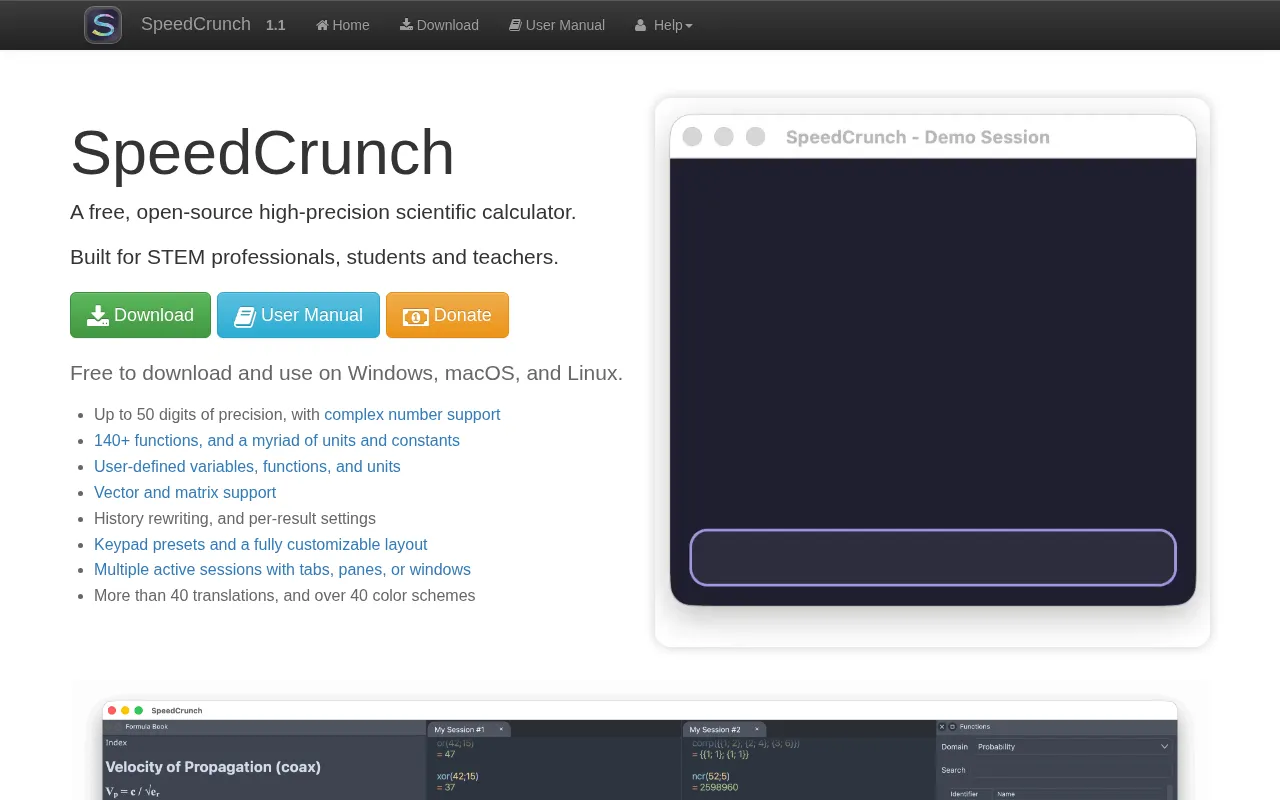
An open-source calculator that isn't exactly new has once again hit 190 points and 37 comments on Hacker News. The star is SpeedCrunch, with version 1.1 listed on the site. No big-name backing, no commercial launch event, and even the official website looks as plain as it has for years—yet the technical community keeps pulling it back into the spotlight. That fact itself is more worth discussing than the version number.
A Veteran Tool That Keeps Getting Remembered
SpeedCrunch's positioning is clear: it targets engineers, students, and developers who need to do calculations frequently, with keyboard-driven input and expression evaluation as its core strengths. Users type a line of expression, hit Enter, and the result appears instantly. History is preserved in a split-pane view above and below, ready to be reviewed and reused at any time.
It's cross-platform, open-source, and free, supports arbitrary-precision arithmetic, doesn't require an internet connection, and needs no account registration. For people who routinely need unit conversions, base conversions, function values, matrices, or simple statistics, the core value of this kind of tool is that it "doesn't interrupt your train of thought," not how many buttons are on the interface.
190 points on Hacker News isn't exactly a blockbuster number, but combined with 37 comments, the engagement is real. The comments section typically features two kinds of voices: long-time users sharing their keyboard-shortcut workflows, and people used to command-line tools or built-in system calculators discussing why they still keep a window open for a standalone calculator. This kind of "voting with their feet" discussion is precisely the most authentic source of word-of-mouth for small tools like this.
Arbitrary-precision arithmetic means the number of significant digits in a result isn't fixed to the 32-bit or 64-bit floating-point values natively supported by hardware; instead, software allocates memory on demand to store and compute values, so dozens or even thousands of significant digits can be retained. Ordinary calculators or the double type in programming languages accumulate rounding errors during successive operations—for example, 0.1 + 0.2 cannot exactly equal 0.3—whereas arbitrary-precision arithmetic can be exact in integer and rational-number scenarios. For engineers, this means tasks like unit conversions, factorials of large numbers, and comparisons of high-precision constants (such as pi) won't suffer from "the last few digits don't match" issues caused by floating-point truncation. SpeedCrunch uses this as one of its key capabilities that distinguishes it from system calculators.
Why "Plainness" Has Become a Selling Point
Many calculation products today are heading in two directions: either becoming an entry point for a general-purpose AI assistant, or piling on visual charts and cloud sync. SpeedCrunch takes a third path—it does almost nothing but calculate, and it does this small thing very reliably.
Specifically, its expression input supports variable definitions, function calls, and unit conversion, and the results panel can simultaneously display expressions at different precisions or in different bases for easy cross-checking. A configurable constant library and user-defined variables mean repetitive engineering calculations don't require re-assembling formulas from scratch every time. None of these capabilities is flashy on its own, but combined in a single keyboard-first interface, the efficiency gains accumulate.
Being open-source also means its behavior can be audited, and data stays entirely local. For people handling sensitive values or working in poor-network environments, this is a practical reason to choose it—not a sentimental label.
Expression evaluation differs from the key-by-key input of ordinary calculators: instead of settling the result each time an operator is pressed, the user enters an entire line of mathematically valid syntax, such as 2*(3+4)^2 or sin(pi/4), and the software first parses it into a syntax tree before evaluating it as a whole. The advantage of this model is that it preserves operator precedence, supports nested parentheses and function calls, and makes it easy to rewrite and reuse historical expressions directly. SpeedCrunch's variable definitions, function calls, and unit conversion are all built on this mechanism, which makes it closer to a lightweight interactive math interpreter than a traditional electronic calculator.
The Signal Behind Version 1.1
Judging from version 1.1 posted on the official site, the significance of this update lies more in the signal that "the project is still maintained." For an old tool that has long lived on users' desktops, the maintenance cadence itself is a source of confidence: it shows that someone is tracking dependencies, fixing issues, and adapting the software to new system environments.
The community's reaction to this kind of update is usually pragmatic—people don't cheer for a specific feature so much as care about whether old configurations migrate smoothly, whether commonly used shortcuts have changed, and whether packaging covers the distribution they use. These details determine whether a tool can truly stay in a workflow long-term, rather than being tried once as a novelty toy.
The Survival Logic of Standalone Calculators in the AI Era
AI assistants can already solve equations, write scripts, and do unit conversions—so why still need a dedicated calculator? The implicit answer in the HN discussion is: a calculator provides "predictable instant feedback."
Calling a general-purpose assistant requires describing context, waiting for generation, and checking whether the result is reliable, whereas tools like SpeedCrunch give deterministic results that can be verified digit by digit. For scenarios requiring repeated trial calculations and quick comparisons, this determinism is more valuable than intelligence. It doesn't replace AI; it occupies the gap AI isn't good at—high-frequency, short-path, zero-explanation-cost computation.
Judging from the feedback of 190 points and 37 comments, SpeedCrunch 1.1 isn't trying to change its positioning. It's simply continuing to do "a reliable open-source calculator" well. For the technical community, this may be exactly why it gets brought up again every so often.
Deterministic computation means that the same input under the same version necessarily produces exactly the same, digit-by-digit reproducible output, without involving sampling, probability, or model inference. When large language models generate mathematical results, they are essentially doing token prediction and may give plausible-looking but actually incorrect values, and asking the same question multiple times doesn't necessarily yield consistent results; whereas tools like SpeedCrunch have execution paths fixed by parsers and numerical algorithms, so results can be manually verified digit by digit and are easy to reproduce in engineering records. For scenarios requiring repeated trial calculations, cross-validation, or auditable calculation processes, this reproducibility constitutes the underlying reason why standalone calculators are hard to replace with general-purpose assistants.
One-line Summary
Veteran open-source calculator SpeedCrunch 1.1 is back in the Hacker News spotlight, holding its ground in the AI era through deterministic computation.
Paragraph Summary
After its 1.1 release, SpeedCrunch earned 190 points and 37 comments on Hacker News, bringing this plain, veteran open-source calculator back into the technical community's view. The article outlines its core positioning: keyboard-driven expression evaluation, reuse of history via split-pane display, arbitrary-precision arithmetic, and being cross-platform, free, locally run, and requiring no internet or account. None of these capabilities is flashy alone, but combined they significantly reduce the cost of interrupting one's train of thought. The significance of version 1.1 lies more in the signal that "the project is still maintained," with the community focused on pragmatic details such as configuration migration, shortcut stability, and distribution packaging. Against the backdrop of widespread AI assistants, the article points out that the survival logic of standalone calculators lies in providing predictable instant feedback and digit-by-digit verifiable deterministic results, occupying the high-frequency, short-path, zero-explanation-cost computation gap.
Related articles

iPhone Duo Transformed into a Windows 98 Gaming PC: Hands-On Test and Experience
XDA tests turning the iPhone Duo foldable into a Windows 98 gaming PC using RetroArch and DOSBox Pure with virtual 3DFX, running Unreal Tournament, Half-Life, and Quake 3, plus Windows XP feasibility and limits.

Type-Safe Keep Rules in R8 and DEX Optimization in Practice
Google Play requires over 25% DEX optimization. This article explains the R8 configuration analyzer, Jetpack Keep type-safe annotations, and the Android CLI validation tool to help Android developers narrow keep rules, improve shrinking/optimization/obfuscation, and reduce ANRs.

Why Are Old Buildings More Beautiful Than New Ones? Pulitzer Prize-Winning Author Reveals an Overlooked Economic Truth
Pulitzer Prize-winning author Robert Caro found that poorer countries built more beautiful buildings. He reveals how cheap skilled craftsmen created the intricate details of old New York architecture, and how rising labor costs changed architectural aesthetics.