Speko: A Unified Routing Platform for Voice AI — Building the OpenRouter for Speech

YC-backed Speko builds a unified API routing layer for voice AI, positioning as the OpenRouter for speech.
Speko, a YC S26 startup, aims to become the OpenRouter of voice AI by offering a unified API that aggregates multiple speech providers for STT, TTS, and end-to-end voice models. As voice AI technology hits an inflection point and the provider ecosystem becomes increasingly fragmented, Speko addresses developer pain points around integration costs, vendor lock-in, and cost comparison, while facing unique challenges around real-time latency that make voice aggregation harder than text.
Voice AI Gets Its Own "OpenRouter"
In the large language model (LLM) space, OpenRouter has become a familiar piece of infrastructure for developers — it aggregates hundreds of models through a unified API, letting developers flexibly switch, compare prices, and route requests without building separate integrations for each provider. Founded by Alex Atallah, OpenRouter's core philosophy is to offer developers a single API endpoint that aggregates hundreds of LLMs from OpenAI, Anthropic, Google, Meta, and more. Developers can seamlessly switch between providers by changing just one parameter (the model name), without rewriting any integration code. This model succeeds because it addresses a real engineering pain point: as the number of models has exploded, it's simply impractical for developers to maintain separate API integrations and billing logic for each one. Now, this same approach is being replicated in the voice AI space.
Recently on Hacker News, YC S26 batch startup Speko officially launched with a clear and direct positioning: building the OpenRouter for voice AI. The post received 88 upvotes and 51 comments, reflecting strong interest from the developer community.
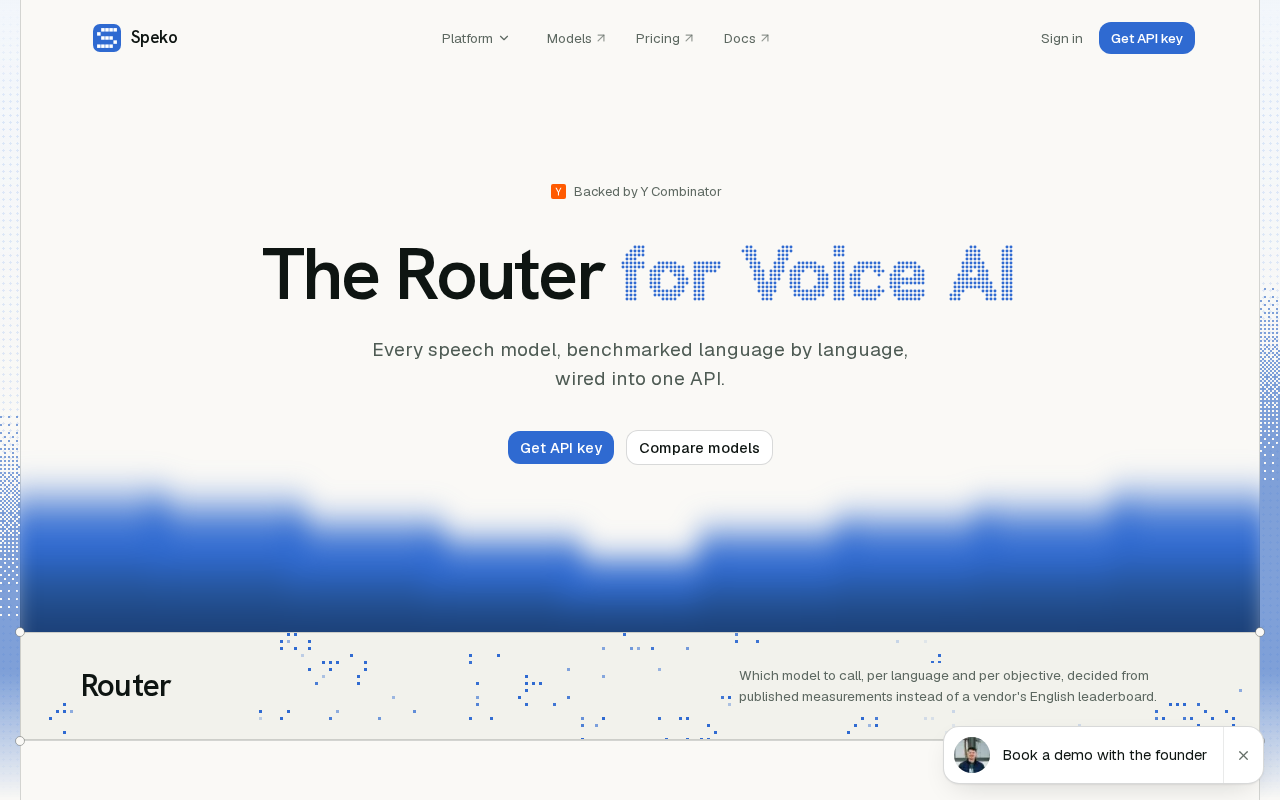
As voice interaction use cases explode — from customer service bots and voice assistants to real-time translation and content dubbing — developers face challenges similar to the early LLM ecosystem: provider fragmentation, inconsistent API standards, and difficulty comparing costs across vendors. Speko aims to solve these pain points with a unified abstraction layer.
The Fragmentation Problem in Voice AI
Too Many Providers, Too Many Interfaces
The current voice AI tech stack typically involves multiple components: speech recognition (STT/ASR), speech synthesis (TTS), and the increasingly popular end-to-end voice conversation models. Each component has numerous providers — ElevenLabs, Deepgram, Cartesia, OpenAI, Google, and more — each with its own API specification, billing model, and performance characteristics.
Specifically, STT (Speech-to-Text), also known as ASR (Automatic Speech Recognition), converts user voice input into text. Representative services include Deepgram, Whisper (OpenAI's open-source model), and Google Speech-to-Text. TTS (Text-to-Speech) works in reverse, converting text into natural-sounding voice output. ElevenLabs and Cartesia are leaders in this space, with ElevenLabs particularly known for its highly realistic voice cloning capabilities. End-to-end voice conversation models (such as GPT-4o's real-time voice mode) break away from the traditional STT→LLM→TTS pipeline architecture, directly understanding and generating speech at the audio level, dramatically reducing total latency while preserving paralinguistic information like tone and emotion.
For developers, this means:
- Every new provider requires writing custom adapter code;
- Comparing voice quality, latency, and pricing across providers is expensive;
- If a provider raises prices, goes down, or degrades in quality, migration costs are enormous.
Vendor lock-in is particularly acute in voice AI: different providers have varying audio format support (PCM, Opus, MP3), streaming protocols (WebSocket vs HTTP SSE vs gRPC), sample rate requirements, and voice model ID systems. Once an application is deeply integrated with a specific provider's features — such as ElevenLabs' voice cloning API or Deepgram's keyword boosting — migrating to an alternative requires extensive code refactoring and testing. Even more challenging, voice quality evaluation is often subjective, requiring companies to conduct extensive A/B testing before switching providers to ensure the user experience doesn't degrade.
The Core Value of Unified Routing
Speko's core value proposition is using a single API to abstract away the differences between underlying providers. Developers integrate once and can freely switch between multiple voice models, or even intelligently route based on latency, cost, or quality. This is highly consistent with the value OpenRouter provides in the LLM space — reducing integration costs, avoiding vendor lock-in, and optimizing overall spend.
This "aggregator" model tends to generate strong network effects at the infrastructure layer: the more providers connected, the more attractive it becomes to developers; the more developers using it, the stronger its bargaining power with providers. From a two-sided platform economics perspective, on the supply side, as Speko integrates more voice model providers, developers gain access to more comprehensive options and more competitive pricing. On the demand side, when the developer base using Speko reaches sufficient scale, the accumulated call volume data can generate unique insights — such as which provider performs best for specific accents, languages, or scenarios. This kind of quality benchmark data based on real traffic is extremely difficult for newcomers to replicate. Large-scale call volumes also give the platform leverage to negotiate volume discounts with providers, enabling it to offer lower per-unit pricing than developers could get by purchasing directly. Once this "data flywheel" starts spinning, it creates a formidable competitive moat.
Why Is a Voice AI Aggregation Platform Emerging Now?
A Technical Inflection Point for Voice AI
Over the past year or two, voice AI technology has made a significant leap. Exemplified by GPT-4o's real-time voice capabilities, end-to-end voice models have dramatically improved in naturalness and response speed, making truly "usable" voice interaction products a reality.
In May 2024, when OpenAI unveiled GPT-4o's real-time voice conversation capabilities, it marked a critical inflection point for voice AI. Traditional voice conversation systems use a cascaded architecture: first converting speech to text with ASR, then processing the text through an LLM, and finally converting the response back to speech with TTS. This pipeline architecture typically incurs 2-5 seconds of total latency and loses the speaker's tone, emotion, and prosody information during the ASR stage. GPT-4o's end-to-end approach processes audio as a native modality, reducing response latency to approximately 320 milliseconds (close to the natural reaction time in human conversation) while being able to perceive and generate emotionally expressive speech. This breakthrough opened up a wealth of real-time voice application possibilities and directly fueled the explosion in demand for voice AI infrastructure.
Breakthroughs in speech synthesis quality from companies like ElevenLabs have also dramatically lowered the barrier to voice content production.
Technological maturity leads to an explosion of applications, and an explosion of applications inevitably creates demand for unified infrastructure. This is precisely the timing logic behind Speko's market entry — the market is large enough, the pain points are real enough, and the ecosystem is fragmented enough to create the perfect opening for an aggregator.
Building on a Proven Business Model
Speko explicitly positions itself as the voice AI equivalent of OpenRouter — a smart positioning strategy. OpenRouter's success has already validated the "API aggregation + intelligent routing" business model in the AI infrastructure space. OpenRouter's business model charges a small service fee on top of underlying provider pricing while offering intelligent routing features — for example, automatically selecting models based on strategies like lowest cost, fastest speed, or highest quality. The developer community already has a mental model for this approach, so Speko doesn't need to educate the market from scratch — it just needs to prove it can execute well in the voice vertical.
Speko's Opportunities and Challenges
Potential Competitive Moats
The aggregator model may seem simple, but doing it well is far from easy. The real moat often comes from:
- Routing intelligence: Can it make optimal decisions based on real-time quality, cost, and latency?
- Breadth and depth of provider coverage: Can it integrate emerging models as soon as they appear?
- Value-added capabilities: Such as unified usage analytics, caching, failover, A/B testing, and more.
Addressing the Skeptics
In the Hacker News discussion, common concerns about aggregation platforms include: How do you ensure latency comparable to direct provider integration? How do you extract value at the middle layer without significantly increasing costs? And will providers restrict cooperation out of fear of being "disintermediated"?
These are questions Speko will need to continuously answer at both the product and business levels. For real-time voice — a use case extremely sensitive to latency — every millisecond added by the middle layer can affect user experience. This is what makes voice aggregation significantly more challenging than text aggregation. The natural turn-taking time in human conversation is approximately 200-500 milliseconds; latency exceeding 1 second feels noticeably unnatural to users, and beyond 2 seconds, it severely disrupts conversational flow. This means the additional latency Speko introduces as a middle layer (known as "hop latency") must be kept extremely low. For text API aggregation, a few dozen milliseconds of routing overhead is negligible. But for streaming audio data, the middle layer must handle real-time forwarding of audio frames, WebSocket connection management, and potentially format conversion — each step can introduce latency. This requires Speko to adopt an edge deployment strategy architecturally, placing proxy nodes as close as possible to both users and providers, while using high-performance data transfer techniques like zero-copy to minimize processing overhead.
Conclusion: The Inevitable Trend Toward Layered AI Infrastructure
Speko's emergence is fundamentally another manifestation of the "layering" trend in AI infrastructure. When a particular technology layer (voice models) matures and becomes highly fragmented, an aggregation, abstraction, and optimization layer inevitably emerges.
From LLMs to voice, from images to video, we'll likely see more and more "OpenRouter for X" platforms. For developers, this is undeniably good news — less integration burden, more freedom of choice, and more transparent costs. For Speko, whether it can truly build sufficient technical moats and ecosystem network effects in the voice vertical will determine how far it can go.
Related articles

Workbuddy for Absolute Beginners: How a Desktop AI Agent Fits Into Real Workflows
A beginner's guide to the Workbuddy desktop AI agent: installation, claiming credits, file management, and building automated workflows—compared with CodeX for fit and cost, helping professionals shift from AI question-askers to AI managers.

OpenAI's New Agent Stack: Computer Use, Decisions API, and Ultra-Fast Workflows
OpenAI Dev Day unveiled a new agent stack: Computer Use outperforms humans, Decisions API delivers ultra-low-latency classification via Luna, Agents API opens the same Computer Use capabilities, and GPT-6.1 Sol costs only one-seventh of Astra. Core updates, benchmark data, and developer insights.

Liang Wenfeng Open-Sources DeepInfo Inference Framework, Takes On U.S. Ban
DeepSeek open-sources its DeepInfo inference framework after its models, featuring GPU/CPU cross-pipelining, small-model prediction with large-model verification, and full Huawei Ascend and NVIDIA chip support—facing the U.S. federal ban head-on. This article analyzes its significance for AI deployment and open-source strategy.