Spira Maxima: One-Click Video Generation from Script to Viral Content

Spira Maxima converts a text script into a complete social video with AI avatar, B-roll, and music in one click.
Spira Maxima is a one-pass text-to-video tool that debuted at #2 on Product Hunt. Users input a script and the tool automatically generates a presenter, B-roll, subtitles, and background music — ready to post with no editing. Key differentiators include generating a personalized AI clone from a single photo and audio clip, support for real product imagery, and a model post-trained on social trend and performance data to maximize virality. It targets independent creators, small brand marketers, and social media teams. The concept is compelling, but real-world output quality and AI clone naturalness still await broader validation.
From a Script to a Finished Video
Spira Maxima launched on Product Hunt and immediately climbed to #2 of the day, earning 200 upvotes and 23 comments. Its pitch is straightforward: take a plain-text script and turn it into a publish-ready social short video in a single pass.
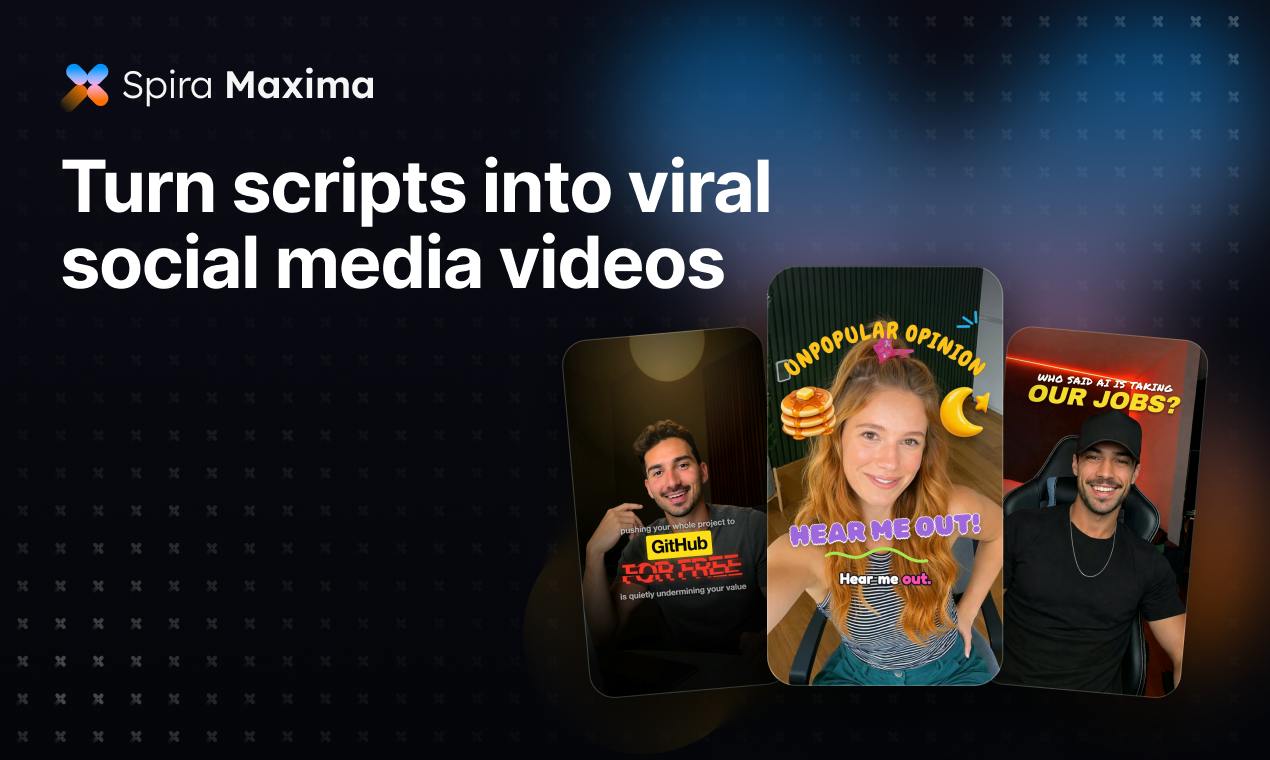
Unlike typical "AI-assisted editing" tools, Spira Maxima is built around the idea of a one-pass generation. You input a script, and it automatically assembles a presenter on camera, trend-aligned B-roll footage, subtitles, and background music — producing a video you can post without any additional editing. For creators and marketing teams that need to publish at high frequency, this end-to-end pipeline is where the real time savings lie.
Putting "You" in the Video
One of Spira Maxima's key differentiators is personalization. You can upload a single photo and a short audio clip to generate your own AI clone, and the tool will build the entire video's editing logic around that likeness.
Beyond digital avatars, it also supports importing real product photos or existing recorded footage, so the generated video retains authentic brand elements and product details. This means it's not limited to churning out generic, template-driven content — it can weave a creator's personal brand and product imagery directly into the final cut, balancing both efficiency and recognizability.
This design philosophy addresses a core pain point in short-video marketing: the need to produce at scale while maintaining a human, personalized voice. AI videos that rely entirely on stock footage often feel generic, and Spira Maxima attempts to preserve the "human" element within an automated workflow.
Technical note: AI clone technology works by reconstructing a person's visual appearance and voice characteristics from minimal input (one photo + a few seconds of audio), then compositing that representation into video frames. The industry currently follows two main approaches: diffusion model-based image animation (as seen in tools like D-ID and HeyGen), and 3D reconstruction via Neural Radiance Fields (NeRF) or 3D Gaussian Splatting. The former is lighter and less demanding on input quality, but can produce distortions during larger head movements. The latter yields more realistic results but requires significantly more compute and input data. Spira Maxima's emphasis on "one photo is all you need" suggests it uses the lightweight approach — which lowers the barrier to entry but may involve trade-offs in facial detail accuracy and motion naturalness.
A Generation Engine Driven by Trend Data
Spira Maxima's most noteworthy claim is that its model has been post-trained on social trend and performance data. In other words, the model isn't just generating a video that looks "decent" — it's attempting to replicate the content formats that are actually performing well and spreading on social platforms right now.
Every output is designed to follow patterns that are "working" on platforms — whether that's pacing, cut timing, or subtitle style — with the goal of maximizing social impact. This data-feedback loop elevates the tool from a "content production" utility to a "content performance optimization" engine, which is exactly why it can confidently use the word viral in its tagline.
That said, trend-data-driven generation is a double-edged sword: it can boost the reach of individual videos, but over-indexing on trends can also lead to homogenized content. Real-world effectiveness still needs to be validated by creators against their own specific positioning.
Technical note: In the context of large models, "post-training" typically refers to further fine-tuning a pre-trained model using domain-specific data or feedback signals after the initial pretraining phase. Common forms include Supervised Fine-Tuning (SFT) and Reinforcement Learning from Human Feedback (RLHF). Spira Maxima's claim of being "post-trained on social trends and performance data" implies that on top of general video generation capabilities, an additional optimization layer was applied using real platform signals — such as like rates, completion rates, and share counts — to steer outputs toward high-virality content formats. This approach closely mirrors the logic of recommendation algorithms: essentially converting user behavioral data into implicit constraints on content generation. Its effectiveness is bounded by the recency and platform coverage of the training data — if the data is stale, the so-called "trend-driven" outputs may actually be chasing formats that have already peaked.
Who Is It For?
Spira Maxima's target audience is fairly well-defined:
- Independent creators: No editing team, but a need for consistent, high-frequency output.
- Small-to-mid-sized brands and marketers: Want to rapidly test multiple product promotion or awareness videos.
- Social media teams: Need to respond quickly to trending topics and generate content in batches.
The product is categorized under Social Media, Marketing, and Artificial Intelligence — three tags whose overlap maps almost perfectly to what the tool does.
A Measured Take
Spira Maxima's strong Product Hunt ranking reflects the market's sustained enthusiasm for the text-to-video space. But based on publicly available information, the product is largely describing an ideal workflow at the narrative level. Key metrics — actual output video quality, the naturalness of the AI clone, audio-visual sync accuracy — still need long-term validation from real users.
"No editing required" is a bold promise. For users focused on publishing speed, it could dramatically compress their workflow. But for professional content with precise visual standards, whether automated output can truly meet the bar is something you'll need to test yourself. Regardless, the emergence of tools like this continues to lower the barrier to entry for short-form video creation.
Related articles

Chain of Thought Isn't Just for AI: How Humans Can Use CoT to Improve Thinking Quality
Chain of Thought isn't just a prompt trick for large models. Starting from a Hacker News discussion, this article analyzes why CoT works for human thinking too, breaks down actionable ways to transfer it, and highlights the key differences between human CoT and machine CoT.
Cloudflare Teams Up with OpenAI: Closi…
Cloudflare Teams Up with OpenAI: Closing the Loop from Vulnerability Discovery to Defense with AI
Cloudflare uses OpenAI Daybreak to investigate security vulnerabilities and generate reviewable remediation plans, while developers use Codex to boost coding efficiency and quality.

Orca Multi-Agent Orchestration in Practice: A Guide to Parallel Collaboration with Claude and Codex
Orca is Stable AI's free open-source agent workbench supporting 34 agents like Claude Code and Codex in parallel. Learn its Git worktree isolation, multi-model orchestration, and mobile management.