Splice CEO: AI Emails Are Killing Real Conversation

Splice CEO warns AI-written emails boost efficiency while quietly erasing authentic human connection.
Splice CEO Kakul Srivastava offers a counterintuitive warning about AI writing tools: as AI generates polished emails at scale, surface-level efficiency rises, but the core human value in communication — personality, emotion, and authenticity — quietly fades. When both parties let AI do the talking, genuine connection is reduced to an exchange between algorithms. Her perspective from the music industry carries special weight: Splice serves a world where human distinctiveness is everything. She's not against AI, but calls for using it on supporting tasks while preserving real, personal expression wherever relationships and emotions are at stake.
When Efficiency Meets Communication: A Warning from a Tech CEO
Splice is a well-known sampling platform in the music production world — countless producers rely on it for one-shots and melodic loops. Samples pulled from the platform have found their way into numerous hit songs, including Lisa's Money and Sabrina Carpenter's Espresso. In many ways, Splice has become core infrastructure for the modern music creation workflow.
It's fitting, then, that Splice's CEO — someone deeply attuned to creativity and collaboration — is raising a thought-provoking concern: AI-generated emails are quietly killing genuine human conversation.
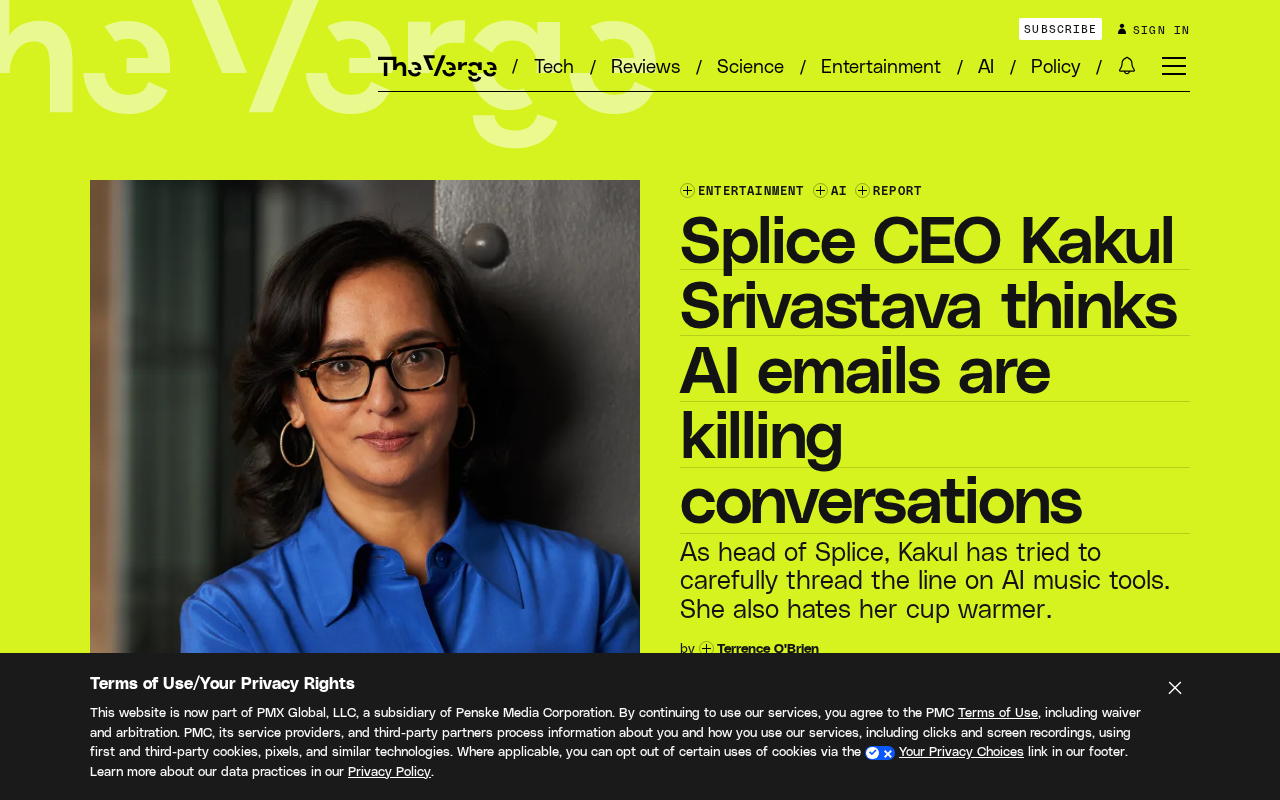
Founded in 2013, Splice is now one of the world's largest music sample subscription platforms, with over 4 million registered users and tens of millions of audio assets. Its business model resembles "the Spotify of music samples" — producers pay a monthly fee to download licensed samples for commercial use without worrying about copyright issues. CEO Kakul Srivastava brings extensive product and leadership experience from across the tech industry, having previously worked at GitHub, Flickr, and other prominent platforms. Her deep understanding of creator tools and community ecosystems gives her a unique vantage point when discussing AI's impact on creative communities — one that balances technical fluency with genuine sensitivity to human values.
The AI Email Paradox: More Efficient, But Increasingly Hollow
Kakul's core concern isn't hard to grasp. As more people use AI tools to draft, polish, and respond to emails en masse, surface-level communication efficiency does go up — but the substance of that communication may be going down.
An AI-written email tends to be well-worded and well-structured, yet it easily becomes templated. It lacks the sender's authentic tone, natural pauses, and emotional texture. And the recipient may very well reply using the same AI tools. The result: two machines holding a conversation on behalf of two people, while genuine human connection gets quietly diluted.
This phenomenon is especially worth watching in professional settings. Email is supposed to carry both information and relationship. When content becomes highly standardized, the personality and trust it once conveyed disappear along with it. Kakul's observation names a side effect that the era of widespread AI writing tools has largely overlooked.
The Value of Conversation Lies in Its Imperfections
Authentic human communication is often precious precisely because of its imperfections — a slightly casual turn of phrase, an expression with a personal flair, even the occasional slip — all of these signal that there's a living, breathing person on the other end.
AI's optimization logic works against exactly this. When every email is "just right," distinctiveness and authenticity vanish with it. This is the deeper meaning behind Kakul's warning about conversation being "killed" — it's not that communication disappears, but that the parts of communication that are genuinely human do.
There's a relevant theoretical framework in communication studies here. Marshall McLuhan's famous idea — "the medium is the message" — holds that the form of a communication tool profoundly shapes the nature of what gets transmitted. When AI becomes the intermediary layer for writing emails, the medium effectively shifts from "a person" to "a person plus an algorithm," and the quality of what recipients perceive changes accordingly. Meanwhile, psychological research shows that people rely on subtle linguistic cues — informal phrasing, incidental grammatical preferences, even deliberate silences — to judge whether someone is being sincere. Once these signals are smoothed away by AI's standardized output, building trust becomes considerably harder.
A Perspective Shaped by the Creative Industry
Kakul's background makes her perspective especially credible here. Splice serves an industry that depends fundamentally on human creativity and individual expression. Music producers use samples as building blocks, but the soul of the final work still comes from each creator's unique aesthetic sensibility and choices.
In an industry that treats human distinctiveness as a core value, a CEO's wariness toward AI-standardized communication makes complete sense. She isn't opposed to AI — Splice itself is exploring AI applications within its music tools — but she's urging people to distinguish between contexts where AI can legitimately boost efficiency and contexts where human warmth must be preserved.
What This Means for Communicators in the AI Era
This conversation matters well beyond the music industry. As generative AI embeds itself deeper into productivity software, virtually every knowledge worker faces the same choice: let AI communicate on your behalf, or preserve the authenticity of expressing yourself.
A useful balance point: use AI for supporting tasks like organizing information, drafting initial versions, and polishing language — while reserving direct, personal expression for communications involving relationship-building, emotional conveyance, and critical decisions. Tools can boost efficiency, but they shouldn't replace judgment and feeling.
Kakul's warning isn't a pessimistic take on AI. It's a necessary moment of reflection amid the current technological sprint: in our pursuit of communication efficiency, are we inadvertently sacrificing the very purpose of communication? Truly effective communication, in the end, is still about people understanding and trusting each other.
Conclusion
AI-assisted email writing is a natural step in the evolution of productivity tools — but Kakul Srivastava's perspective reminds us to stay clear-eyed. Technology's value lies in serving people, not in stripping away what makes us human. In an age when anyone can generate a perfectly polished email, the communicators willing to stay real and imperfect may turn out to be the rarest ones of all.
Related articles

Chain of Thought Isn't Just for AI: How Humans Can Use CoT to Improve Thinking Quality
Chain of Thought isn't just a prompt trick for large models. Starting from a Hacker News discussion, this article analyzes why CoT works for human thinking too, breaks down actionable ways to transfer it, and highlights the key differences between human CoT and machine CoT.
Cloudflare Teams Up with OpenAI: Closi…
Cloudflare Teams Up with OpenAI: Closing the Loop from Vulnerability Discovery to Defense with AI
Cloudflare uses OpenAI Daybreak to investigate security vulnerabilities and generate reviewable remediation plans, while developers use Codex to boost coding efficiency and quality.

Orca Multi-Agent Orchestration in Practice: A Guide to Parallel Collaboration with Claude and Codex
Orca is Stable AI's free open-source agent workbench supporting 34 agents like Claude Code and Codex in parallel. Learn its Git worktree isolation, multi-model orchestration, and mobile management.