Spotify Launches Taste Profile: Users Can Now Shape Recommendations Using Natural Language

Spotify's Taste Profile lets US Premium users reshape their recommendations using natural language for the first time.
Spotify is launching Taste Profile for US Premium subscribers, a landmark step toward making its recommendation system transparent and user-controllable. The feature lets users see how the platform interprets their musical taste and, for the first time, reshape those recommendations through natural language — breaking the long-standing "black box" of algorithmic curation. It signals a philosophical shift from "the algorithm decides for you" to "humans and algorithms collaborating," in line with the generative AI-driven trend of natural language as interface. The feature is currently in phased rollout, and the real-world accuracy of natural language instructions remains to be validated.
Spotify Hands Users the Keys to Its Recommendation Algorithm
Spotify is rolling out a new feature called Taste Profile to Premium subscribers in the United States. It lets listeners see exactly how the streaming platform understands their music preferences — and, for the first time, allows users to reshape their recommendations using natural language.
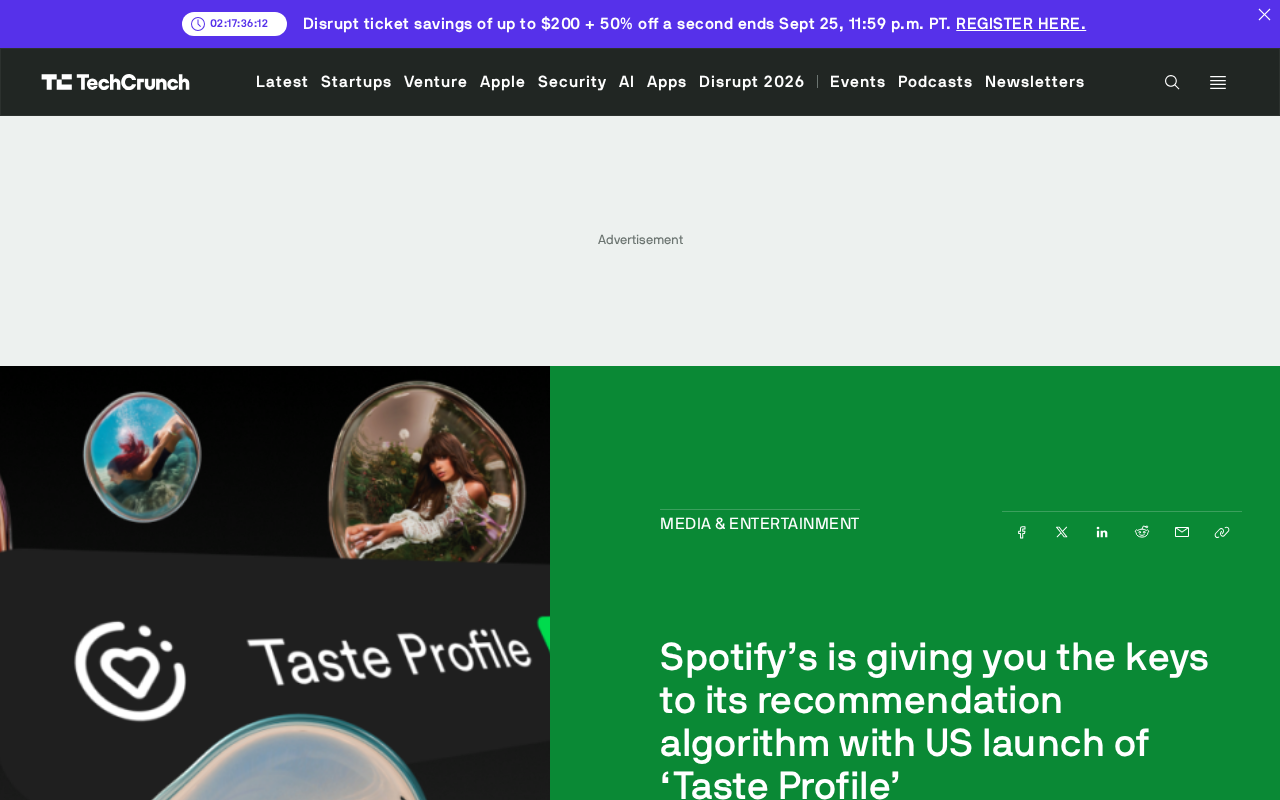
For users who have long relied on algorithmic recommendations, this is a noteworthy product shift. Historically, recommendation systems have been a "black box" — users passively received whatever songs or playlists the platform pushed their way, with no visibility into how the system understood them and no way to actively intervene. Taste Profile aims to break through that opacity.
From Passive Recipient to Active Participant
Taste Profile's core value lies in two things: visibility and control.
On one hand, it surfaces the platform's understanding of your taste in a way you can actually read. Listeners can clearly see what styles, artists, and musical moods Spotify thinks they enjoy. This kind of transparency is itself a response to the longstanding trust issues surrounding recommendation systems.
On the other hand — and this is the more groundbreaking part — users can reshape their recommendations through natural language. That means you no longer have to slowly train the algorithm by repeatedly clicking "Like" or "Not Interested." Instead, you can simply tell the system in plain text what you want: adjust the proportion of a certain type of music, or nudge it to explore in a new direction. This interaction model clearly reflects the influence of the current large language model wave.
Why This Update Matters
The recommendation algorithm has always been one of Spotify's core competitive advantages. Whether it's the weekly-refreshed Discover Weekly or the personalized annual Wrapped recap, a massive user modeling and recommendation engine powers it all. Handing users partial control over that system represents a shift in product philosophy — from "the algorithm decides for you" to "humans and algorithms working together."
Controlling recommendations through natural language also lowers the barrier for everyday users to intervene. Adjusting recommendations used to require a series of cumbersome actions, but conversational interaction makes the process feel far more intuitive. This aligns closely with the "natural language as interface" trend that generative AI has been driving across the industry.
Spotify's recommendation engine has long combined three types of technology: Collaborative Filtering, natural language processing, and audio analysis. Collaborative filtering identifies users with similar tastes by analyzing the listening behavior of millions of people, then infers what you might enjoy. NLP scrapes blogs, reviews, and other web text to extract semantic tags for artists and songs. Audio analysis directly reads a track's tempo, key, and timbre. Together, these layers build each user's unique "taste vector," which drives personalized products like Discover Weekly. The system's power comes precisely from its opacity — implicit feedback (skips, repeat plays, saves) is continuously collected, but the decision-making process is invisible to users. Taste Profile attempts to preserve this mechanism while opening up a readable, writable "semantic interface" for users, fundamentally shifting the power dynamic between users and recommendation systems.
Current Limitations and What's Next
Based on what's been disclosed so far, Taste Profile is only available to Premium subscribers in the United States, with a phased rollout still underway. Whether and when free users or listeners in other regions will get access remains unclear.
Additionally, official materials don't go into detail about whether large language models are directly involved under the hood, how accurately the system interprets natural language instructions, or how significantly user inputs actually influence recommendation outcomes. These critical experience-layer details are yet to be validated by broader user testing.
Even so, Taste Profile stands as a landmark attempt at making streaming recommendation systems more transparent and user-controllable. As more platforms begin handing users the keys to their algorithms, the way we discover music may be in for a meaningful change.
Making recommendation systems "user-controllable" has been an ongoing area of industry exploration, but it faces a core tension: a user's explicit stated preferences ("I want to hear more jazz") often don't match their actual implicit behavior (skipping most jazz tracks in practice). Bridging that gap is the key technical challenge that will determine whether natural language instructions can truly deliver in the real world. Platforms like Netflix and YouTube have previously experimented with "why was this recommended" explanatory features, but giving users the ability to actively edit their preferences remains rare. If Spotify can effectively solve the problems of instruction comprehension accuracy and the weighting of behavioral data, it could provide a replicable model for the entire streaming industry.
Related articles

JobRunner MCP Server: AI Agents Can Now Fix Failed Java Jobs
JobRunner launches an open-source MCP server enabling AI agents to view cluster status, diagnose failures, and recover Java jobs—incident response from any cloud coding environment or existing agent.

MLAI Digital Launches 9 Security Agents: MCP Server Safeguards the Full Lifecycle of Agentic AI
MLAI Digital launches Security MCP Server with nine built-in specialized security agents covering vulnerability discovery, attack simulation, prompt injection detection, API and infrastructure assessment, and accelerated remediation—embedding security validation across the full Agentic AI lifecycle from development to production.

Running Isaac Lab on H100 GPUs: Exploring Better Approaches
Exploring optimization methods for running Isaac Lab on NVIDIA H100 GPUs, including MIG configuration, mixed precision, TensorRT acceleration, and community experience to improve robotics simulation and reinforcement learning efficiency.