Spotify's New Tool: AI Covers Can No Longer Impersonate Real Artists

Sony demands removal of 260,000 deepfake songs as Spotify launches a tool to block AI covers at the attribution stage.
Amid a flood of AI covers and deepfake songs, Spotify has launched a new tool whose core goal is not to eliminate AI-generated audio but to prevent it from being wrongly attributed to real artists. This choice has practical considerations: deepfake content is scattered across countless accounts and playlists, making item-by-item takedown extremely costly, while safeguards at the naming and display level can reduce the spread of misleading content at the distribution end. Sony Music has already requested removal of over 260,000 deepfake songs—nearly double its previously disclosed figure—exposing the bottlenecks of the passive-response model. The article argues this marks a shift in streaming platform governance from "post-hoc deletion" to "pre-emptive isolation," though the tool's technical details, retrospective capability, and cross-platform effectiveness remain to be seen.
Deepfake Songs Run Rampant, Forcing Streaming Platforms to Act
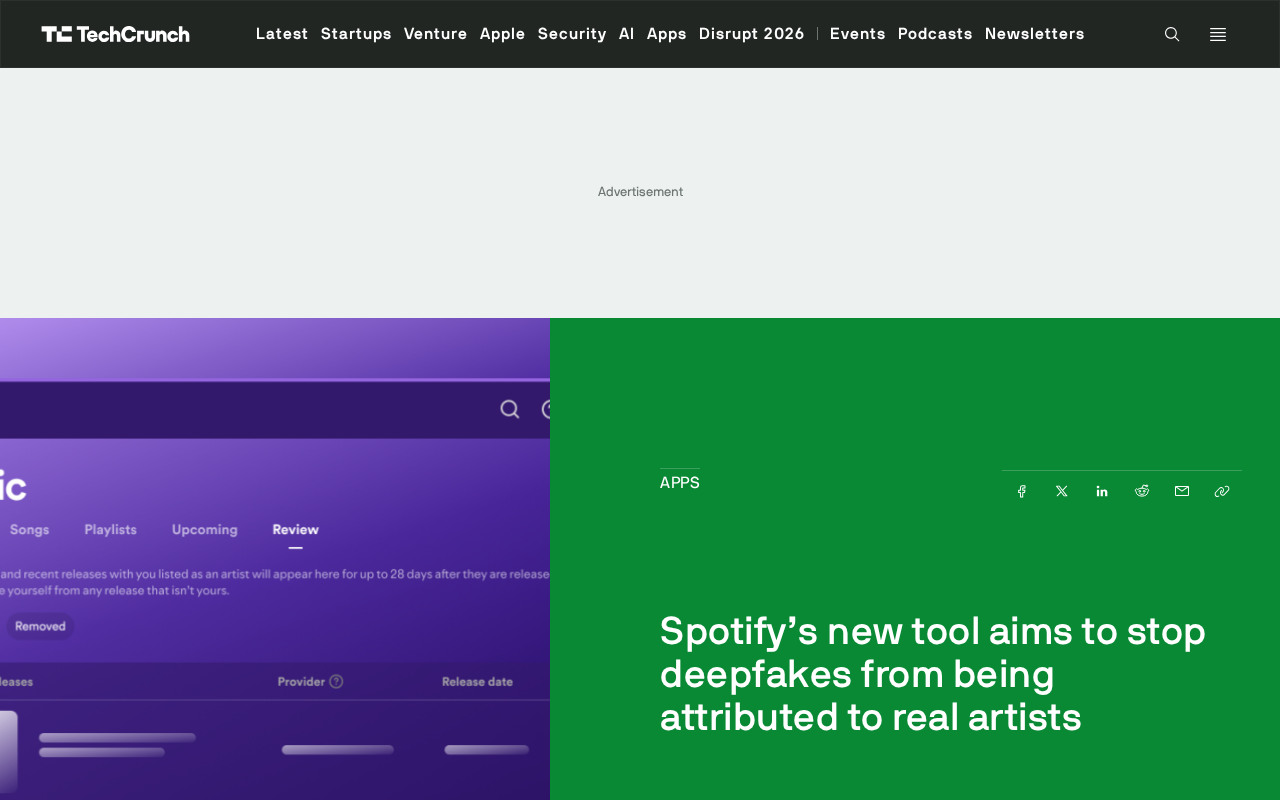
AI covers and deepfake songs are becoming a ticking time bomb for the music industry. According to a Billboard report last month, Sony Music has demanded that major digital platforms remove more than 260,000 deepfake songs—nearly double the number the label disclosed in March. Faced with infringement on such a massive scale, Spotify has rolled out a new tool aimed at preventing deepfake works from being wrongly attributed to real artists.
The core logic of this update isn't complicated: sever the erroneous link between "AI-generated audio" and "real artist attribution" at the platform level. In other words, even if an AI cover is convincing enough to pass as the real thing in timbre, Spotify wants to use metadata and attribution mechanisms to prevent listeners from mistaking it for the artist's own work.
Why "Attribution" Is Harder to Solve Than "Takedown"
The challenge of governing deepfake songs lies in the fact that they simultaneously involve copyright, personality rights, and platform liability. Traditional content takedown processes rely on rights holders filing complaints, but the production speed of AI covers far outpaces the response capacity of manual review. The 260,000 removal requests disclosed by Sony Music itself demonstrates that the passive-response model is already struggling to keep up.
What's noteworthy about Spotify's new tool is its entry point: it doesn't claim to eradicate deepfake audio entirely, but instead focuses on the "attribution" stage. This choice has practical considerations—deepfake content is scattered across countless accounts and playlists, making item-by-item identification and takedown extremely costly; but once the platform establishes safeguards at the naming and display level, it can reduce the spread efficiency of misleading content at the distribution end.
A Signal of Shift in Platform Governance Approach
From an industry perspective, this represents a migration in how streaming platforms govern AI content—from "post-hoc deletion" toward "pre-emptive isolation." For real artists, the brand damage caused by misappropriation of their name is often harder to quantify than piracy and harder to quickly mitigate through legal channels. Spotify's move at least addresses this pain point at the mechanism level.
The three legal dimensions involved in deepfake songs each have their own basis: copyright concerns whether the use of original lyrics, compositions, and recordings in AI covers has been authorized; personality rights (often extended to voice rights and publicity rights in the music context) protect artists' commercial use of their names, images, and identifiable voices; and platform liability derives from safe harbor rules and notice-and-takedown mechanisms—platforms have an obligation to promptly handle infringing content upon receiving notice from rights holders, or they may bear joint liability. These three are often triggered simultaneously yet fall under different legal pathways, making it difficult for a single complaint to resolve all issues at once—this is the structural reason why governance costs remain persistently high.
The so-called "pre-emptive isolation" differs fundamentally from traditional "post-hoc deletion" in terms of governance cost. Post-hoc deletion relies on rights holders or user reports, with each piece of content requiring individual verification, and costs growing linearly with the volume of infringement; pre-emptive isolation, by contrast, sets structural constraints at the metadata, attribution field, and distribution rule levels—one configuration can apply to content in bulk, with marginal costs approaching zero. Similar approaches have precedent in the copyright field: YouTube's Content ID, for example, completes matching and triage at the upload stage through fingerprint comparison, rather than waiting for rights holders to file complaints one by one. Although Spotify's approach doesn't use audio fingerprinting, it shares the same logic of "moving governance forward to the distribution end."
What Sony's 260,000 Figure Reveals
The number disclosed by Sony Music is a key reference for understanding this governance battle. According to Billboard, the company has requested removal of more than 260,000 deepfake songs—nearly double its previously disclosed figure. This growth rate reveals two facts: the barrier to entry for AI audio generation tools continues to drop, and there are clear bottlenecks in the throughput capacity of content identification and complaint processes.
For Spotify, manual review alone clearly cannot handle an impact of this magnitude. Whether the new tool can effectively intercept at the attribution level will depend on the depth of data collaboration between it and record labels, as well as whether the platform's labeling standards for AI-generated content are sufficiently clear.
The lowering of barriers to AI audio generation stems largely from the proliferation of voice cloning technology. Current mainstream speech synthesis and singing voice conversion models require only minutes—or even tens of seconds—of target vocal samples to learn timbre, vibrato, and articulation characteristics, and transfer them to any track. The combination of open-source models and consumer-grade GPUs means that mass-producing AI covers requires virtually no professional studio conditions. This means the supply curve for infringing content is extremely steep, while manual review throughput is constrained by manpower and judgment complexity—the scissors gap between the two is the mechanistic cause behind the 260,000 figure.
Unanswered Questions
Technical details about this tool remain limited at present. It's still unclear what specific detection or attribution mechanism it employs, and it's impossible to determine whether it has retrospective capability for already-uploaded content. Another challenge in deepfake governance is cross-platform fluidity—even if Spotify establishes safeguards, infringing content may still migrate to other distribution channels.
What is certain is that the music industry's attitude toward AI deepfakes is shifting from wait-and-see to systematic defense. Sony's large-scale removal requests and Spotify's tool update together constitute a footnote to this shift. For real artists, preventing misappropriation of their name is only the baseline—how to redefine the ownership of voice in the AI era is the longer-term proposition.
Related articles

Prompt Engineering for Beginners: From Writing Prompts to Engineering Thinking
Starting from the essence and four functions of prompts, this article systematically explains the six-step process, four success criteria, learning value, and practical limitations of prompt engineering to help you build a complete understanding.

Anthropic Launches Nasdaq IPO: AI Giant's Listing and Risk Disclosures
Anthropic officially launches its Nasdaq IPO under ticker ANT, with market valuation expected to potentially exceed SpaceX's record. The prospectus devotes nearly 100 pages to AI risks, while first-half revenue grew over 14x but net losses widened sharply, reigniting the AI bubble debate.

Rust cURL Clone Uses 4,832 unsafe Blocks—Is the Memory Safety Myth Broken?
A Rust cURL clone uses 4,832 unsafe keywords, challenging Rust's memory safety narrative. We analyze what unsafe really means, compare Fil-C, and examine rewrite motives.