Spring AI Alibaba Graph in Practice: HR Recruitment Workflow Agent Design and Core Technical Analysis

Build a full HR recruitment Workflow Agent using Spring AI Alibaba Graph with 20 core technical points.
This article walks through a complete HR recruitment Workflow Agent built with Spring AI Alibaba Graph, covering resume parsing, RAG-based job match scoring, tiered interview question generation, Human-in-the-Loop checkpointing, and time travel state rollback. It explains why Workflow Agents dominate enterprise AI and how Java developers can apply this architecture to any industry with repetitive processes.
In the wave of enterprise AI adoption, the applications with real commercial value aren't flashy AI chatbots — they're automated workflows that replace repetitive human labor. This article is based on a complete Spring AI Alibaba Graph HR recruitment workflow Agent project, walking through the design philosophy and key technical points of Workflow-style Agents to help Java developers quickly build enterprise-grade Agent applications.
Why Workflow Agents Dominate Enterprise AI
Today's AI Agents generally fall into two categories: fully autonomous Agents that make their own decisions, and Workflow-style Agents where developers pre-define the execution path. In real enterprise deployments, Workflow Agents dominate — and the reason is simple: enterprises demand controllability.
At the technical level, Workflow Agents typically use a Directed Acyclic Graph (DAG) or State Machine to describe execution paths.
A DAG (Directed Acyclic Graph) is a fundamental data structure in graph theory — composed of nodes and directed edges with no cycles. In engineering, DAGs were first widely adopted in task scheduling systems: Apache Airflow uses them to describe data pipeline dependencies, and Apache Spark's execution plans are also represented as DAGs, ensuring each computation stage only triggers after its dependencies complete. Topological sorting guarantees nodes execute in dependency order, making DAGs a natural fit for multi-step business process orchestration. A State Machine (FSM) is a mathematical model describing transitions between a finite set of discrete states, widely used in network protocol design (TCP connection states), game AI behavior trees, order management systems, and approval workflows. Spring AI Alibaba Graph combines the strengths of both — using graph structure to describe the macro execution path while using state to encapsulate context data passed between nodes. This gives complex business processes both a clear topological view and strict data flow control. Each node represents an atomic operation, edges represent transition conditions, and the overall topology is pre-defined by the developer in code — closely aligned with the core abstractions of mainstream frameworks like LangGraph.
In contrast, Autonomous Agents (such as the ReAct architecture) rely on the LLM to dynamically decide which tool to call next at runtime. While flexible, they're highly non-deterministic and consume more tokens. Enterprise requirements for SLAs and audit traceability make the Workflow approach the mainstream engineering choice.
Leaving an LLM to autonomously decide every step offers flexibility, but in industries like finance, manufacturing, and HR — where process rigor is paramount — that unpredictability is unacceptable. The core idea of the Workflow approach is: developers define the overall execution path upfront, while leaving AI flexibility at key nodes. This ensures controllability and predictability while fully leveraging the LLM's capabilities for understanding, scoring, and generation.
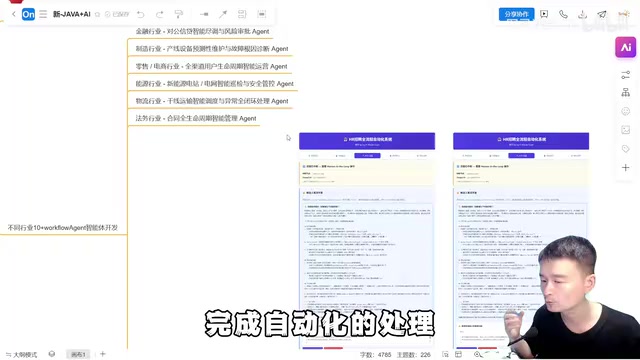
Almost every industry has an abundance of repetitive work. Processes that once required large teams can now be automated through Agent orchestration. The ability to deliver "vertical-industry Workflow Agents" is exactly what enterprises need — and it's far more competitive than building AI customer service bots.
Business Design of the HR Recruitment Workflow Agent
This project uses HR recruitment as its entry point, but the architecture is transferable to any industry with repetitive processes. The core goal is clear: free HR professionals from tedious tasks like resume screening and interview scheduling.
The Complete Process Chain
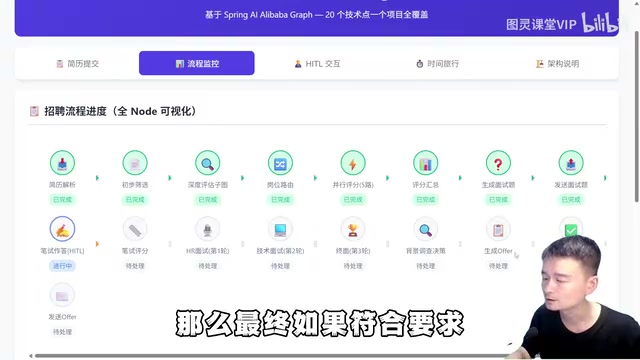
The Agent's execution flow is tightly connected:
-
Resume Submission: The candidate submits a resume, officially kicking off the process.
-
Resume Parsing: The system automatically parses the resume into structured data, extracting key information. This step uses a "structured information extraction" prompt engineering pattern — feeding the raw resume text to the LLM and requiring output in a predefined JSON Schema (e.g., years of experience, skill lists, project history), balancing accuracy with parseability.
-
Initial Screening: A first-pass filter based on hard criteria like years of experience and age to determine whether basic job requirements are met.
-
Job Match Scoring: A comprehensive evaluation of the candidate's technical skills and project experience against the current job requirements. This is a classic RAG (Retrieval-Augmented Generation) combined with Scoring Chain scenario.
RAG was proposed by Meta AI Research in 2020. The core idea is to combine the LLM's parametric knowledge with an external dynamic knowledge base: at inference time, retrieve the most relevant document chunks from the knowledge base (typically via vector similarity), then concatenate them into the prompt as context to guide the model toward more accurate, traceable answers. Compared to relying solely on model memory, RAG significantly reduces hallucination risk and supports real-time knowledge updates without retraining. In this scenario, the Job Description (JD) acts as the "knowledge base," the candidate's structured resume serves as the query, and the model outputs a score based on semantic matching between the two. The Scoring Chain is a prompt engineering design pattern: by enforcing explicit output format constraints (requiring the model to output JSON with scores and reasoning), it transforms the model's natural language reasoning into structured data consumable by downstream code — delivering "explainable AI decisions" rather than black-box judgments.
-
Tiered Question Generation: Dynamically generates interview questions of appropriate difficulty based on the candidate's level (junior/mid/senior). This step fully leverages the LLM's instruction-following capability, dynamically adjusting question difficulty and knowledge domain coverage based on the candidate's level tag — enabling truly personalized question bank generation.
-
Waiting for Candidate Answers: The interview questions are sent to the candidate, and the workflow pauses here to wait for human input.
-
Answer Scoring: Intelligent scoring of the candidate's submitted answers.
-
Multiple In-Person Interview Rounds: First, second, and third interviews, with results entered manually after each round.
-
Generate and Send Offer: If the candidate meets all requirements, an offer is automatically generated and sent.

This workflow clearly demonstrates the value division in a Workflow Agent: AI handles intelligence-intensive tasks like parsing, scoring, and question generation, while process orchestration ensures the entire recruitment pipeline advances in order.
Core Technical Highlights
Beyond the standard linear flow, this project implements two critical capabilities for enterprise-grade Agent applications.
Human-in-the-Loop (Checkpoint & Resume)
Not every step in an Agent application can be fully automated — human intervention is often required. The project's Human-in-the-Loop (HITL) mechanism (checkpoint and resume) is designed exactly for this purpose.
The HITL concept originated in active learning, where algorithms actively select the most uncertain samples to request human annotation, maximizing model performance improvement with minimal labeling cost. In the context of Agent engineering, it has evolved to mean "introducing human intervention at critical decision nodes in an automated process." Notably, standards bodies like IEEE and NIST have incorporated HITL into Responsible AI technical specification frameworks, and the EU AI Act explicitly requires that high-risk AI systems retain human override capability at key decisions — meaning good HITL design is not just an engineering choice, but a regulatory compliance requirement. This design is especially critical in high-risk scenarios like financial compliance (large transfers requiring human review) and medical assisted diagnosis (AI provides recommendations, doctor makes final decision), offering an adjustable balance between efficiency and safety.
Take the "candidate answers interview questions" step as an example: the system must pause here and wait for the candidate to submit answers before continuing to subsequent nodes.
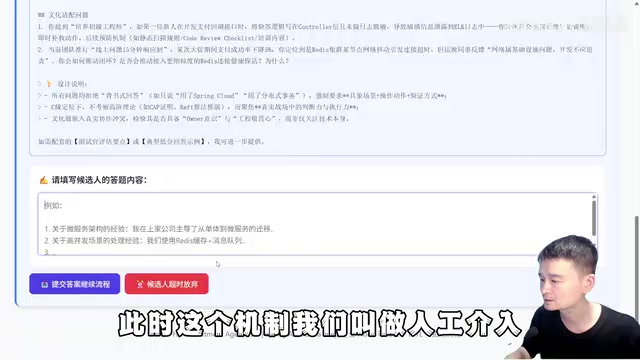
At the engineering level, the core of HITL lies in the framework's Checkpointing capability. Checkpointing originated in high-performance computing (HPC), used to periodically save process state during long-running scientific computations to prevent loss from hardware failures. In the big data era, Apache Flink advanced this into an exactly-once semantics guarantee mechanism based on the Chandy-Lamport distributed snapshot algorithm, and Spark Streaming also uses checkpointing for stateful stream processing fault recovery. In Agent frameworks, the goal of checkpointing expands from "fault recovery" to "execution state lifecycle management": when the workflow reaches a node requiring human intervention, the framework serializes and persists the complete current execution state (including processed context and intermediate variables) to external storage (typically a database or Redis), and suspends the current execution thread. It must not only recover after system crashes, but also support active suspension (for HITL waiting), cross-session resumption (a user continuing the next day), and historical state queries (for audit and time travel). When human input arrives, the system restores state from persistent storage and continues driving subsequent nodes. This complete "suspend-persist-resume" cycle is also the underlying mechanism for interview result entry, offer manager approval, and other real business scenarios. The ability to implement this gracefully is an important measure of whether an Agent framework is production-ready.
Time Travel (State Rollback)
Another core highlight is Time Travel — state rollback capability. When a workflow is halfway through execution and needs to re-execute from a historical node, this can be achieved through state rollback.
Technically, time travel is state version management built on the Checkpointing mechanism, closely mirroring the design philosophy of MVCC (Multi-Version Concurrency Control) in database systems. MVCC is the classic mechanism used by mainstream databases like PostgreSQL and MySQL InnoDB to resolve read-write concurrency conflicts — by retaining historical versions of data rather than overwriting directly, enabling non-blocking reads and transaction isolation. Agent time travel applies this concept to execution state management: after each node completes, the framework automatically writes a state snapshot to persistent storage with a version number or timestamp, forming a complete execution history chain. When re-execution from a historical node is needed, the system reads the target version's state snapshot and uses it as the starting point to re-drive subsequent nodes.
Its value goes beyond debugging and error correction — it also provides infrastructure for A/B testing different decision paths and auditing complete execution traces for compliance. In heavily regulated industries like finance and healthcare, a complete, traceable execution history is itself core evidence for regulatory compliance, representing a natural compliance advantage. This means the Agent's execution state is persistable and traceable — not a one-time black-box process — truly meeting production-environment operability standards.
20 Technical Points, One Project to Master Spring AI Alibaba Graph
The entire project covers 20 core technical points of Spring AI Alibaba Graph, with the goal of helping developers quickly master Agent application development with this framework through a single complete project.
Spring AI is a Java AI application development specification framework released by Pivotal/VMware in 2023, aiming to provide the Java ecosystem with a unified AI integration layer similar to Python's LangChain, abstracting away API differences between LLM vendors. LangChain was released by Harrison Chase in October 2022 and quickly became the de facto standard framework for building LLM applications in the Python ecosystem. Its core abstractions — Chain (sequential calls), Agent (autonomous decision-making), Memory (context retention), and Tool (tool calling) — have deeply influenced the design patterns of subsequent AI application frameworks. LangGraph, as LangChain's graph execution extension released in 2024, upgraded Agent execution paths from linear chains to stateful directed graphs, becoming the mainstream choice for Workflow Agent orchestration.
Spring AI Alibaba is Alibaba Cloud's enterprise-grade extension built on Spring AI, deeply integrating Tongyi Qianwen, the Bailian platform, and other Alibaba Cloud AI services, while maintaining compatibility with international mainstream models like OpenAI and Anthropic. Its Graph component is conceptually well-aligned with LangGraph, but its engineering implementation is deeply embedded in the Java/Spring ecosystem: leveraging the Spring IoC container to manage node Bean lifecycles, using Spring transactions to ensure atomicity of state persistence, and integrating with Spring Boot Actuator and the Micrometer metrics framework for execution observability — all deeply integrated with Spring Boot's dependency injection, transaction management, and configuration systems. For Java enterprises with decades of Spring investment, this means Agent capabilities can be seamlessly integrated into existing microservice architectures rather than building separate Python services from scratch — gaining production-grade Agent orchestration capability with near-zero migration cost. For developers in the Java ecosystem, this is a direction worth close attention, as the Graph component's process orchestration, state management, and human-in-the-loop capabilities align precisely with the actual needs of enterprise-grade Agent scenarios.
Summary
The real value of this HR recruitment Agent project isn't the "recruitment" scenario itself — it's that it demonstrates a transferable enterprise-grade Workflow Agent methodology:
- Developers define controllable execution paths via DAG/State Machine, drawing on mature engineering practices from the big data scheduling domain (Airflow, Spark, Flink)
- AI handles intelligent processing tasks like structured parsing, scoring chains (RAG-enhanced explainable scoring), and tiered question generation
- Checkpointing-based (originating from HPC and stream computing) Human-in-the-Loop (HITL) and Time Travel (MVCC-style state version management) ensure production readiness and compliance auditability
Whether in finance, manufacturing, or any other industry with repetitive processes, this architectural approach can be applied directly. For Java developers looking to demonstrate real Agent delivery capabilities, mastering vertical-industry Workflow Agent development is far more competitive and valuable than staying at the AI chatbot level.
Key Takeaways
Related articles

The Truth Behind Codex 'Build a Website in 5 Minutes': AI Isn't Creating Sites—It's Helping You Copy Them
Exposing the truth behind viral Codex 5-minute website videos: creators aren't building original sites with AI—they're copying shared prompts or scraping others' work. Learn AI coding tools' real limits.

Getting Started with AI Agent Development: A Complete Guide from Concept to Practice
A comprehensive guide to AI Agent architecture and development, covering automated marketing, intelligent customer service, and investment analysis scenarios with single and multi-agent collaboration.

The Truth Behind Codex 'Build a Website in 5 Minutes': AI Isn't Creating Sites — It's Helping You Copy Them
Exposing the truth behind viral Codex 5-minute website videos: creators aren't building original sites with AI — they're copying shared prompts or scraping others' work.